
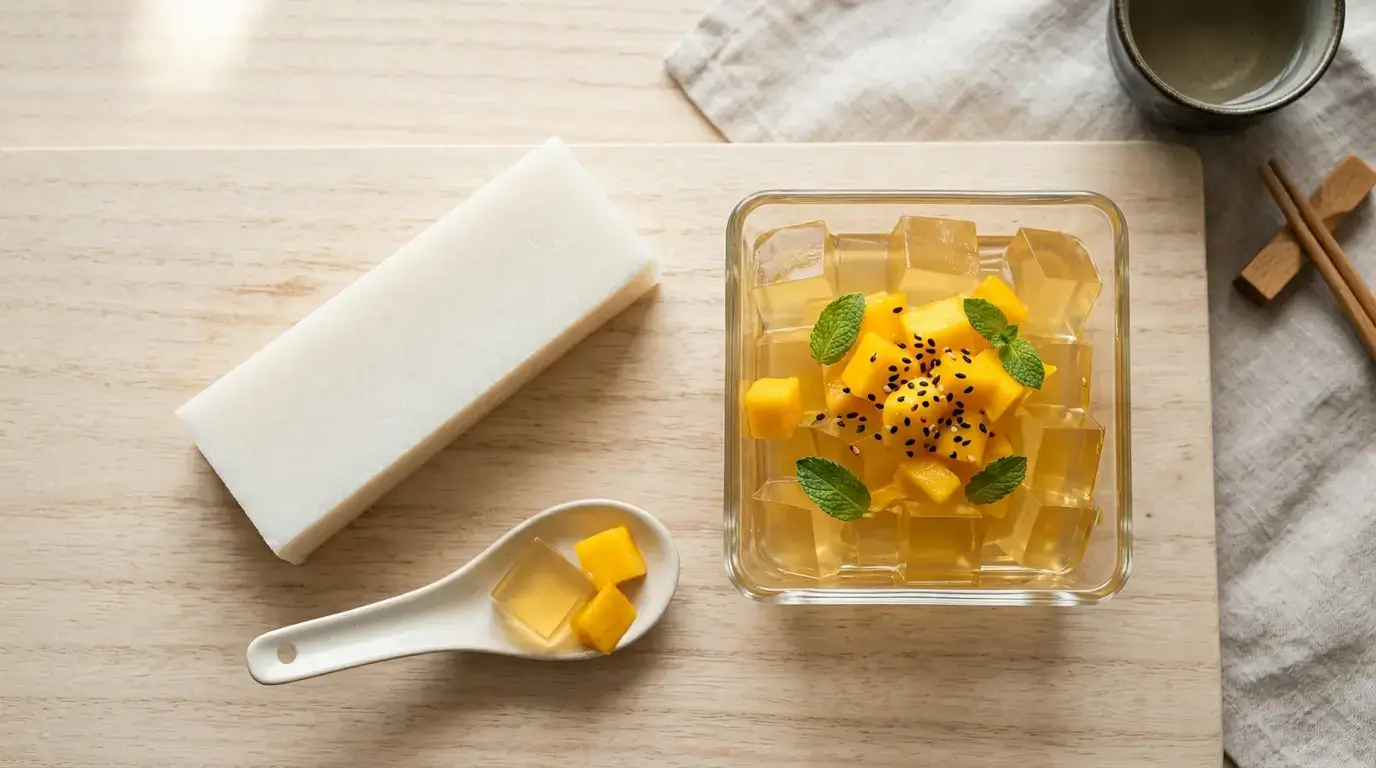
If you’ve stumbled across the term “gelatin sticks” and found yourself confused — you’re not alone. Searches for “gelatin sticks meaning” have exploded recently, and for good reason: this format of gelatin is standard in Asian kitchens but almost unknown in Western grocery aisles.
So what exactly are gelatin sticks? And more importantly, how do you use them?
This guide covers everything: the three main types of gelatin sticks, what each one is made from, how they compare to powdered gelatin, exact conversion ratios, and a collection of recipes worth trying today.
What Are Gelatin Sticks? The Short Answer
“Gelatin sticks” is a term that most commonly refers to agar agar in bar or stick form — a plant-based gelling agent derived from red seaweed that functions similarly to animal-based gelatin but sets firmer and at room temperature.
Agar agar is a whitish color, and comes in either sticks, flakes, granules, or powder. The stick form (also called bars or kanten bars) is the traditional format used for centuries in Japanese, Chinese, and Southeast Asian cooking — long before agar powder became widely available in Western health food stores.
Beyond agar agar bars, the term “gelatin sticks” also refers to:
- Konjac jelly sticks — the popular Asian snack candy in individual stick packaging
- Collagen/gelatin supplement sticks — single-serving drink mix sachets
Each is completely different. This guide covers all three so you know exactly what you’re dealing with.
Type 1 — Agar Agar Sticks (Bars)
What Are They?
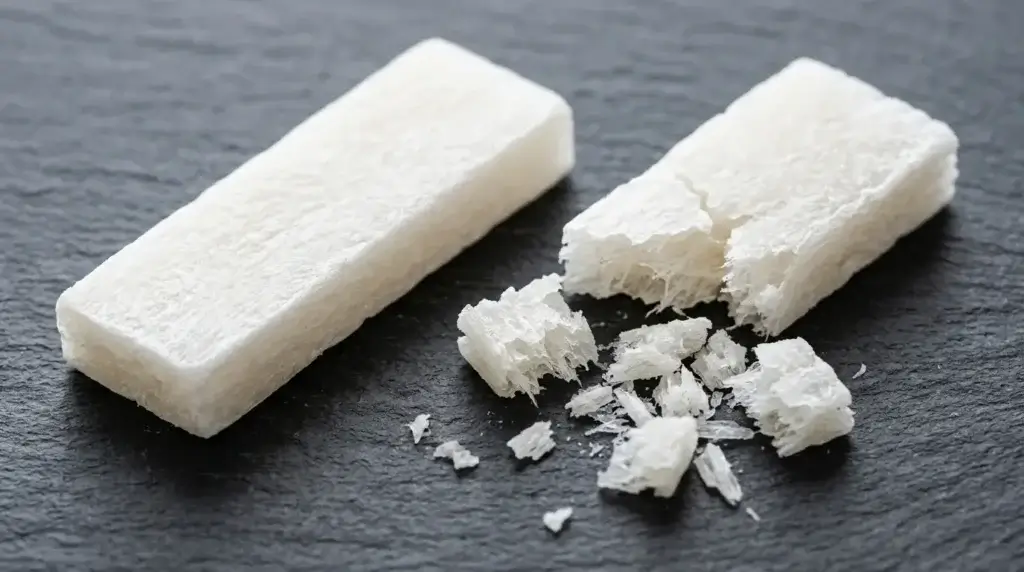
Agar agar sticks — also called kanten bars or agar bars — are compressed, dried bars of agar agar. They look like thin, rectangular blocks of cloudy white material, typically 20–25cm long and about 2cm wide. Each bar contains the same gelling substance as agar powder, just in a different physical form.
Agar agar is derived from the cell walls of red seaweed (algae) and has been used in Asian desserts and cooking for hundreds of years. In Japan, it’s called kanten. In China and Southeast Asia, it simply appears as agar or jelly strips.
Why sticks instead of powder? The stick/bar format was the original way agar was sold before industrial grinding made powder the standard. Many traditional Asian recipes specifically call for agar sticks because the texture produced is considered slightly different — some cooks say the bars produce a softer, more delicate gel than powder. Asian grocery stores almost always carry the bar form, often at a lower price than health food store powder.
How to Use Agar Agar Sticks
Using agar agar bars requires one extra step compared to powder — you need to break or shred the bar before use.
Step 1 — Measure and break Tear the agar bar into small pieces or use kitchen scissors to cut it into rough sections. You can also run it along a box grater to shred it finely, which helps it dissolve more evenly.
Step 2 — Soak (optional but recommended) Soak the torn agar pieces in cold water for 30 minutes. The agar will absorb the water and soften — this significantly reduces the cooking time needed to dissolve it fully.
Step 3 — Dissolve in hot liquid Add the soaked agar pieces directly to your cooking liquid. Bring to a boil while stirring, then simmer for 3–5 minutes until completely dissolved. Every piece must dissolve — any undissolved fragments result in an uneven, lumpy gel.
Step 4 — Add remaining ingredients and set Follow your recipe from this point. Agar sets at room temperature — no refrigeration required, though chilling improves the texture.
Agar Agar Sticks Conversion Chart
This is the most searched question about agar agar bars — and the most important practical knowledge.
| Format | Conversion | Notes |
|---|---|---|
| 1 bar / stick agar agar | = 2 teaspoons agar powder | Standard bar, approximately 8g |
| 1 bar / stick agar agar | = 6 teaspoons agar flakes | Flakes are weaker than bars |
| 1 bar / stick agar agar | = 2 teaspoons unflavored gelatin | For direct recipe substitution |
| 1 teaspoon agar powder | = ½ agar bar | Half a standard bar |
Important: Agar strength varies between brands. Always do a small test before making a large batch — boil 1 cup of water with your measured agar, let a spoonful set on a cold plate, and check the firmness. Adjust as needed.
Granulated form is twice as strong as flaked; powdered is three times as strong. This is why conversions matter — you can’t just swap one format for another without adjusting quantities.
Type 2 — Konjac Jelly Sticks (Asian Snack)
What Are They?
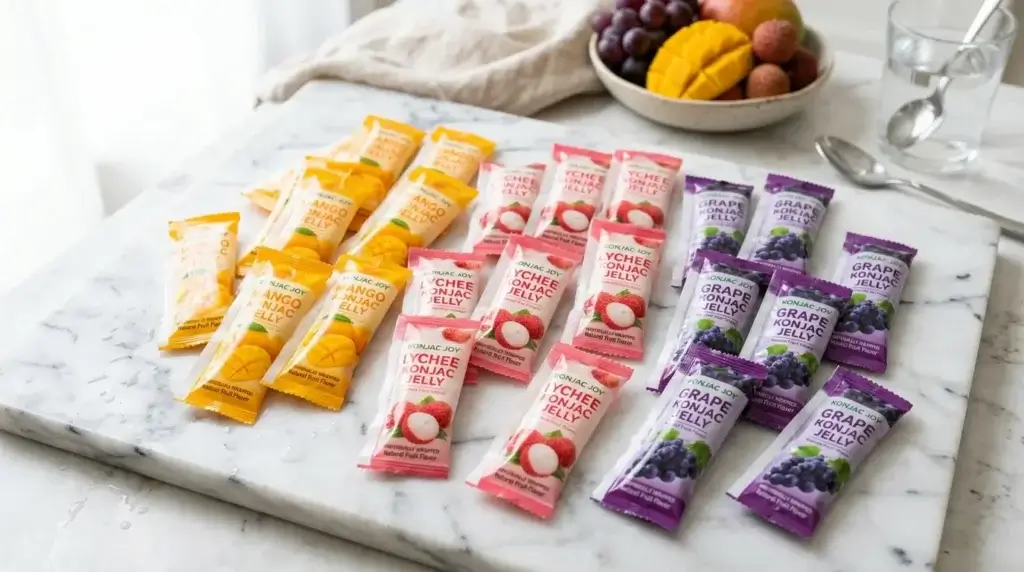
Konjac jelly sticks — also called jelly straws or jelly candies — are the colorful, individually packaged fruity snack sticks sold in Asian grocery stores. They come in a wide range of flavors (mango, lychee, grape, peach, strawberry) and have a distinctly chewy, slightly firm texture unlike standard gelatin gummies.
Asian jelly sticks are made from a konjac-based gel (sometimes combined with carrageenan) rather than animal gelatin. Konjac is derived from the konjac root and is extremely high in soluble fiber — the same ingredient used in konjac jelly weight loss recipes.
The individual stick packaging makes them a popular lunchbox snack, party treat, and low-calorie dessert option.
How to Make Konjac Jelly Sticks at Home
Making these at home is simpler than you’d think — and lets you control the flavor, sweetness, and ingredients completely.
Ingredients (makes approximately 20 sticks):
- 2 cups 100% fruit juice (mango, lychee, or grape work beautifully)
- 1½ teaspoons agar agar powder (or ½ an agar stick, shredded)
- 2 tablespoons sugar or honey
- 1 tablespoon lemon juice
Instructions:
- Combine fruit juice, agar agar, and sugar in a small saucepan. Whisk together cold.
- Bring to a boil over medium heat, stirring constantly.
- Simmer for 2 full minutes until agar is completely dissolved.
- Add lemon juice and stir.
- Pour into silicone straw molds or a rectangular dish.
- Let cool at room temperature for 20 minutes, then refrigerate 1 hour.
- If using a dish: cut into long thin strips to create the stick shape.
- Store in an airtight container in the refrigerator for up to 5 days.
Flavor variations: Replace half the fruit juice with coconut milk for a creamy tropical version. Add a pinch of salt to mango versions for a Thai-inspired flavor.
Type 3 — Collagen/Gelatin Supplement Sticks
The third meaning of “gelatin sticks” refers to single-serve supplement sachets — thin stick-shaped packets containing powdered collagen peptides or unflavored gelatin designed to be mixed into water or a beverage.
These are simply the convenient, portable version of collagen supplements. They function identically to a scoop of powdered collagen but in pre-measured, travel-friendly packaging.
If this is what you were searching for — they dissolve instantly in water (hot or cold) and are used the same way as any hydrolyzed collagen powder. For the full guide on how to use unflavored gelatin for weight loss and wellness, see our gelatin trick recipe.
Agar Agar Sticks vs Agar Powder vs Agar Flakes
If you’re standing in an Asian grocery store trying to decide which format to buy, here’s the practical breakdown:
| Format | Best for | Prep needed | Relative strength |
|---|---|---|---|
| Agar bars/sticks | Traditional recipes, Asian desserts, economy | Tear/shred + optional soak | Medium |
| Agar flakes | Easy measuring, Western recipes | None | Weakest |
| Agar powder | Precision baking, easiest to use | None | Strongest |
For most home cooks: agar powder is the most convenient. Measure, add to liquid, boil — done. No tearing, no soaking, no guessing about how finely shredded your bar pieces are.
For traditional Asian dessert recipes that specifically call for agar bars: use the bars. The slight texture difference some cooks note is real — the bar format can produce a marginally smoother gel in delicate desserts.
For economy: agar bars from Asian grocery stores are significantly cheaper per gram of gelling power than health food store powder. If you’re making large batches of jelly desserts, bars are worth the extra prep step.
4 Recipes Using Gelatin Sticks
Recipe 1 — Traditional Kanten (Japanese Agar Jelly)
The classic Japanese dessert that has been made with agar bars for centuries.
Print
Gelatin Sticks – What Are They, How to Use Them & Best Recipes
- Total Time: 40 minutes + 2 hours chilling
- Yield: 4 servings 1x
- Diet: Vegan
Description
A light, elegant Japanese agar jelly made from agar agar sticks — the traditional kanten recipe used in Japanese kitchens for centuries. Plant-based, naturally vegan, and sets beautifully at room temperature.
Ingredients
- 1 agar agar bar/stick, torn into small pieces
- 2 cups water
- 3 tablespoons sugar
- ½ teaspoon vanilla or almond extract
- Fresh fruit to set inside (optional)
Instructions
- Tear the agar agar bar into small pieces and soak in the 2 cups of water for 30 minutes
- Bring the soaked agar and water to a boil in a saucepan, stirring frequently
- Simmer for 3–4 minutes until completely dissolved — hold the spoon up to the light to check for remaining pieces
- Add sugar and extract, stir until fully dissolved
- Pour into a shallow dish or individual molds
- Add fresh fruit pieces if using
- Cool to room temperature for 20 minutes
- Refrigerate for 2 hours until fully set
- Cut into cubes or unmold to serve
Notes
Always simmer agar for the full 3–4 minutes — undissolved pieces create a grainy texture. Shred the bar as finely as possible before soaking for faster, more even dissolution. Avoid fresh pineapple, kiwi, and papaya — their enzymes prevent setting. Use canned or cooked versions instead. Agar sets at room temperature, so refrigeration is for texture improvement, not essential for the set.
- Prep Time: 5 minutes + 30 minutes soaking
- Cook Time: 5 minutes
- Category: Dessert
- Method: Stovetop
- Cuisine: Japanese / Asian
Nutrition
- Serving Size: ½ cup
- Calories: 45
- Sugar: 9g
- Sodium: 5mg
- Fat: 0g
- Saturated Fat: 0g
- Unsaturated Fat: 0g
- Trans Fat: 0g
- Carbohydrates: 11g
- Fiber: 0g
- Protein: 0g
- Cholesterol: 0mg
Keywords: gelatin sticks recipe, agar agar sticks, kanten recipe, Japanese gelatin, agar agar bar recipe
Ingredients (4 servings):
- 1 agar agar bar, torn into small pieces
- 2 cups water
- 3 tablespoons sugar
- ½ teaspoon vanilla or almond extract
- Optional: fresh fruit to set inside
Instructions:
- Soak torn agar pieces in the 2 cups of water for 30 minutes.
- Bring the soaked agar + water to a boil in a saucepan, stirring frequently.
- Simmer 3–4 minutes until completely dissolved — hold the spoon up to the light to check for any remaining pieces.
- Add sugar and extract. Stir until dissolved.
- Pour into a shallow dish or individual molds. Add fresh fruit if using.
- Cool to room temperature, then refrigerate 2 hours.
- Cut into cubes or unmold to serve.
Recipe 2 — Coconut Mango Agar Jelly
A vibrant, creamy dessert popular across Southeast Asia.
Ingredients (6 servings):
- 1 agar agar bar, shredded finely
- 1 cup coconut milk
- 1 cup mango juice (or blended fresh mango)
- 3 tablespoons sugar
- Pinch of salt
Instructions:
- Soak shredded agar in ½ cup cold water for 20 minutes.
- Add coconut milk, mango juice, sugar, and salt to the soaked agar. Stir.
- Bring to a boil, stirring constantly. Simmer 3 minutes until fully dissolved.
- Pour into a rectangular dish or 6 individual glasses.
- Cool, then refrigerate 2 hours.
- Serve in glasses, or cut the dish into cubes and serve with additional mango.
Recipe 3 — Almond Jelly (Chinese Buffet Style)
The beloved firm jelly from Chinese restaurant dessert tables — now you can make it at home.
Ingredients (8 servings):
- 1 agar agar bar, torn into pieces
- 2 cups water
- 1 cup whole milk (or coconut milk for dairy-free)
- 3 tablespoons sugar
- 1 teaspoon almond extract
- 1 can fruit cocktail (for serving)
Instructions:
- Soak torn agar pieces in 1 cup of the water for 30 minutes.
- Add remaining cup of water to the soaked agar. Bring to a boil, stirring.
- Simmer 3 minutes until fully dissolved.
- Remove from heat. Add milk, sugar, and almond extract. Stir well.
- Pour into a rectangular baking dish.
- Refrigerate 3–4 hours until very firm (this sets firmer than standard agar jelly).
- Cut into cubes. Serve in bowls with canned fruit cocktail and syrup.
Recipe 4 — Rainbow Agar Jelly Dessert
A showstopper layered dessert using agar bars — popular at celebrations and parties across Asia.
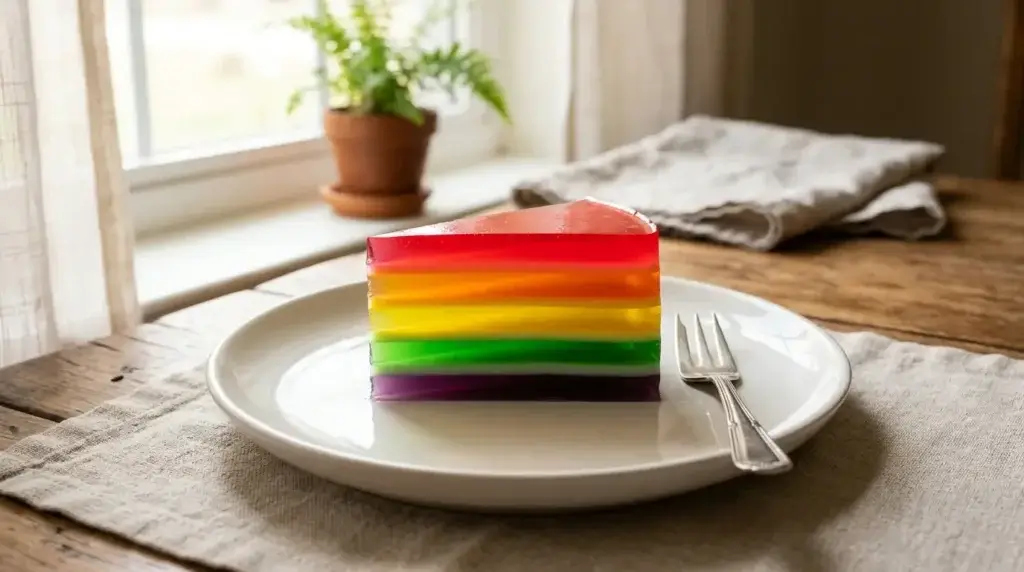
Method: Prepare 4–5 separate batches of agar jelly using the kanten recipe above, each tinted a different color using natural fruit juices or food coloring.
Pour the first layer into a rectangular dish and refrigerate until firm (about 45 minutes — firm but not sticky). Pour the second layer over the first. Refrigerate again. Repeat for each layer. Final set: 2 hours minimum.
Cut into slices to reveal the colorful cross-section — stunning presentation for minimal effort.
Where to Buy Gelatin Sticks
Asian grocery stores: The best source. Agar agar bars are a staple item, typically sold in the dried goods or baking section. Brands vary but quality is consistently good. Price is usually significantly lower than health food stores.
Online: Amazon and specialty Asian food retailers carry multiple brands. Look for bars from Japan or Thailand — Telephone Brand (Thai) and Kanten brand (Japanese) are widely considered the most reliable.
Health food stores: Less likely to carry the bar format — these stores usually stock powder or flakes. If you can only find powder, use the conversion chart above.
What to avoid: Very cheap, unbranded bars from unknown sources. Agar quality varies and weak bars require significantly more product to achieve the same set.
Common Mistakes When Using Agar Agar Sticks
Not shredding finely enough: Large pieces of agar bar take much longer to dissolve and may leave undissolved fragments. Shred or cut as finely as possible, or soak well before cooking.
Not simmering long enough: Unlike agar powder, bars need 3–5 minutes of simmering (not just boiling) to fully dissolve. Under-dissolved agar = grainy, lumpy texture.
Using the same amount as powder: A whole agar bar is roughly equivalent to 2 teaspoons of agar powder. Using a full bar where the recipe calls for 1 teaspoon of powder will produce an unpleasantly rubbery result.
Skipping the soak: Not mandatory, but soaking for 20–30 minutes dramatically reduces the simmering time needed and ensures more even dissolution.
Same fruit enzyme issue as gelatin: Fresh pineapple, kiwi, and papaya prevent agar from setting, just as they prevent animal gelatin from setting. Use canned or cooked versions of these fruits. For more on this, see our Knox gelatin guide.
Frequently Asked Questions
What is a gelatin stick?
Most commonly, a gelatin stick refers to an agar agar bar — a compressed, dried bar of plant-based gelling agent made from red seaweed. It produces a gel when dissolved in hot liquid and cooled. The term can also refer to konjac jelly snack sticks or collagen supplement stick packets.
Are gelatin sticks the same as agar agar?
Yes — in most culinary contexts, gelatin sticks and agar sticks refer to the same product: agar agar in bar form. They are the traditional bar format of agar agar, widely used in Asian cooking.
How many teaspoons is one agar agar bar?
One standard agar agar bar equals approximately 2 teaspoons of agar agar powder, or about 8g by weight. Always check your specific brand as sizes vary.
Are agar agar sticks vegan?
Yes — agar agar is derived from red seaweed with no animal products involved. It is completely vegan, vegetarian, halal, and kosher by default.
Can I use agar agar sticks in any recipe that calls for gelatin?
Almost any recipe, yes. Use 1 agar bar (or 2 tsp powder equivalent) in place of 1 packet (7g) of unflavored gelatin. The result will be slightly firmer and will set at room temperature rather than requiring refrigeration. See our full vegan gelatin substitutes guide for detailed substitution advice.
Where do I find konjac jelly sticks?
Asian grocery stores almost always carry them in the snacks or candy section. They’re also available online. Common brands include TianHua, Cocon, and various Thai brands in fruit flavors.
Are konjac jelly sticks healthy?
Konjac jelly sticks are very low in calories (typically 10–15 calories per stick) and contain glucomannan fiber, which has genuine satiety benefits. They’re a smart low-calorie snack option.
The Bottom Line
“Gelatin sticks” most likely refers to agar agar bars — the traditional Asian format of agar agar that functions as a plant-based gelatin substitute. Once you understand the conversion ratios and the extra prep step (tear, optional soak, simmer longer), they work beautifully in any recipe that calls for gelatin or agar powder.
If you found them in an Asian grocery store and weren’t sure what to do: shred one bar, simmer in 2 cups of liquid for 3–4 minutes, add your flavorings, and refrigerate. You’ll have a perfect, firm, plant-based jelly every time.
Related Articles
- Vegan Gelatin Substitutes – Complete Guide
- Knox Gelatin Guide – How to Use It & Best Recipes
- Konjac Jelly for Weight Loss Recipe
- Halal Gelatin Guide
- Gelatin Trick Recipe
- Unflavored Gelatin Recipe
This article is for informational and culinary purposes only.