
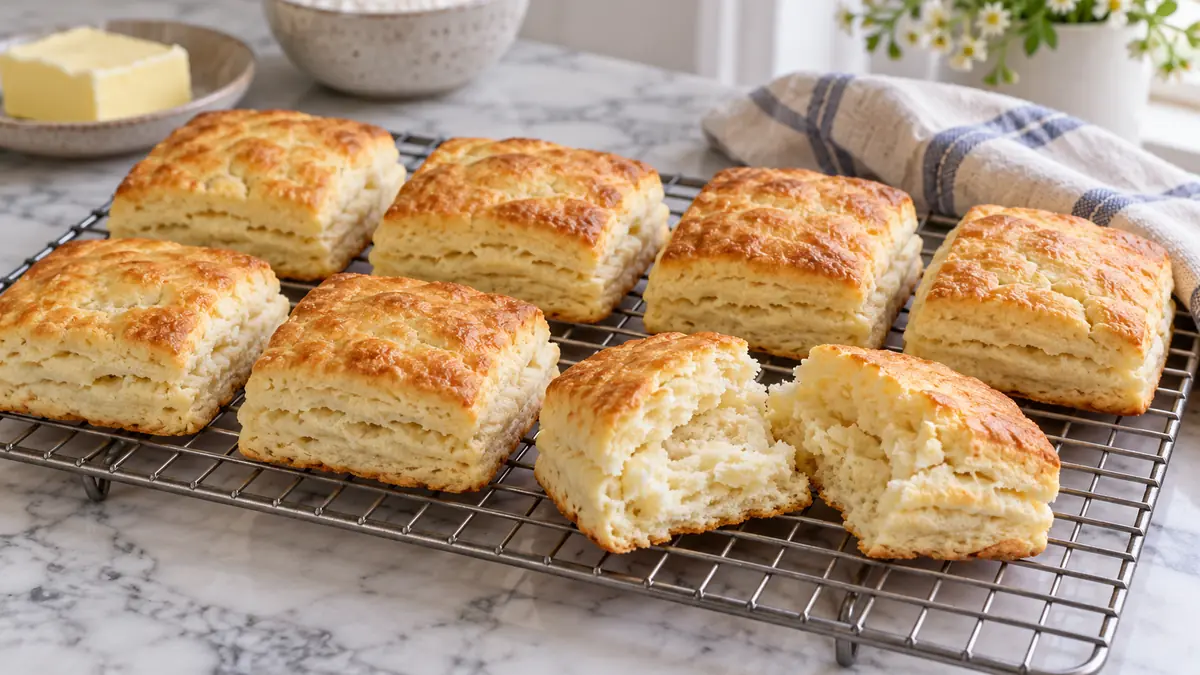
Baking powder biscuits are American-style quick breads made without yeast. Flour, baking powder, butter, milk, and salt come together in a soft dough that bakes into golden biscuits with tender centers. Keep the butter cold, handle the dough gently, and leave it thick enough to rise.
This recipe makes 8 rectangular butter biscuits using five basic ingredients. You will also find a simple four-ingredient option, a three-ingredient version using self-rising flour, and a drop biscuit variation for days when you want to skip shaping.
These are the soft, savory biscuits served with breakfast or dinner in the United States, rather than crisp cookies sometimes called biscuits elsewhere.
Jump to: Recipe · 4 ingredients · 3 ingredients · Drop biscuits · Troubleshooting.
What Are Baking Powder Biscuits?
Baking powder biscuits are a type of quick bread: they use a chemical raising agent instead of waiting for yeast fermentation. The dough can go into the oven soon after mixing.
Butter supplies richness, milk brings the dough together, and the flour provides structure. Salt seasons the finished biscuit. Sugar, eggs, and buttermilk are not required for the base recipe on this page.
The dough should look slightly uneven before baking. Small butter pieces and a gently gathered texture are welcome here; this is not a dough you knead until smooth and stretchy.
If you are choosing between leaveners, our baking soda vs baking powder guide explains why they are different ingredients. Do not replace the baking powder in this recipe with the same amount of baking soda.
Choose Your Biscuit Version
Ingredient counts can be confusing because self-rising flour already contains more than plain flour. Count the products you measure, while still checking what those products contain.
| Version | Ingredients you measure | What changes |
|---|---|---|
| Classic recipe | All-purpose flour, baking powder, salt, unsalted butter, milk | The main five-ingredient formula below |
| Four-ingredient biscuits | All-purpose flour, baking powder, salted butter, milk | Omit separate salt; seasoning depends on the butter. |
| Three-ingredient biscuits | Self-rising flour, butter, milk | Omit separate baking powder and salt. |
| Drop biscuits | Main ingredients with additional milk | Scoop instead of folding and cutting. |
The main recipe gives you separate control over the leavener and seasoning. The shorter versions are useful when the ingredients in your pantry fit those approaches.
Baking Powder Biscuits Ingredients
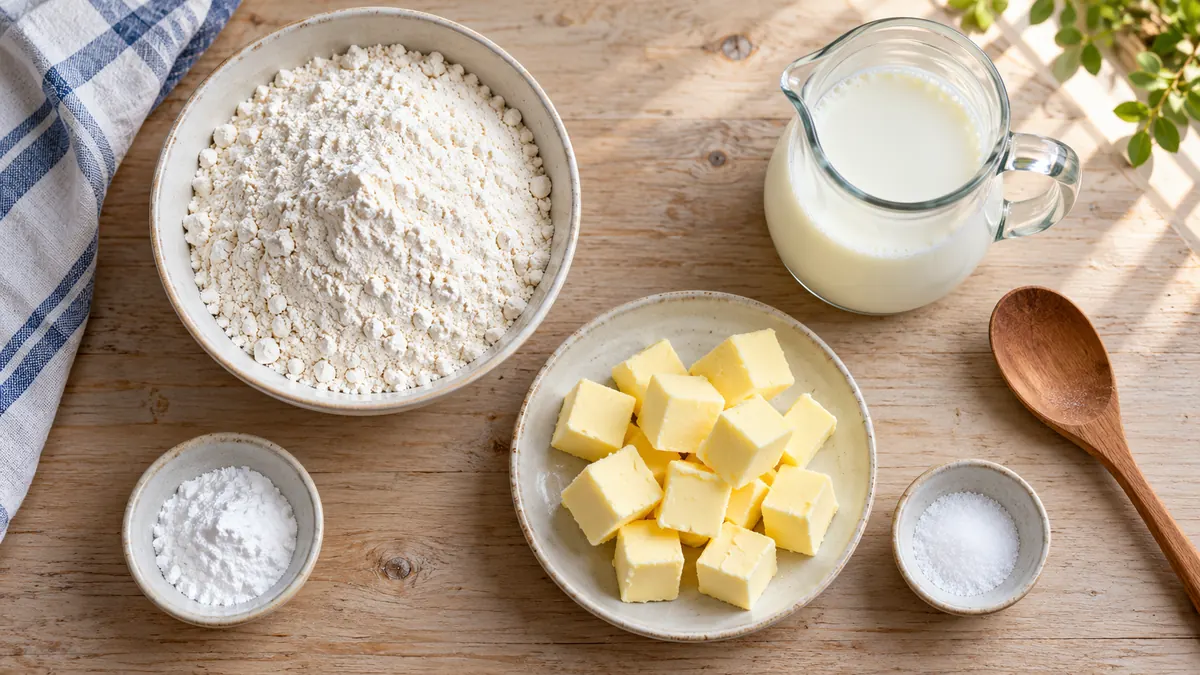
All-purpose flour
Use 240 g all-purpose flour, with a little extra available for the work surface. In this recipe, 240 g is approximately 2 U.S. cups measured lightly. Weighing is the more repeatable approach.
Scooping flour directly from a packed bag can add more than intended. Extra flour makes a dough feel easier to handle at first but can leave the baked biscuits dry.
Baking powder
Use 1 tablespoon baking powder, approximately 12 g depending on the product. Check that it is within its recommended storage period and has been kept dry.
Do not add an extra spoonful simply because you want taller biscuits. Dough thickness, shaping, handling, and oven heat also affect the result. More leavener is not a reliable fix for a dough problem.
Salt
Use 1/2 teaspoon fine table salt. Large-crystal salts do not measure identically by volume, so avoid assuming every half teaspoon provides the same seasoning.
Cold butter
Use 85 g cold unsalted butter, or 6 tablespoons. Cut it into small cubes before working it into the flour.
Unsalted butter makes the separate salt measurement easier to control. If salted butter is what you have, see the four-ingredient variation rather than automatically adding the full separate salt amount.
Cold milk
Start with 180 ml cold milk, or 3/4 U.S. cup. Have another tablespoon or two available only if the dough needs it. Whole milk is a useful starting choice for this recipe.
The goal is a soft dough that gathers together, not a pourable batter. Flour and measuring differences affect how much liquid is needed, so look at the dough before adding more.
Easy Baking Powder Biscuits Recipe
Prep: approximately 15 minutes Bake: 14 to 18 minutes Total: approximately 30 to 35 minutes, depending on preheating Yield: 8 biscuits Oven: 425°F / 220°C, conventional oven
Ingredients
- 240 g all-purpose flour, approximately 2 U.S. cups, plus a little for shaping
- 1 tablespoon baking powder, approximately 12 g
- 1/2 teaspoon fine table salt
- 85 g cold unsalted butter, cut into small cubes
- 180 ml cold whole milk, plus 1 to 2 tablespoons only if needed
Equipment
Use a mixing bowl, fork or pastry blender, measuring tools, baking sheet, sharp knife, and a heat-safe cooling rack. If lining the tray with parchment, check that the product is suitable for the baking temperature.
1. Preheat the oven
Heat the oven to 425°F / 220°C with a rack near the center. Prepare the baking sheet before you mix the dough so the shaped biscuits do not sit around while you search for equipment.
Cut the butter and return it to the refrigerator if your kitchen is warm. Measure the milk and keep it cold as well.
2. Combine the dry ingredients
Whisk the flour, baking powder, and salt thoroughly. Break up any visible lumps of baking powder so it is distributed through the flour rather than concentrated in one bite.
Keep the extra shaping flour separate. It is there to help prevent sticking, not to be mixed into the bowl automatically.
3. Work in the butter
Add the cold butter cubes. Use a pastry blender, fork, or your fingertips to break them into smaller pieces coated with flour. Stop while some small flattened pieces remain visible.
Do not work the mixture into a greasy paste. If the butter starts smearing and the bowl feels warm, pause and chill the mixture briefly before continuing.
4. Add the milk
Pour in the 180 ml milk and stir gently until a shaggy dough forms. Scrape around the bowl to bring the dry pockets together.
If loose flour still refuses to join the dough, add milk one tablespoon at a time. Stop as soon as the mixture can be gathered. It should feel soft and a little tacky, not dry and crumbly.
5. Fold lightly
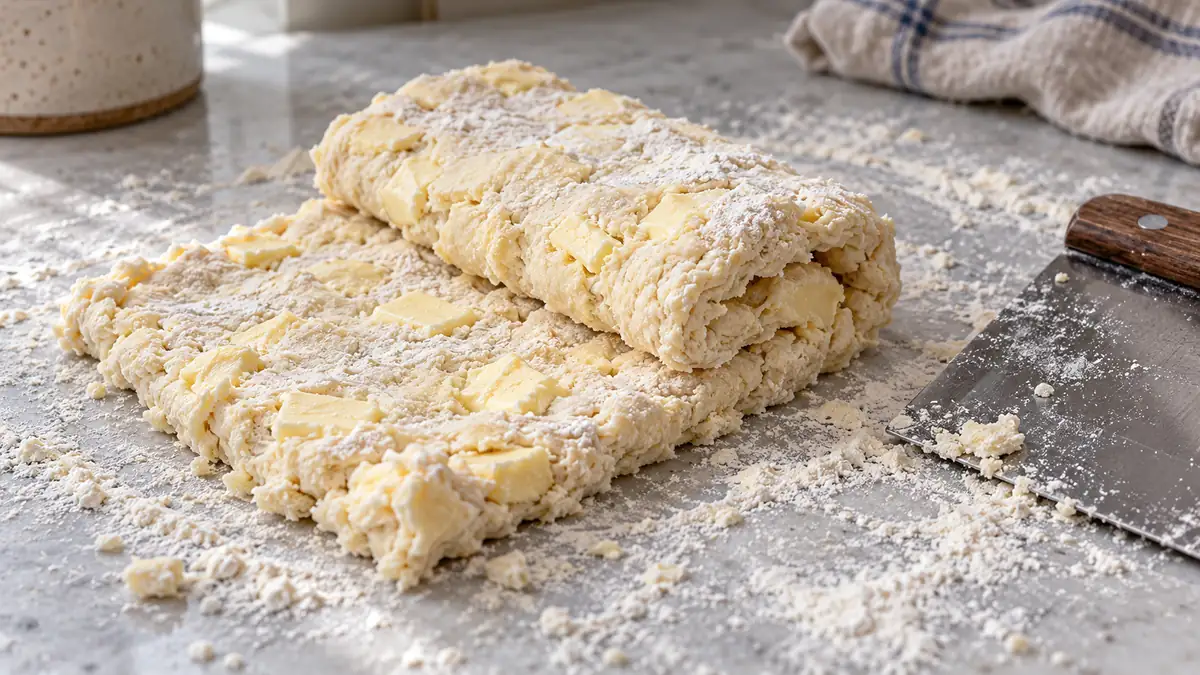
Turn the dough onto a lightly floured work surface. Gather it gently into a rough rectangle, fold it in thirds, and pat it down. Repeat once more, using only enough extra flour to prevent sticking.
You are making a couple of folds, not kneading bread. Stop before the dough becomes smooth and elastic.
6. Shape and cut
Pat the dough into a rectangle roughly 8 by 5 inches, about 3/4 inch thick. Use the thickness as your main guide rather than forcing the dough to match an exact outline.
With a sharp knife, cut the rectangle into 8 similar pieces, using two rows of four. Press down cleanly instead of sawing repeatedly through the dough.
Rectangles avoid the need to reroll scraps. If you prefer rounds, use a sharp biscuit cutter and accept that the exact yield can change with its size.
7. Arrange and bake
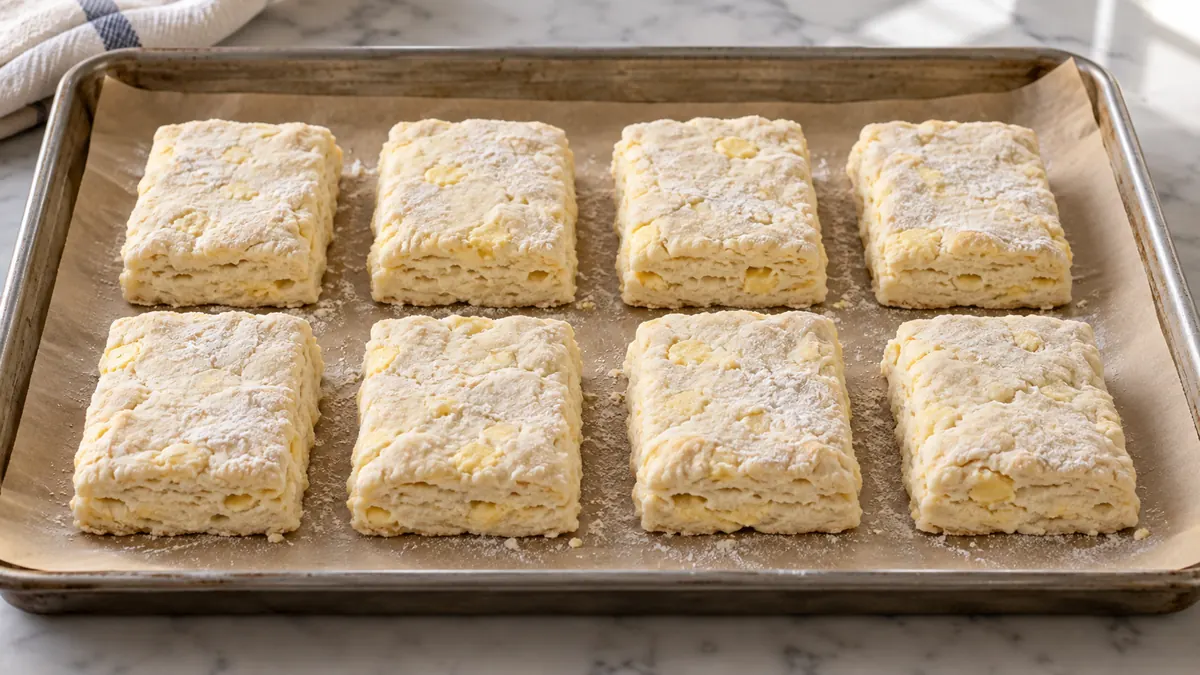
Place the biscuits on the baking sheet with a small gap between them. Put the tray into the fully preheated oven and bake for 14 to 18 minutes.
Look for golden tops, set sides, and a center that is baked through. A pale, wet-looking interior needs more time. Oven behavior and biscuit size affect the timing, so begin checking toward the early end of the range.
8. Serve warm
Transfer the biscuits to a rack and let them settle briefly before splitting. Serve warm, or cool completely before storing.
Butter, jam, honey, cheese, and gravy are serving choices rather than ingredients required for the dough. Add them according to the meal you are preparing.
Print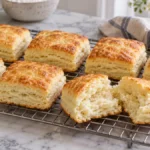
Baking Powder Biscuits
- Total Time: 33 minutes
- Yield: 8 biscuits 1x
Description
American-style baking powder butter biscuits with tender centers. Makes 8 rectangular biscuits, with 3-ingredient, 4-ingredient and drop-biscuit variations in the article.
Ingredients
- 240 g all-purpose flour (approximately 2 U.S. cups), plus a little for shaping
- 1 tablespoon baking powder (approximately 12 g)
- 1/2 teaspoon fine table salt
- 85 g cold unsalted butter (6 tablespoons), cubed
- 180 ml cold whole milk (3/4 U.S. cup), plus 1 to 2 tablespoons only if needed
Instructions
- Preheat a conventional oven to 425°F / 220°C with a rack near the center. Prepare a baking sheet; use parchment only if rated for this temperature.
- Whisk the flour, baking powder and salt thoroughly.
- Work the cold butter into the flour with a pastry blender, fork or fingertips, leaving small visible pieces. Chill briefly if the mixture becomes greasy.
- Add 180 ml milk and stir gently into a soft shaggy dough. Add extra milk one tablespoon at a time only if dry flour will not gather.
- Turn onto a lightly floured surface. Gather into a rectangle, fold in thirds and pat down. Repeat once more, avoiding prolonged kneading.
- Pat to roughly 8 by 5 inches and about 3/4 inch thick. Cut into 8 similar rectangles in two rows of four with a sharp knife.
- Place on the prepared tray with small gaps. Bake for 14 to 18 minutes, until golden and cooked through. Timing depends on biscuit size and the oven.
- Transfer to a rack, let settle briefly and serve warm. Cool completely before storing.
Notes
Four ingredients: use salted butter and omit separate salt; seasoning can be milder and varies by butter. Three ingredients: use 240 g self-rising flour, 85 g unsalted butter and 150 ml milk to start, adding milk gradually as needed; omit separate baking powder and salt. Drop biscuits: add 2 to 4 tablespoons extra milk gradually to the main dough and scoop into 8 thick mounds; bake until cooked through. Store cooled plain biscuits covered for 1 to 2 days for quality, or freeze well wrapped and aim to use within 2 months. This is a research-based recipe, not kitchen-tested. Times and yield are estimates; no precise nutrition analysis is provided.
- Prep Time: 15 minutes
- Cook Time: 18 minutes
- Category: Breakfast
- Method: Baking
- Cuisine: American
Nutrition
- Serving Size: 1 biscuit
Keywords: baking powder biscuits, fluffy biscuit recipe, butter biscuits, drop biscuits
How to Make Fluffy Biscuits
A fluffy center depends on several small decisions working together. It is not just a matter of adding more baking powder.
Handle the dough gently
Stop mixing once the flour is incorporated and the dough holds together. Repeated kneading can make the texture tougher. King Arthur Baking’s biscuit tips also emphasize a gentle touch and limiting unnecessary handling.
Keep enough height
A thin piece of dough starts at a disadvantage if your goal is a tall biscuit. Pat to approximately the thickness given in the recipe instead of rolling it flat like cookie dough.
Use small, visible butter pieces
For this method, start with cold butter and avoid rubbing it completely into the flour. Keep the mixture manageable by chilling if it becomes greasy or difficult to handle.
Give the oven time to preheat
Do not treat the first beep as a reason to rush if your oven is slow to reach a stable temperature. Have the oven ready before the shaped dough goes in.
Avoid burying the dough in flour
A light coating on the work surface is enough. Repeatedly dusting and folding in more flour changes the formula and can make the centers dry.
Simple Biscuit Recipe With 4 Ingredients
To reduce the base recipe to four measured ingredients, use:
- 240 g all-purpose flour
- 1 tablespoon baking powder
- 85 g cold salted butter
- 180 ml cold milk, adjusted gradually if needed
Follow the same method and omit the separate salt. Salted butter provides some seasoning, but the amount varies by brand, and the biscuits can taste milder than the separately seasoned main recipe.
If you decide to add more salt, that becomes a five-ingredient version. There is nothing wrong with doing so; the point is to describe the ingredient count accurately.
Do not confuse this variation with a self-rising-flour recipe. Here, the flour is still all-purpose, so baking powder remains necessary.
3 Ingredient Biscuit Recipe With Self-Rising Flour
A three-ingredient biscuit uses self-rising flour, butter, and milk. The flour already contains a raising agent and salt, so you leave those separate additions out.
For a variation on the base dough, start with 240 g self-rising flour, 85 g cold unsalted butter, and 150 ml cold milk, keeping additional milk available. Work in the butter, then add milk gradually until you reach the same soft, shaggy consistency described above. The flour brand can change how much liquid is needed.
Shape and bake as directed for the main recipe, checking for doneness rather than relying on an identical result from every flour brand. Do not add the base recipe’s tablespoon of baking powder or its separate salt.
King Arthur Baking’s self-rising biscuit recipe is another example of this three-product approach. The shortcut comes from using a blended flour product, not from making the leavening disappear.
Check your package carefully: self-rising flour, self-raising flour, and complete biscuit mix are not automatically identical products. Use the directions appropriate to the product you actually have.
Easy Drop Biscuit Variation
Drop biscuits are useful when you want to skip patting, folding, and cutting. Their rough tops and irregular edges are part of the style.
Make the main dry mixture and work in the butter. Add the original milk, then increase it gradually by 2 to 4 tablespoons until the dough is soft enough to scoop in mounds. It should remain thick rather than flowing like pancake batter.
Divide into 8 similar mounds on the prepared tray, leaving room between them. Bake at 425°F / 220°C, starting to check at about 14 minutes and continuing until golden and cooked through. Larger or wetter mounds can take longer.
This variation changes the shape and handling, so expect a more rustic biscuit rather than the same layered rectangle. Add extra liquid gradually instead of pouring in the full adjustment before seeing the dough.
Cream-based drop biscuits are another style. They use a different balance of fat and liquid, so do not replace milk with cream in this formula and assume every measurement will behave identically.
Butter Biscuits, Shortening Biscuits and Publisher Recipes
Butter and shortening versions are both found in American biscuit recipes. This page uses butter for its flavor and gives instructions around that choice.
If you arrived while looking for Betty Crocker baking powder biscuits or an Allrecipes biscuit recipe, use that publisher’s own recipe when you want its exact formula. Different recipes can vary in fat, seasoning, dough thickness, and baking temperature.
Avoid taking the ingredient amounts from one recipe and the oven instructions from another without accounting for those differences. This page is a YumaRecipes recipe draft, not a claim to reproduce a particular publisher’s tested version.
The best biscuit recipe for your meal also depends on the result you want: a quickly scooped drop biscuit, a tender self-rising-flour biscuit, or a butter biscuit with a more defined shape.
Troubleshooting Homemade Biscuits
Why are my biscuits dense?
Look at the flour measurement, leavener, and handling first. Too much flour, repeated kneading, or a dough rolled too thin can all work against the texture you wanted.
Check one variable at a time on the next batch. Changing the flour, butter, milk amount, and oven setting together makes it harder to identify the cause.
Why are the biscuits dry?
The dough may have needed a little more milk, picked up too much shaping flour, or baked too long. A dry mixture should not be forced together by kneading harder; add a small amount of milk while it is still in the bowl.
Why did the butter leak onto the tray?
Some butter on the pan can occur, but excessive pooling is a reason to check whether the dough became warm or the oven was ready. Avoid working with visibly greasy, soft dough.
Why do they taste bitter?
Recheck the baking powder measurement and its distribution. Do not accidentally use tablespoons where a different recipe called for teaspoons, or add extra baking powder to self-rising flour.
Why are the bottoms dark before the centers are done?
Check tray color, rack position, and oven behavior. A very dark pan or a rack too close to the lower heat can brown the base quickly. Move toward the oven’s center and begin checking sooner on the next batch.
What to Serve With Baking Powder Biscuits
Serve biscuits as part of breakfast, or use them as a side for soup and other meals. Their neutral savory flavor works with both simple spreads and fuller dishes.
- Pair them with eggs or another option from these savory breakfast ideas.
- Serve a warm biscuit beside Marry Me Chicken Soup.
- For another soup pairing, explore our guide to what swamp soup is.
- Split one and add a filling immediately before eating so it does not sit and become soggy.
Choose the biscuit version for the occasion. Rectangular biscuits are convenient to split, while drop biscuits are easy to serve straight from a tray.
Storage, Freezing and Reheating
The biscuits are at their best soon after baking. Cool leftovers completely, then store covered at room temperature for 1 to 2 days for quality. Freeze plain baked biscuits if you want to keep them longer.
For freezing, wrap cooled biscuits well or place them in a suitable airtight freezer container. Label the date and aim to use them within about 2 months for a practical quality window.
Warm thawed biscuits in a 350°F / 175°C oven until heated through, checking after about 5 minutes. Larger biscuits and colder starting temperatures need longer. Loosely cover if the tops brown before the middle is warm.
Store biscuits with perishable fillings according to the filling’s requirements rather than treating them like plain baked bread. Do not wrap the plain biscuits while hot, because trapped steam can make the outside damp.
FAQS
What are baking powder biscuits?
They are American-style quick breads raised with baking powder instead of yeast. The basic dough uses flour, fat, liquid, and seasoning, then goes into the oven without a yeast rise.
What makes biscuits fluffy?
Correct measuring, suitable leavening, gentle handling, sufficient dough thickness, and a preheated oven all help. Adding extra baking powder is not a substitute for getting those steps right.
Can I make a 3 ingredient biscuit recipe?
Yes. Use a recipe based on self-rising flour, butter, and milk. Because the flour already contains leavening and salt, omit those separate additions from an all-purpose-flour formula.
Can I make biscuits with 4 ingredients?
Yes. The variation here uses all-purpose flour, baking powder, salted butter, and milk. It omits separate salt, so seasoning depends on your butter and can be milder than the main recipe.
How do I make drop biscuits?
Add milk gradually to the base dough until it can be scooped into thick mounds. Divide into similar portions and bake until the centers are cooked through. The article gives the adjustment range.
Can I replace baking powder with baking soda?
Not as an equal swap in this recipe. They work differently, and baking soda needs an appropriate acidic formulation. Use baking powder as directed or follow a recipe specifically developed for baking soda.
Can I use salted butter?
Yes. Follow the four-ingredient variation and omit the separate salt initially. Different brands contain different amounts of salt, so expect some variation in seasoning.
Is this the Betty Crocker baking powder biscuit recipe?
No. This is a separate butter-based YumaRecipes formula. Follow the original publisher if you want its exact recipe, and avoid mixing measurements and baking instructions from different versions.
Do I need a biscuit cutter?
No. The main recipe makes rectangular biscuits with a sharp knife. That also avoids rerolling scraps. A round cutter is optional, and its size affects the yield.
Can I freeze baking powder biscuits?
Yes. Cool the baked biscuits completely, wrap well, and freeze. Thaw and warm gently in the oven. The suggested two-month window is for quality rather than a claim that every freezer stores food identically.