
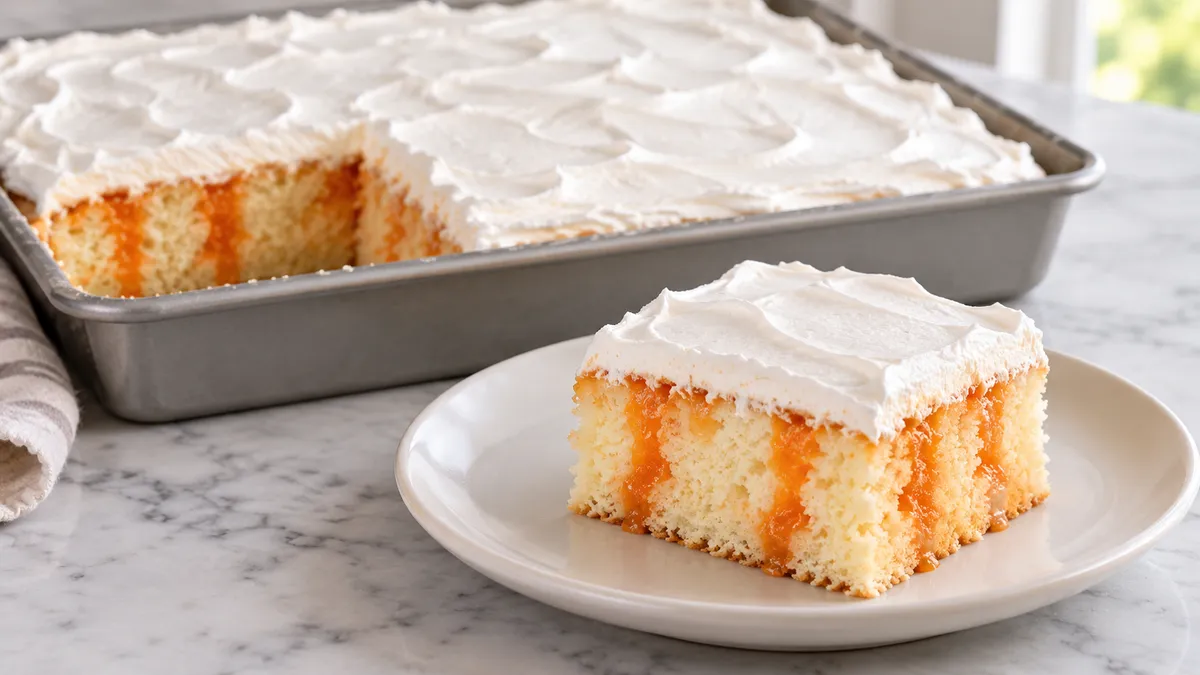
Orange jello poke cake is a vanilla cake pierced with small holes, soaked with liquid orange gelatin, chilled, and finished with whipped topping. The orange mixture runs into the holes and creates colorful streaks inside each slice while the surface stays creamy and simple.
This orange jello poke cake recipe starts with a homemade vanilla sheet cake in a 9 by 13-inch pan. You will mix and bake the cake, let it cool briefly, add the measured gelatin mixture, and refrigerate before topping. There is no condensed milk, instant pudding, or extra orange juice in the base version.
Plan for about 4 hours 30 minutes, including cooling and at least 3 hours of refrigeration. The active work is roughly 25 minutes spread across preparation, soaking, and topping. This is a proposed home formulation, not a kitchen-tested recipe; pan material, oven performance, and ingredient brands can affect the result.
Jump to: Recipe overview · Equipment · Make the cake · Variations.
What Is Orange Jello Poke Cake?
A poke cake is baked first and then pierced so a filling or flavored liquid can enter the crumb. For this version, the filling is orange gelatin mix dissolved in measured water. It goes into the cake while still liquid, then the whole dessert chills in its baking pan.
The finished dessert should be served cold in squares, with orange streaks running through a light-colored cake. It is different from a gelatin mold and different from a cake with orange zest mixed directly into the batter.
For a spoonable fruit dessert with no baked cake, our mandarin orange jello salad uses cottage cheese, whipped topping, and drained fruit. Its dry-powder method does not apply to the liquid gelatin filling here.
Recipe at a Glance
| Detail | This recipe |
|---|---|
| Pan | One 9 by 13-inch baking pan, at least 2 inches deep |
| Cake base | Homemade vanilla cake |
| Oven | 350°F, conventional oven |
| Baking time | About 30-35 minutes |
| Gelatin | One 3 oz box regular orange dessert mix |
| Filling liquid | 1 cup boiling water and 1/2 cup cold water |
| Active work | About 25 minutes total |
| Initial cooling | About 30 minutes, as needed |
| Refrigeration | At least 3 hours |
| Planned total | About 4 hours 30 minutes |
| Yield | About 15 squares |
The cooling period is an estimate. The pan and cake should no longer be very hot before refrigerating, but this is not an instruction to leave the prepared dessert out for hours. Follow the storage guidance below.
Orange Jello Poke Cake Ingredients
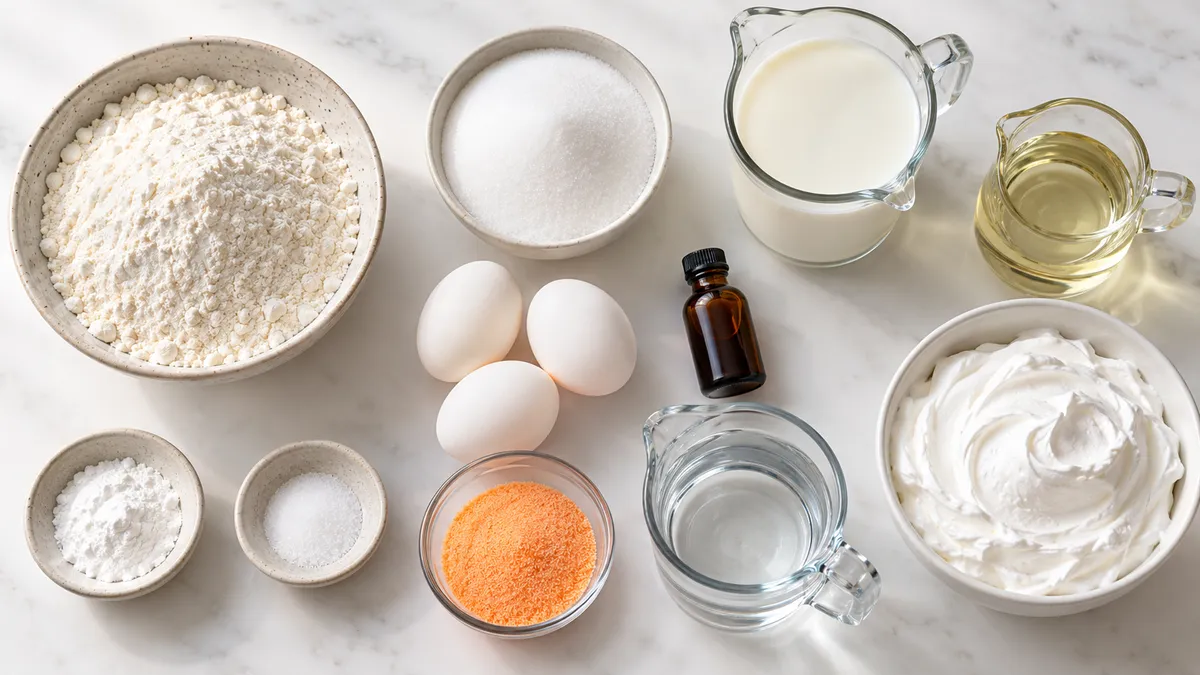
For the vanilla sheet cake
- 2 1/2 cups all-purpose flour, 300 g. Weighing is preferable. If using cups, spoon in the flour and level the surface without packing it down.
- 1 1/2 cups granulated sugar, 300 g. Use regular granulated sugar for the listed formulation.
- 2 1/2 teaspoons baking powder. Measure level spoonfuls and break up lumps.
- 1/2 teaspoon fine table salt. Different coarse salts do not have the same volume measure.
- 3 large eggs. Crack them into a separate bowl before adding.
- 1 cup whole milk, 240 mL. Use plain dairy milk for this version.
- 1/2 cup neutral oil, 120 mL. Choose a mild oil intended for cooking and baking.
- 2 teaspoons alcohol-free vanilla flavoring. Check the product label and suggested strength.
For the orange filling and topping
- One 3 oz box regular orange gelatin dessert mix, about 85 g. This is flavored gelatin powder, not pudding mix or plain unflavored gelatin.
- 1 cup boiling water, 240 mL. Measure the water that goes into the mixing jug after heating.
- 1/2 cup cold water, 120 mL. Add after fully dissolving the powder.
- One 8 oz tub frozen whipped topping, thawed in the refrigerator according to its label. The tub weight is not the same as a liquid measuring-cup volume.
Optional orange segments are a garnish only. If using them, drain canned segments or prepare fresh pieces separately and add shortly before serving.
What kind of orange gelatin works here?
Use the specified small box of regular sweetened orange gelatin mix. A sugar-free packet may weigh much less and should not be substituted by matching the 3 oz weight.
A large box also needs different quantities. Check the product and size before opening it, rather than assuming every orange box is equivalent. The filling ratio below belongs to this proposed poke cake formulation, not a general instruction for preparing all gelatin desserts.
Equipment and Pan Choice
You will need the baking pan, two mixing bowls, a whisk, a spatula, measuring equipment, a cooling rack, a heatproof pouring jug, and a round skewer about 1/8 to 1/4 inch wide. Choose a pan suitable for both baking and refrigerated storage.
Grease the pan before mixing. The cake stays in the pan for soaking and serving, so you do not need to turn it out onto a plate. Use a container cover or another suitable cover that will not press onto the finished topping.
Follow the manufacturer’s instructions for your pan, especially if using glass or ceramic. Avoid abrupt temperature changes, such as putting a very hot glass dish directly onto a cold surface or into a refrigerator.
Print
Orange Jello Poke Cake
- Total Time: 4 hours 30 minutes
- Yield: About 15 squares 1x
Description
A homemade vanilla sheet cake soaked with measured orange gelatin and chilled before finishing with whipped topping.
Ingredients
Vanilla sheet cake
- 2 1/2 cups all-purpose flour (300 g)
- 1 1/2 cups granulated sugar (300 g)
- 2 1/2 teaspoons baking powder
- 1/2 teaspoon fine table salt
- 3 large eggs
- 1 cup whole milk (240 mL)
- 1/2 cup neutral oil (120 mL)
- 2 teaspoons alcohol-free vanilla flavoring
Orange filling and topping
- 1 box (3 oz / 85 g) regular orange gelatin dessert mix
- 1 cup boiling water (240 mL)
- 1/2 cup cold water (120 mL)
- 1 tub (8 oz) frozen whipped topping, thawed in the refrigerator according to its label
Instructions
- Heat a conventional oven to 350°F. Grease a 9 by 13-inch baking pan at least 2 inches deep.
- Whisk the flour, sugar, baking powder and salt in a large bowl. Separately whisk the eggs, milk, oil and alcohol-free vanilla. Stir wet ingredients into dry just until combined, scraping the bowl.
- Spread batter evenly in the pan. Bake about 30-35 minutes, checking near 30 minutes. The center should be set and a toothpick should come out without wet batter.
- Cool on a rack for about 20 minutes. Use a narrow round skewer, about 1/8 to 1/4 inch wide, to make holes about 1 inch apart nearly to the bottom.
- Dissolve the orange gelatin powder in 1 cup boiling water, stirring about 2 minutes until dissolved. Stir in 1/2 cup cold water. Keep the mixture liquid.
- Pour the filling slowly and evenly over the cake, pausing as it absorbs. If liquid pools heavily, pause rather than forcing it into one spot. Do not add extra water or juice.
- Cool about another 10 minutes, or until the pan is no longer very hot. Refrigerate for at least 3 hours until thoroughly cold, covering appropriately once cooled. Follow the pan manufacturer’s temperature guidance.
- Gently spread thawed whipped topping over the cold cake. Cut into about 15 squares. Add optional drained orange garnish just before serving if desired. Keep refrigerated.
Notes
Proposed home formulation, not kitchen tested. Planned total includes active work across mixing, soaking and topping, 35 minutes baking, about 30 minutes initial cooling, and 3 hours chilling. Actual cake doneness and complete chilling control readiness. The small regular gelatin box is not interchangeable by weight with sugar-free packets. Optional orange garnish is not included in the twelve main ingredient entries. Boxed cake is an adaptation: use its own ingredients and baking directions for a 9 by 13-inch pan. Do not add condensed milk, juice or extra package-preparation water. Store covered at 40°F or below and use within 3 days or shorter ingredient-label guidance. Limit time outside refrigeration to 2 hours, or 1 hour above 90°F.
- Prep Time: 25 minutes
- Cooling and Chilling Time:
- Cook Time: 35 minutes
- Category: Dessert
- Method: Baking
- Cuisine: American
Nutrition
- Serving Size: 1 square
Keywords: orange jello poke cake,orange jello cake,orange poke cake recipe
How to Make Orange Jello Poke Cake
1. Prepare the oven and dry ingredients
Heat a conventional oven to 350°F. Grease the 9 by 13-inch pan and set it aside. Arrange an oven rack near the center.
Whisk the flour, sugar, baking powder, and salt in a large bowl until evenly distributed. Check for small pockets of baking powder, which are easier to break up now than after adding liquid.
2. Combine the wet ingredients
In another bowl, whisk the eggs, milk, oil, and alcohol-free vanilla until combined. Pour the mixture into the dry ingredients and stir until no broad streaks of flour remain.
Scrape the sides and bottom of the bowl with a spatula. Stop once the batter is combined rather than beating it for several extra minutes. This is a simple stirred cake batter, not a whipped sponge that relies on a separate egg-foaming stage.
3. Bake the vanilla cake
Spread the batter evenly in the prepared pan. Smooth the top gently, making sure the corners have batter as well as the center.
Bake for about 30-35 minutes, checking near the earlier end of the range. The center should look set, and a toothpick inserted near the middle should come out without wet batter. Continue in short intervals if it still needs time.
Do not rely on the gelatin soak to repair an underbaked center. The cake needs to be baked through before the filling is added. At the other extreme, avoid leaving it in the oven just to reach the maximum time if it is already done.
4. Cool briefly and make the holes
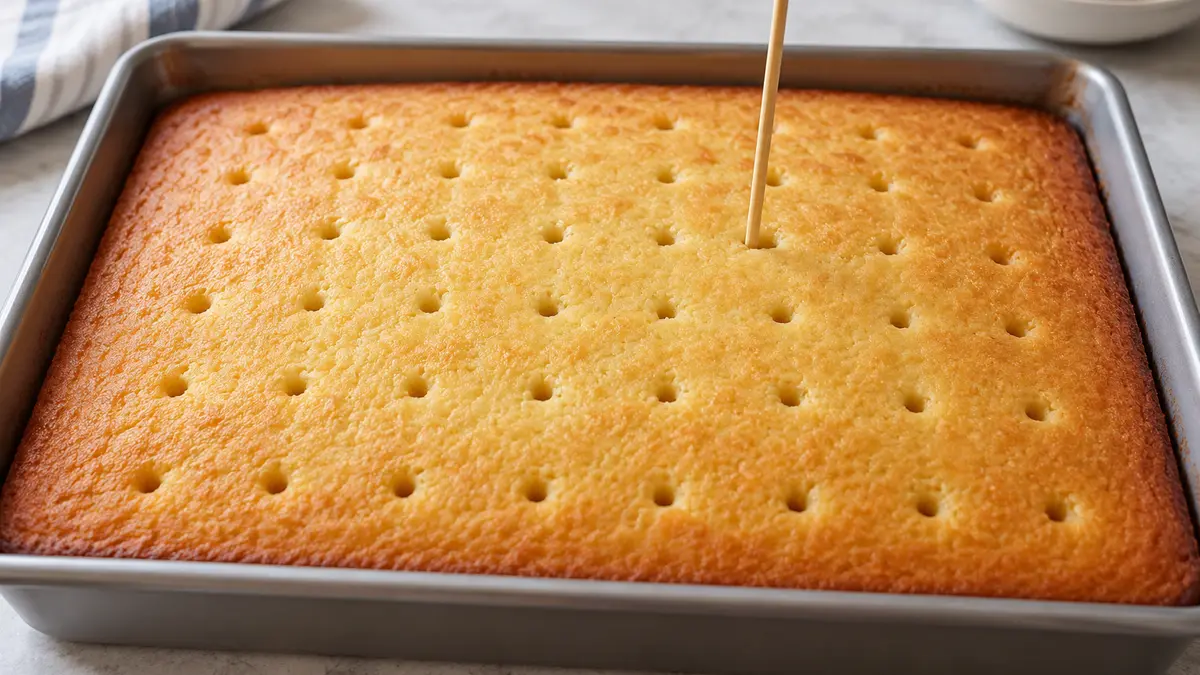
Set the pan on a rack and let the cake cool for about 20 minutes. It can still be warm for soaking, but it should no longer be straight from the oven and extremely hot.
Use the skewer to make holes about 1 inch apart across the surface, reaching nearly to the bottom without repeatedly scraping the pan. Keep the holes fairly narrow and reasonably even.
Do not use a very wide wooden-spoon handle to excavate large channels for this thin filling. Oversized holes can concentrate liquid into a few soft pockets instead of distributing it throughout the cake.
5. Prepare the liquid orange gelatin
Put the orange gelatin powder in the heatproof jug or bowl. Add 1 cup boiling water and stir for about 2 minutes, until fully dissolved. Check the bottom for remaining granules.
Stir in 1/2 cup cold water. The mixture should still be completely liquid when poured over the cake. Do not refrigerate it until it becomes partly set in the jug.
Do not add orange juice, soda, or the rest of a package’s standard water quantity on top of these measured liquids. The recipe already specifies how much filling goes into this cake.
6. Pour slowly and distribute evenly
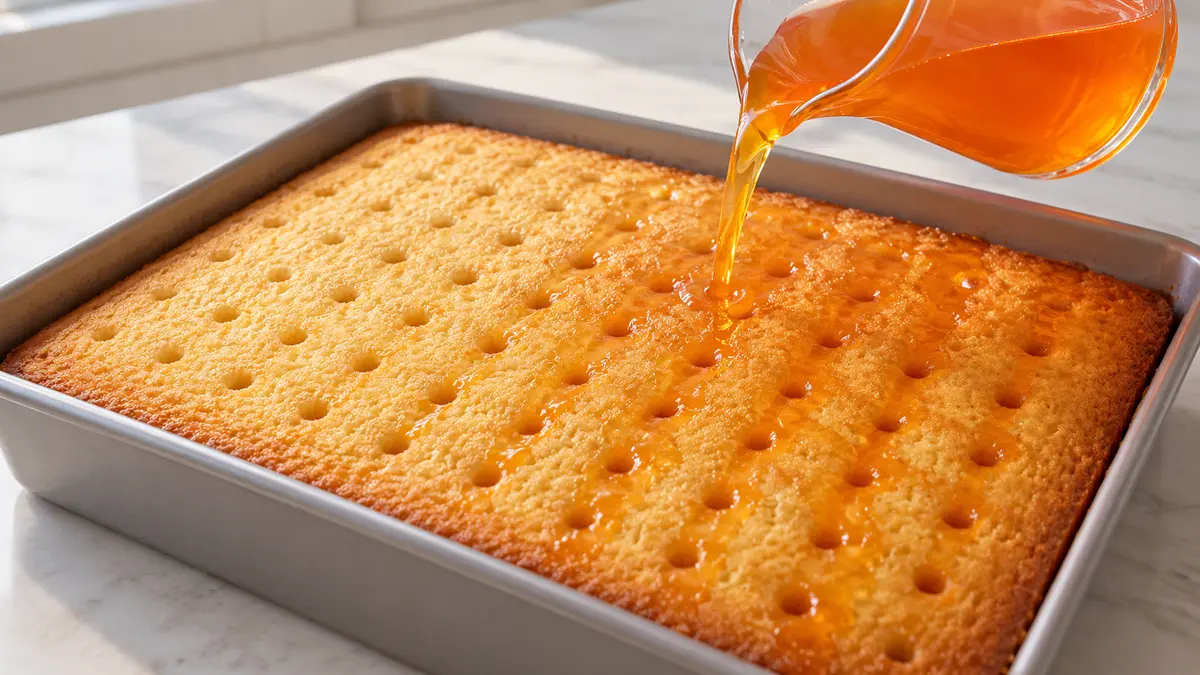
Pour the orange mixture slowly across the pierced surface, moving around the pan instead of emptying the jug onto one spot. Pause briefly as the liquid absorbs, then continue distributing it.
Use the full listed filling only as the cake absorbs it. If liquid pools heavily and stops absorbing, pause rather than forcing it into one corner. A correctly baked cake, narrow holes, and gradual pouring are the intended approach.
Allow approximately another 10 minutes of cooling after soaking, checking that the pan is no longer very hot. This and the earlier cooling period make up the approximate 30-minute initial cooling allowance.
7. Refrigerate before topping
Refrigerate the cake for at least 3 hours, until thoroughly cold. Cover appropriately once the pan has cooled, without trapping a large amount of steam against the surface.
The gelatin filling needs refrigeration, and the cake should be chilled before the topping is applied. A warm cake can soften the topping and make the surface harder to spread neatly.
8. Add the topping and cut into squares
Spread the thawed whipped topping gently over the cold cake. Use broad strokes and avoid dragging the spatula repeatedly through the same patch of crumb.
Cut into about fifteen squares, using a five-by-three cutting pattern as a starting point. Add optional orange garnish shortly before serving. Keep the cake refrigerated between servings.
How to Avoid a Soggy Poke Cake
Start with a fully baked cake and the right pan size. A wet center is not the same problem as a moist baked crumb, and adding gelatin does not finish the baking process.
Measure the filling carefully. Extra water, juice, or soda adds more liquid to a cake that already has a planned soak. If you want to change the flavor, use a recipe designed around that liquid rather than adding it freely.
Keep holes evenly spaced. A few large holes can collect much more liquid than the surrounding cake, leaving an uneven texture. Narrow holes distributed over the surface give the filling more places to enter.
Finally, chill before cutting. Refrigeration is part of the preparation, not an optional serving suggestion. Cutting a warm, recently soaked cake makes it difficult to judge the intended texture and may leave messy pieces.
Orange Poke Cake Variations
Orange creamsicle-style presentation
The vanilla cake, orange filling, and white topping already create an orange-and-cream flavor direction. You do not need to add dairy cream to the gelatin filling or pour condensed milk into the holes as an additional step.
For a separate dessert designed around an actual creamy gelatin mixture, these orange creamsicle jello shots provide that preparation in small cups. Keep the two methods separate.
Using a boxed cake base
If you prefer a boxed vanilla or white cake, choose one intended to make a 9 by 13-inch cake and follow that product’s ingredients and baking instructions. The homemade batter quantities above do not automatically become the correct additions for a cake mix.
A different base may absorb the filling differently, so this is an adaptation rather than a tested brand-specific shortcut. Keep the pan size and measured filling in mind and pour gradually.
Fruit on top
Use a small amount of well-drained mandarin orange segments as a garnish shortly before serving. Large amounts of wet fruit added hours ahead can introduce unwanted surface moisture.
Fruit is optional. The base recipe does not depend on buying a second orange product or decorating every square individually.
Dietary substitutions
This version contains wheat, eggs, dairy, and gelatin. It is not automatically vegetarian, halal, dairy-free, gluten-free, or sugar-free. Check product ingredients and any certification that matters to your household.
Replacing the flour, eggs, milk, gelatin mix, or whipped topping changes the formulation. No tested one-for-one dietary substitution is supplied in this article.
Make-Ahead, Storage, and Transport
This dessert can be prepared the day before serving. Bake, soak, and chill the cake in its pan, then add the topping after it is completely cold. Keep optional fruit separate until serving.
Store the finished cake covered in the refrigerator at 40°F or below. For this proposed recipe, use within 3 days as a conservative household limit, or follow any shorter guidance on the products you use.
General FDA food-storage guidance recommends prompt refrigeration of perishables. Limit total time outside refrigeration to 2 hours, or 1 hour when the temperature is above 90°F.
For a potluck, transport the chilled cake in an insulated cooler with cold packs if needed. Keep the pan level and arrange refrigerator space at the destination. Serve a smaller number of portions at a time rather than leaving the entire dessert out throughout a long event.
Freezing the assembled soaked cake is not the intended storage method here. The topping and gelatin-soaked crumb may change after thawing. Plan a refrigerated batch sized for the occasion.
Troubleshooting Orange Jello Poke Cake
| Problem | Likely things to check |
|---|---|
| Wet, heavy center | Cake doneness before soaking and amount of liquid |
| Orange liquid pools in one place | Hole size, spacing, and pouring speed |
| Weak orange streaks | Uneven pouring or holes that are too shallow |
| Grainy filling | Gelatin powder not fully dissolved |
| Topping becomes loose | Cake not chilled or topping thawed incorrectly |
| Squares fall apart | Insufficient chilling, oversized holes, or underbaked cake |
If you want a chocolate celebration cake with a frosting and filling rather than a gelatin soak, our Matilda cake recipe follows that different approach. It has its own pan sizes and assembly steps.
FAQS
What is orange jello poke cake?
It is a baked cake pierced with small holes, soaked with liquid orange gelatin, refrigerated, and topped. This version uses homemade vanilla sheet cake and a thawed whipped topping.
Do I let the gelatin set before pouring it over the cake?
No. Dissolve the powder in boiling water, stir in the measured cold water, and pour while the mixture is still liquid. Partly set gelatin will not flow into the holes in the same way.
Should the cake be warm or cold when I add the filling?
For this method, let the baked cake cool for about 20 minutes before making holes and adding the filling. It can remain warm, but should not be extremely hot straight from the oven.
How much water goes into the orange filling?
Use 1 cup boiling water and 1/2 cup cold water with one 3 oz box of regular orange gelatin mix. Do not add extra package-preparation water or juice on top of those quantities.
What should I use to poke the holes?
Use a round skewer about 1/8 to 1/4 inch wide, making holes roughly 1 inch apart and nearly to the bottom. Avoid very large channels that collect too much liquid in one place.
Can I use a boxed white cake mix?
You can adapt a cake mix intended for a 9 by 13-inch pan, following its own added ingredients and baking instructions. Different cake bases absorb liquid differently, so this is not presented as a tested brand-specific substitution.
Can I make orange poke cake the night before?
Yes. Bake, soak, and chill it, then apply the topping after the cake is thoroughly cold. Keep it covered in the refrigerator and add optional fruit shortly before serving.
Can I add condensed milk or orange juice?
Neither is included in this formulation. Adding more liquid can change absorption and texture. Use a recipe developed for those additions instead of pouring them into this cake as an extra step.
Can I use sugar-free gelatin in this recipe?
It is not an equal-weight replacement for the regular 3 oz mix. Packet sizes and formulations differ. Use a recipe developed for your specific product rather than substituting by weight.
How many servings does the cake make?
About fifteen squares from a 9 by 13-inch cake, depending on how it is cut. No numerical nutrition panel is supplied without calculating from the actual products and portion sizes used.