
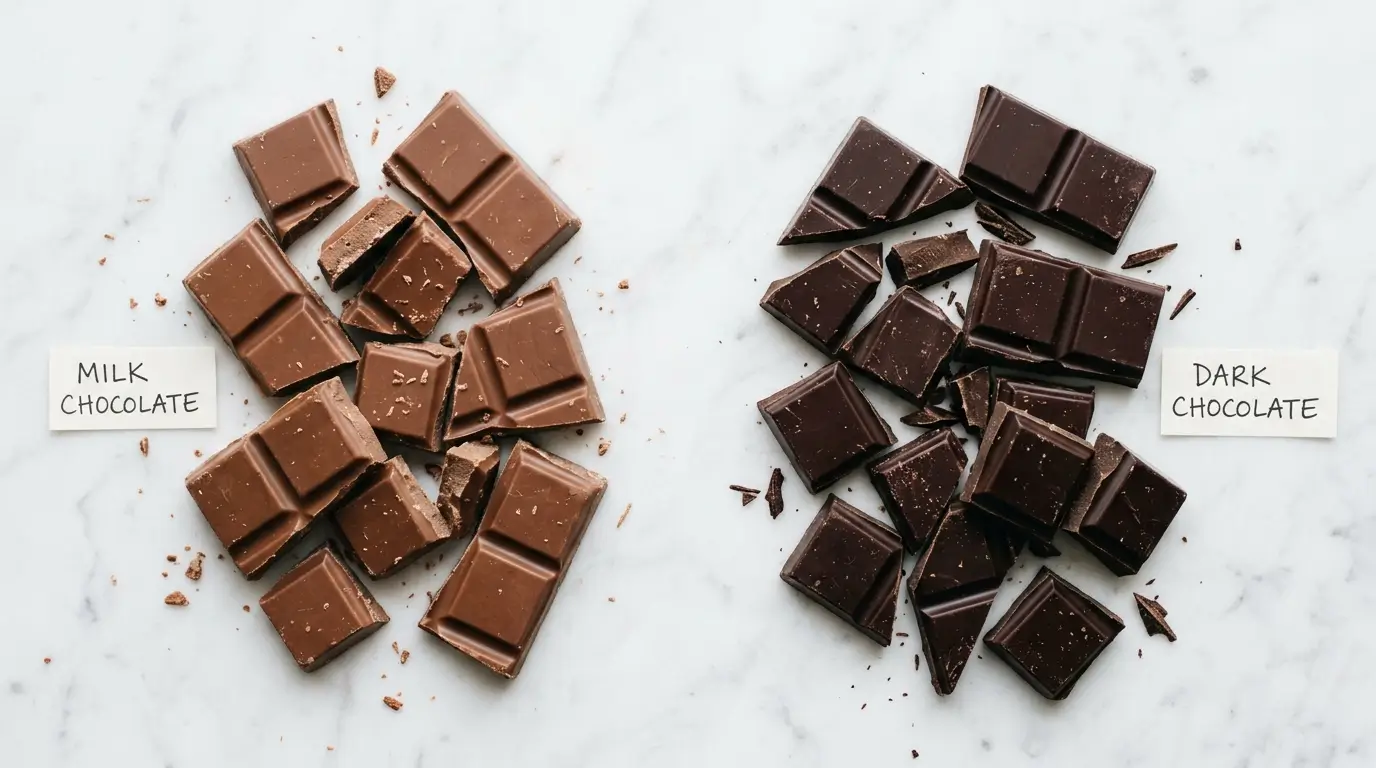
The milk chocolate vs dark chocolate debate has been going on for decades — and most of the answers you’ll find online are either oversimplified (“dark chocolate is always better”) or written by someone trying to sell you something.
The honest answer is more nuanced. Dark chocolate has meaningful health advantages in specific contexts. Milk chocolate isn’t the dietary villain it’s been made out to be. And the “right” choice depends entirely on what you’re optimizing for.
Here’s the complete, evidence-based comparison — covering nutrition, health benefits, weight management, and when each one actually makes sense.
Milk Chocolate vs Dark Chocolate: Nutritional Comparison
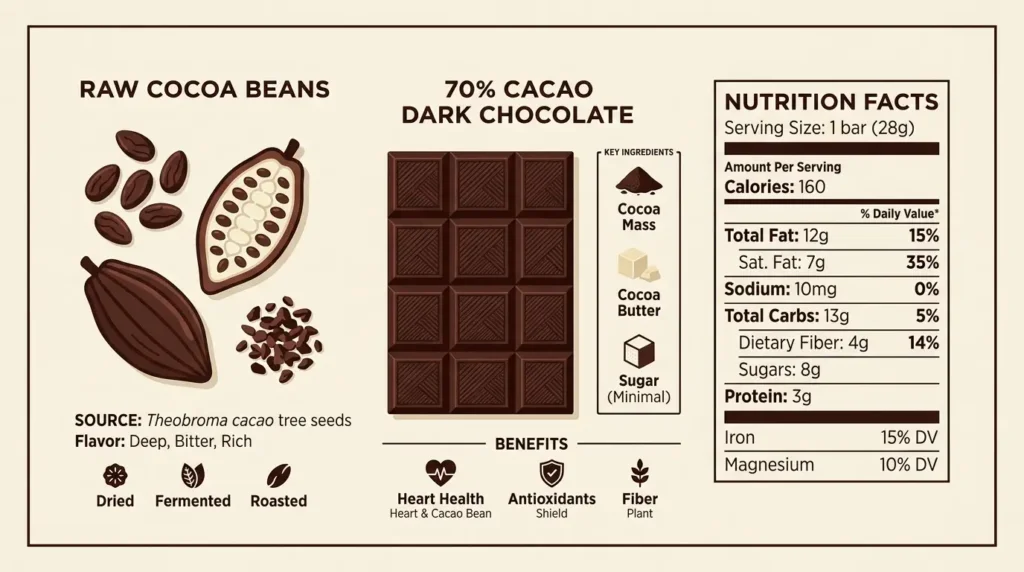
Let’s start with the numbers. The following comparison is based on a standard 40g serving (roughly 4 squares) of each type.
| Nutrient | Milk Chocolate (40g) | Dark Chocolate 70%+ (40g) |
|---|---|---|
| Calories | ~210 kcal | ~220 kcal |
| Fat | 12g | 15g |
| Saturated fat | 7g | 9g |
| Carbohydrates | 24g | 16g |
| Sugar | 22g | 8g |
| Fiber | 0.5g | 3g |
| Protein | 3g | 3g |
| Cocoa content | 10–40% | 70–100% |
| Flavanols | Low | High |
| Iron | Low | ~15% RDA |
| Magnesium | Low | ~16% RDA |
| Caffeine | ~10mg | ~25mg |
For a deep dive into what’s actually in milk chocolate, see our guide on how to make milk chocolate at home — it breaks down every ingredient and its role.
The Key Differences Explained
Cocoa Content — Why It Matters
The single most important variable is cocoa percentage. Cocoa solids contain the flavanols — the polyphenol compounds responsible for most of dark chocolate’s documented health benefits.
Milk chocolate typically contains 10–40% cocoa. Dark chocolate starts at 50% and goes up to 100% (unsweetened baking chocolate). The higher the percentage, the more flavanols, the more minerals, and the less sugar.
Practical implication: A 70% dark chocolate and a 40% dark chocolate are meaningfully different products. When health claims are made about “dark chocolate,” they usually refer to 70%+ varieties.
Sugar Content
This is where milk chocolate’s profile becomes genuinely problematic for weight management. At 22g of sugar per 40g serving, standard milk chocolate is delivering more than half its weight in sugar — creating blood sugar spikes that drive subsequent cravings.
Dark chocolate at 70%+ contains roughly 8g of sugar per 40g serving — less than 40% of the milk chocolate equivalent. The lower glycemic impact makes dark chocolate meaningfully better for appetite control.
Fat Profile
Both types contain significant saturated fat. Dark chocolate’s fat is higher in total, but it comes predominantly from cocoa butter — which contains stearic acid, a saturated fat that research suggests has a neutral effect on cardiovascular risk (unlike palmitic acid, which raises LDL cholesterol).
Milk chocolate’s fat comes from both cocoa butter and dairy fat, which has a more mixed nutritional profile depending on the quality of the milk used.
Does Milk Chocolate Have Caffeine?
Yes — and more than most people realize. For the complete breakdown, see our article on whether milk chocolate has caffeine — including how it compares to dark chocolate and coffee.
Health Benefits of Dark Chocolate (The Evidence)
Cardiovascular Health
The most robust evidence for dark chocolate is in cardiovascular health. Cocoa flavanols improve endothelial function (the inner lining of blood vessels), reduce blood pressure modestly, and improve blood flow. Multiple meta-analyses have confirmed these effects at intakes of 40–50g of 70%+ dark chocolate per day.
Insulin Sensitivity and Blood Sugar
Cocoa flavanols improve insulin sensitivity — meaning your cells respond more effectively to insulin, leading to more stable blood sugar. This is the opposite of what high-sugar milk chocolate does. For people managing blood sugar for weight loss, this is a significant practical advantage.
Brain Function
Flavanols increase cerebral blood flow — blood flow to the brain — which has been linked in studies to improved working memory, attention, and processing speed. The effect is acute (within 2 hours of consumption) and cumulative with regular intake.
Mood and Stress
Dark chocolate stimulates serotonin production and contains phenylethylamine (PEA) — a compound associated with elevated mood. It also reduces cortisol levels in chronically stressed individuals, according to a study in the Journal of Proteome Research. Lower cortisol supports belly fat reduction.
Health Considerations for Milk Chocolate
Milk chocolate doesn’t have the same flavanol-driven benefits — but it isn’t nutritionally useless either.
Calcium and Dairy
Milk chocolate provides meaningful calcium from its dairy content. A 40g serving provides approximately 70–80mg of calcium — about 7% of the daily recommended intake. For people with low dairy consumption, this is a relevant consideration.
Tryptophan and Serotonin
Milk chocolate contains more tryptophan than dark chocolate due to its higher dairy content. Tryptophan is the amino acid precursor to serotonin — which is why milk chocolate specifically (not just chocolate in general) tends to produce a stronger mood-lifting effect for many people.
Palatability and Adherence
This is the argument that rarely gets made but probably matters most: if you genuinely don’t enjoy dark chocolate and force yourself to eat it for health reasons, the psychological cost of that friction has real consequences for dietary adherence.
A small amount of milk chocolate that you actually enjoy is infinitely better than dark chocolate you resent consuming.
Which Is Better for Weight Loss?
For weight management specifically, dark chocolate has a clear practical advantage:
Lower sugar → less blood sugar spike → fewer subsequent cravings Higher fiber → more satiety per calorie More magnesium → supports insulin sensitivity and reduces cortisol-driven cravings More flavanols → improved insulin sensitivity
However, the practical reality is portion control. 40g of either type, consumed mindfully after a meal rather than as a standalone snack, has a minimal impact on overall daily calorie intake.
The evidence suggests dark chocolate is the better choice for weight management — but both types can fit into a well-structured diet when portions are controlled.
Which Is Better for Baking?
This depends entirely on what you’re making.

Use dark chocolate for:
- Brownies and fudgy baked goods (the bitterness balances sweetness beautifully)
- Chocolate sauces and ganache (richer, more complex flavor)
- Pairing with bold flavors — coffee, chili, mint, orange
Use milk chocolate for:
- Cookies (softer, more crowd-pleasing sweetness)
- Candy and confections
- Pairing with caramel, peanut butter, coconut
For homemade chocolate recipes, see our guides on how to make milk chocolate and how to make dark chocolate at home — both use simple ingredients and no special equipment.
For creative pairings and recipes using both types, our chocolate and matcha pairing guide covers the best flavor combinations in detail.
Milk Chocolate vs Dark Chocolate: Which Should You Choose?

| Goal | Better Choice |
|---|---|
| General health | Dark chocolate (70%+) |
| Weight management | Dark chocolate (70%+) |
| Blood sugar control | Dark chocolate (70%+) |
| Cardiovascular health | Dark chocolate (70%+) |
| Calcium intake | Milk chocolate |
| Mood lift (immediate) | Milk chocolate |
| Baking — rich desserts | Dark chocolate |
| Baking — cookies/candy | Milk chocolate |
| You don’t like dark chocolate | Milk chocolate |
The honest summary: Dark chocolate wins on most health metrics. But “healthier” doesn’t mean “eat unlimited amounts.” Portion size and overall dietary context matter more than which type you choose.
What About White Chocolate?
White chocolate contains no cocoa solids — just cocoa butter, sugar, and milk. It has none of the flavanol benefits of dark or milk chocolate and is essentially a confection rather than a chocolate product from a nutritional standpoint.
For baking purposes, white chocolate chips pair beautifully with matcha — see our article on what pairs nicely with matcha for creative combinations.
Frequently Asked Questions
Is dark chocolate actually healthier than milk chocolate?
Yes — for most health metrics. Dark chocolate (70%+) has significantly more flavanols, less sugar, more fiber, and more minerals than milk chocolate. The evidence for cardiovascular, metabolic, and cognitive benefits applies specifically to 70%+ varieties.
How much dark chocolate per day is healthy?
Most studies showing health benefits used 40–50g per day of 70%+ dark chocolate. Beyond that, the calorie cost outweighs the benefit. One to two squares (10–20g) daily as part of a varied diet is a practical target.
Can diabetics eat chocolate?
Dark chocolate (85%+) has a lower glycemic index than milk chocolate and may actually improve insulin sensitivity with moderate regular consumption. Milk chocolate’s high sugar content makes it less suitable. Always consult a healthcare provider for specific dietary guidance.
Does the quality of chocolate matter?
Significantly. Higher-quality chocolate — single-origin, minimally processed, with a clearly stated cocoa percentage — retains more flavanols than mass-produced commercial chocolate that undergoes heavy alkalization (Dutch processing). Dutch-processed cocoa has significantly reduced flavanol content.
Is Cadbury milk chocolate or dark chocolate?
Cadbury’s signature products are milk chocolate. For a complete breakdown of what goes into commercial milk chocolate, see our guide on how to make Cadbury chocolate at home.
What is the best dark chocolate for health?
Look for: 70%+ cocoa content, minimal ingredients (cocoa mass, cocoa butter, sugar, vanilla — that’s it), non-alkalized (non-Dutch processed), single-origin if possible. Brands like Lindt 85%, Green \u0026 Black’s 85%, and Alter Eco 85% consistently score well on flavanol content.
Related Articles
- How to Make Milk Chocolate at Home
- Dark Chocolate Guide
- How to Make Cadbury Chocolate
- Does Milk Chocolate Have Caffeine?
- Chocolate and Matcha Pairing Guide
- What Pairs Nicely With Matcha
- Mounds Cake With Coconut Filling
This article is for informational purposes only and does not constitute medical or dietary advice.