
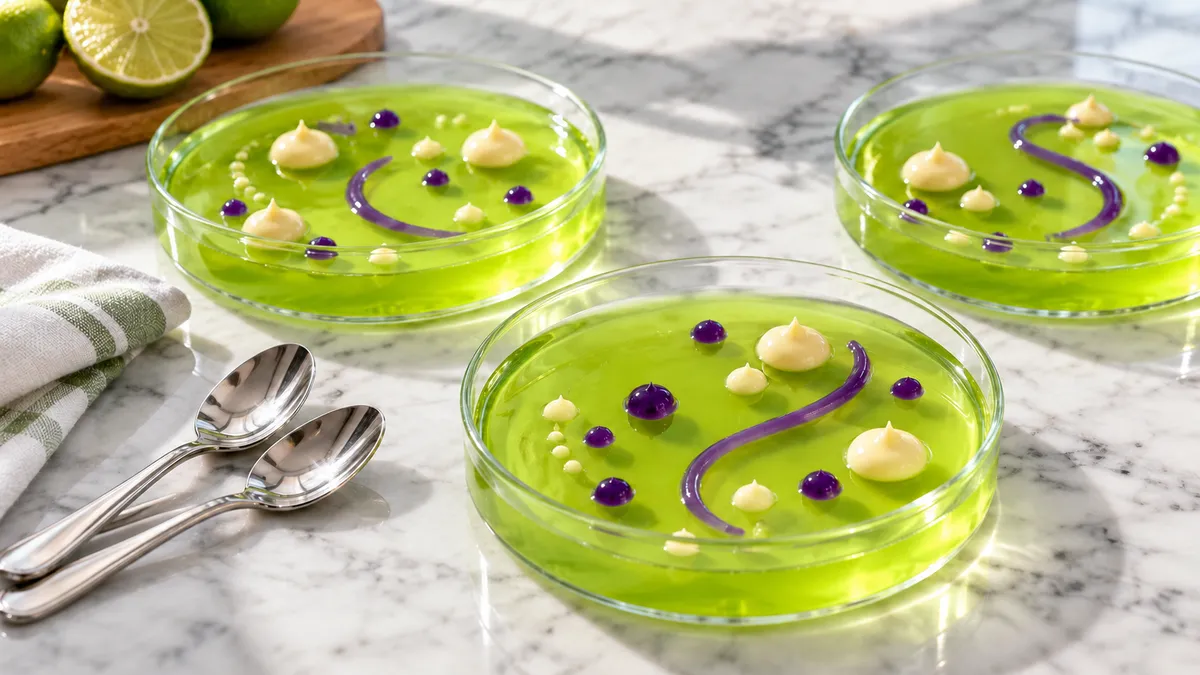
Petri dish jello shots are small gelatin desserts presented in shallow, round, food-safe containers and decorated to resemble pretend laboratory samples. This version is completely alcohol-free: a lime gelatin base is topped with tiny dots of vanilla pudding and food decorating gel.
The fun comes from the surface design, so you do not need a complicated layered recipe. Make the green base ahead, let it set, and add the edible decorations shortly before serving. Everything you put on the dessert should be a food ingredient; the pretend science theme does not involve growing anything.
One two-cup batch makes approximately sixteen 2-tablespoon portions. Your actual dish count depends on its usable capacity, so measure your containers before deciding how many to buy or fill.
Jump to: Recipe overview · Serving dishes · Make the desserts · Decoration ideas.
What Are Petri Dish Jello Shots?
They are party desserts served in dishes that resemble the shallow containers used in laboratories. The word shots describes the small portions here, not an alcoholic ingredient.
Some recipes using this name contain vodka or other spirits. This recipe contains no alcohol, and it is intended to be eaten with a spoon. Label the serving tray clearly if other party foods contain alcohol.
The decorative dots are pudding and food gel, not bacteria, mold, or a culture. You are arranging food on an ordinary gelatin dessert to create a visual effect.
If you are looking for the actual laboratory material or a crossword answer, our Petri dish gelatin guide covers that different question. This page stays focused on the edible party presentation.
Recipe at a Glance
| Detail | This recipe |
|---|---|
| Base | One 3 oz box regular lime gelatin dessert mix |
| Added liquid | 1 cup boiling water plus 1 cup cold water |
| Finished base | Approximately 2 cups |
| Portion size | Approximately 2 tablespoons, or 1 fluid ounce |
| Yield | Approximately 16 small portions, depending on containers |
| Decorations | Vanilla pudding and edible food decorating gel |
| Active preparation | About 15 minutes, including decorating |
| Chilling | At least 4 hours, or until set |
| Alcohol | None added |
The gelatin should be spoonable, not firm enough to pick up like a gummy. The shallow shape gives you a broad surface to decorate without requiring a large serving.
Choose Food-Safe Dishes Before You Start
Use only new containers whose manufacturer explicitly identifies them as suitable for food contact. A dish described as sterile, educational, or laboratory-grade is not automatically approved for serving food.
Check its temperature limits as well. A container suitable for a cold dessert may not be suitable for hot gelatin liquid. Dissolve the mix in a separate heatproof bowl and let the liquid reach an appropriate pouring temperature for the serving containers.
Never reuse laboratory dishes that have held cultures, chemicals, or nonfood materials. Cleaning them does not make them suitable serving equipment for this recipe.
Measure usable capacity, not just diameter
Before preparing the gelatin, put 2 tablespoons of cool water in one of your intended dishes. Check that there is comfortable space above the liquid for handling and for the lid, if using one. Empty and dry it afterward.
If that amount sits too close to the rim, use less per dish and prepare more dishes. A measurement such as 90 mm across does not tell you the usable volume, because depth and internal shape matter too.
Do not fill the lid as if it were a second serving dish unless its manufacturer approves that use. A lid may have a different shape and intended purpose from the base.
If you cannot find suitable containers
Use shallow food-safe dessert bowls or another approved serving container. The exact laboratory appearance is optional; food suitability and a practical portion come first.
Arrange the food-safe alternatives on a tray and use the same decoration idea. There is no need to buy an unidentified craft item just because it looks closer to a photograph.
Ingredients
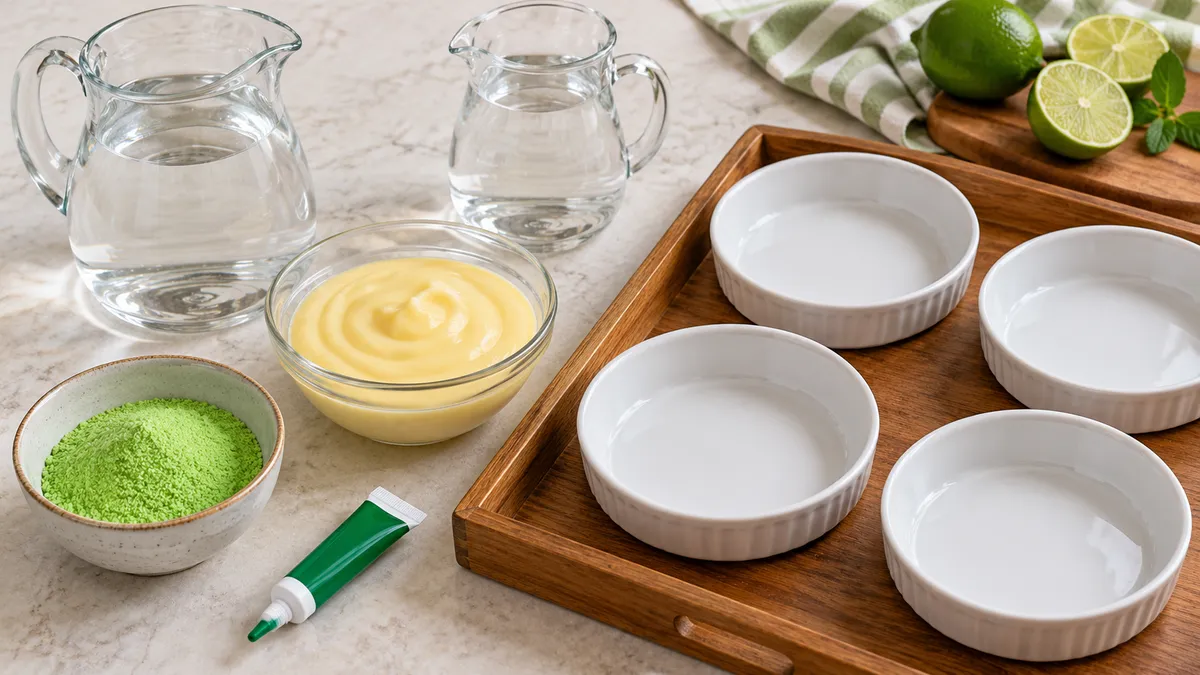
For the lime base:
- One 3 oz box regular lime gelatin dessert mix, approximately 85 g. Choose a box whose standard directions make about 2 cups of prepared gelatin.
- 1 cup boiling water, approximately 240 mL. Measure it carefully after heating.
- 1 cup cold water, approximately 240 mL. This completes the base liquid; do not add extra unmeasured water later.
For the decoration:
- 2 tablespoons prepared vanilla pudding, chilled, or another suitable smooth prepared pudding that works for your dietary needs.
- 1 teaspoon edible food decorating gel, in a contrasting color, for small dots and short lines. Use a product intended to be eaten, not craft paint or nonedible glitter.
You will also need small dessert spoons. The containers and any decorations placed outside them are serving equipment, not ingredients.
The quantities are a starting point for restrained decoration. You do not need to cover the entire surface with pudding. Leaving some transparent green gelatin visible makes the contrasting marks easier to see.
Print
Alcohol-Free Petri Dish Jello Shots
- Total Time: 4 hours 15 minutes
- Yield: 16 servings 1x
Description
Alcohol-free lime gelatin desserts in shallow food-safe dishes, decorated with tiny vanilla pudding dots and edible food gel.
Ingredients
- 1 box regular lime gelatin dessert mix, 3 oz (85 g), intended to make 2 cups prepared gelatin
- 1 cup boiling water (approximately 240 mL)
- 1 cup cold water (approximately 240 mL)
- 2 tablespoons prepared vanilla pudding, chilled
- 1 teaspoon edible food decorating gel, contrasting color
Instructions
- Use new food-contact-approved dishes suitable for the pouring temperature. Test usable capacity with cool water first, then dry. Arrange dishes on a level tray that fits the refrigerator.
- Empty the gelatin mix into a heatproof bowl. Add 1 cup boiling water and stir about 2 minutes until completely dissolved.
- Stir in 1 cup cold water. Let cool briefly if needed to reach a suitable pouring temperature for the containers while remaining liquid.
- Divide into approximately sixteen portions of 2 tablespoons each, or use smaller portions if required by dish capacity. Leave headroom.
- Refrigerate for at least 4 hours or until fully set, keeping the tray level. Cover once chilled.
- Shortly before serving, add tiny pudding dots and contrasting edible decorating gel dots or short lines. Serve chilled with little spoons.
Notes
Yield depends on usable dish capacity, not just diameter. Do not force 2 tablespoons into a dish with insufficient headroom. Use only new containers explicitly approved for food contact and the intended temperature, never previously used laboratory dishes. The decoration is food, not biological growth. No alcohol is added. Check gelatin, pudding and gel labels for dietary suitability. Refrigerate promptly and use within 3 days or any shorter product guidance. Images are AI-generated illustrations, not photographs of a tested batch.
- Prep Time: 15 minutes
- Chilling Time:
- Cook Time: 0 minutes
- Category: Dessert
- Method: No-bake
- Cuisine: American
Nutrition
- Serving Size: approximately 2 tablespoons gelatin base plus a little decoration
Keywords: petri dish jello shots, alcohol-free jello shots, science party gelatin desserts
How to Make Petri Dish Jello Shots Without Alcohol
1. Arrange the dishes
Place your clean, dry, food-safe dishes on a flat tray that fits the refrigerator. Leave enough room between them to move the tray without touching the gelatin surface.
Make sure the refrigerator shelf is level. A shallow layer shows a tilt more obviously than a deep dessert cup, and moving each dish individually increases the chance of spills.
2. Dissolve the lime gelatin
Empty the gelatin mix into a heatproof bowl. Add the measured boiling water and stir for about 2 minutes, until completely dissolved.
Look at the bottom of the bowl for granules. Stir gently but thoroughly instead of whisking lots of air into the mixture. A smooth, bubble-free surface gives you a cleaner background for the decorations.
The manufacturer’s lime gelatin product page describes the standard dissolve, add-cold-water, and refrigerate approach. Match the liquid amounts to the actual package size you buy; the recipe here specifies the small two-cup preparation.
3. Add the cold water
Stir in 1 cup cold water. Keep all the liquid measured; do not add juice, soda, or extra water as an unplanned addition.
If the mixture is still too hot for your chosen containers, let it cool briefly while remaining liquid. Check the container manufacturer’s instructions rather than guessing from how warm the bowl feels.
4. Portion into shallow layers
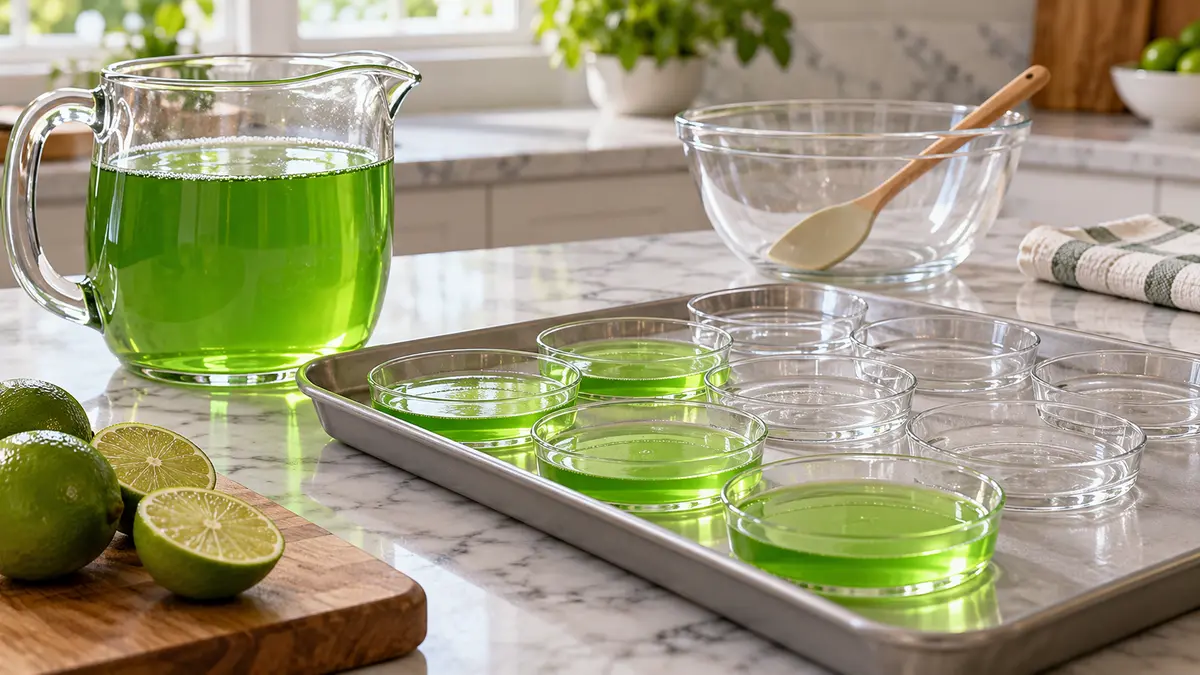
Transfer the liquid to a pouring jug if useful. Pour approximately 2 tablespoons into each suitable dish, or the smaller amount your capacity check indicated.
Keep headroom and leave space below any lid. If your dishes need a smaller fill, the batch will make more portions. Do not force the mixture into sixteen dishes just to match an estimated yield.
5. Refrigerate until fully set
Refrigerate the tray for at least 4 hours, or until the gelatin is set. Keep it level and avoid moving the dishes while the mixture is setting.
Do not assume the thin layer guarantees a particular shorter time. Refrigerator conditions, fill depth, and the mix you use all affect the result. Set the base first, then decorate.
6. Add edible pretend colonies
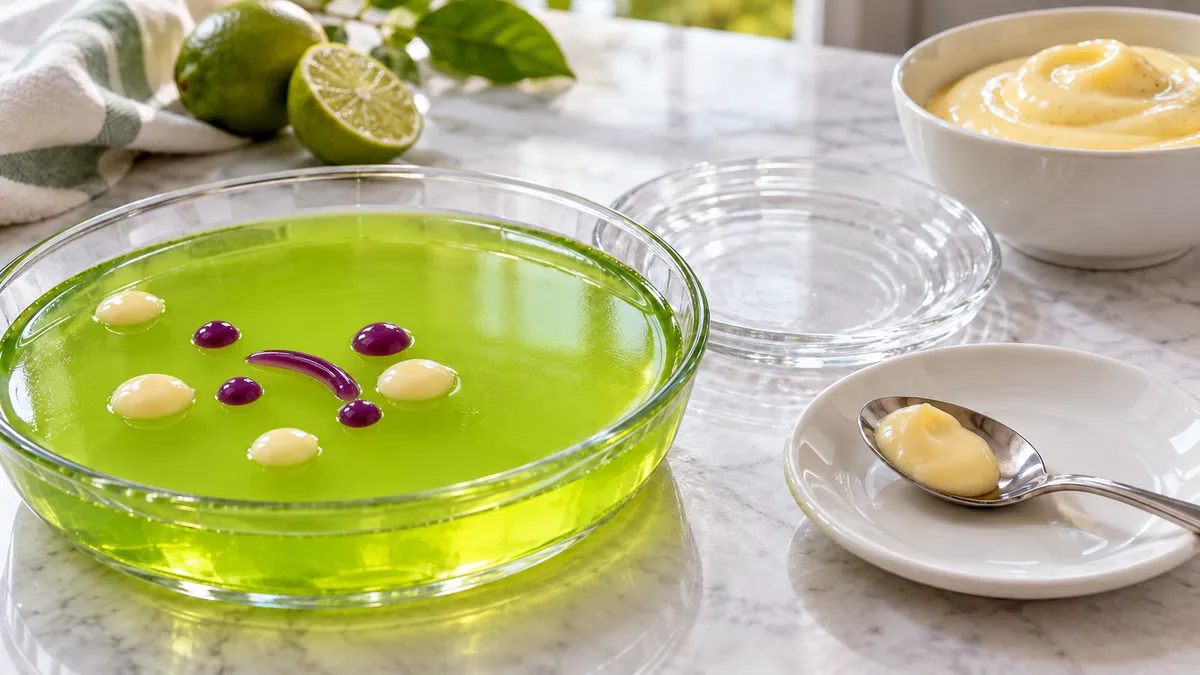
Shortly before serving, use the tip of a clean teaspoon to place tiny pudding dots on the set gelatin. Group a few dots together and leave other areas clear.
Add a few contrasting dots or short curved lines of edible decorating gel. Keep the designs small so they look deliberate and do not overwhelm the flavor.
Serve chilled with little spoons. If using lids, check that they do not touch or smear the decorations before closing them.
Three Simple Decoration Designs
Scattered dots
Place three small pudding dots on one side of the dish and one or two smaller dots elsewhere. Add a tiny colored gel mark near one cluster. The spacing creates the appearance of a pretend sample without requiring intricate piping.
Use less pudding than you think you need. You can add another dot, but scraping a large smear off the gelatin can damage the surface.
Rings and trails
Make a loose ring of tiny dots, then add a short gel trail nearby. Keep your spoon or gel tip above the surface rather than dragging it through the set gelatin.
This version works best when the base is fully set and the decorating gel has a controllable tip. If the gel flows too quickly, use dots instead of trying to draw long lines.
Contrasting specimen colors
Prepare separate batches in different flavors if you want a colorful tray. Use the full package instructions for each batch, and keep each flavor in its own bowl.
Our green apple jello recipe provides a separate apple-flavored preparation. If using its three-cup Sonic batch, calculate portions from that volume rather than applying the two-cup yield here.
The dish presentation is the common theme; the flavor and packet quantities remain separate recipe decisions.
Why Decorate Shortly Before Serving?
Pudding and gel can spread, bleed color, or lose definition during storage. Decorating near serving time gives you a better chance of keeping the small marks distinct.
Store the set base covered and keep the pudding refrigerated separately until needed. Use clean utensils when transferring small amounts to the desserts.
If you want to plan the appearance ahead, sketch the dot placement on paper. There is no need to practice repeatedly on the food itself or leave a decorated tray out while deciding how every dish should look.
Avoid putting fresh fruit, candy, or other extras into the liquid base without a recipe designed for them. For this version, the decorations belong on top after chilling.
Planning Portions for a Party
The base makes approximately 2 cups, equal to 32 tablespoons. At 2 tablespoons per dish, that gives about sixteen small servings before allowing for a little mixture left in the bowl or jug.
For smaller usable containers, divide the total volume by your actual fill amount. For example, a 1-tablespoon layer would make roughly twice as many portions, but each is only a small taste.
If serving several desserts, keep the shallow presentation modest and provide spoons. If these are the main dessert, guests may want more than one small dish. Plan the total amount accordingly rather than making each container too full.
For a larger group, multiply complete batches. Keep the ratio and package size consistent, and consider refrigerator shelf space before increasing the recipe. Several trays that cannot sit flat are harder to manage than a smaller, well-planned batch.
Make-Ahead, Storage, and Transport
Make the gelatin base a day ahead if convenient. Once set, cover it and keep refrigerated. Add the pudding and gel shortly before serving rather than storing elaborate designs for several days.
Use within 3 days as a conservative household limit, or follow any shorter instructions for your pudding, mix, or decorations. This is not a shelf-stable dessert.
FDA food-storage guidance recommends keeping the refrigerator at 40°F or below and refrigerating perishables within two hours, or one hour above 90°F. Apply that care to the finished desserts and pudding topping.
For transport, use an insulated cooler with cold packs and keep the dishes level. Food-safe lids can help protect them, provided the lids do not contact the decorations.
For a party table, display a small tray and replenish it from the refrigerator. Do not use the science theme as a reason to leave the desserts warm for the whole event.
Troubleshooting the Presentation
| Problem | What to check | Adjustment |
|---|---|---|
| Gelatin is too soft | Liquid measurement and chilling | Follow the correct package ratio and allow more time if needed |
| Surface is grainy | Incomplete dissolution | Stir fully during the hot-water stage next time |
| Layer is uneven | Tray or refrigerator shelf is tilted | Use a level surface before filling |
| Dishes overflow | Usable capacity is smaller than assumed | Reduce the fill and prepare more dishes |
| Pudding spreads into a smear | Too much topping or a soft base | Set completely and use smaller dots |
| Gel colors bleed | Decoration stored too long | Decorate close to serving |
| Lids flatten the design | Not enough headroom | Fill less or serve on a protected tray without touching the topping |
Do not fix a runny batch by sprinkling dry gelatin directly over individual dishes. If a safely handled batch has not set, consult the mix instructions and check what was measured before choosing a correction.
Ingredient Substitutions and Dietary Questions
Other gelatin flavors
Use a flavored mix intended to make the same two-cup volume and follow its own directions. Lime, lemon, cherry, and other flavors create different colors and tastes; color alone does not make them equivalent.
Sugar-free mixes
A sugar-free mix may use a much smaller packet weight. Follow its prepared-volume instructions instead of weighing out an amount equal to the regular mix. Pudding and decorating gel can still contain sugar.
Dairy-free decoration
Choose a suitable smooth prepared dairy-free pudding and check its ingredients. It may behave differently, so start with tiny dots on one dish before decorating the whole tray.
Vegetarian, vegan, or halal requirements
Do not assume a gelatin dessert meets these requirements. Check the product and any relevant certification. Agar is not a gram-for-gram substitute with identical preparation and texture; our agar-agar versus gelatin guide explains that different kitchen choice.
This page does not provide a separate agar formula or claim that the boxed recipe is pork-free. The right description depends on the actual products you use.
FAQS
What are Petri dish jello shots?
They are small gelatin desserts served in shallow food-safe dishes and decorated to resemble pretend laboratory samples. This recipe is alcohol-free and eaten with a spoon.
Can I make Petri dish jello shots without alcohol?
Yes. This version uses a two-cup preparation of lime gelatin with 1 cup boiling water and 1 cup cold water. No vodka or other alcohol is added.
Can I use ordinary laboratory Petri dishes for food?
Do not assume they are suitable. Use new containers explicitly approved by their manufacturer for food contact and the intended pouring temperature. Never use dishes that have held cultures, chemicals, or other nonfood materials.
How many dishes does one batch fill?
Approximately sixteen at 2 tablespoons each from a two-cup batch. Actual yield depends on usable dish capacity and filling losses. Measure the containers first and leave headroom.
How do I make the fake bacteria decoration?
After the base sets, add tiny dots of prepared vanilla pudding and contrasting edible decorating gel. These are food decorations, not microorganisms. Add them shortly before serving.
How long do they take to set?
Allow at least 4 hours in the refrigerator, or until fully set. A shallow layer does not guarantee a particular shorter chilling time.
Can I use green apple gelatin instead of lime?
Yes, as a different flavor variation. Follow that product’s own water quantities and calculate portions from its finished volume. A three-cup Sonic batch is larger than the two-cup batch here.
Can I make them the night before?
Yes. Prepare and refrigerate the base, cover once set, and keep the decorations separate. Add the pudding and gel shortly before serving for clearer designs.
Are these vegetarian or halal?
Not automatically. Check the gelatin product, pudding, decorations, and any relevant certification. A vegan alternative requires a separately developed recipe rather than a direct powder swap.
Are these the same as agar culture plates?
No. They are food desserts with pretend decorations. They do not contain a laboratory culture medium and should not be used for growing microorganisms.