
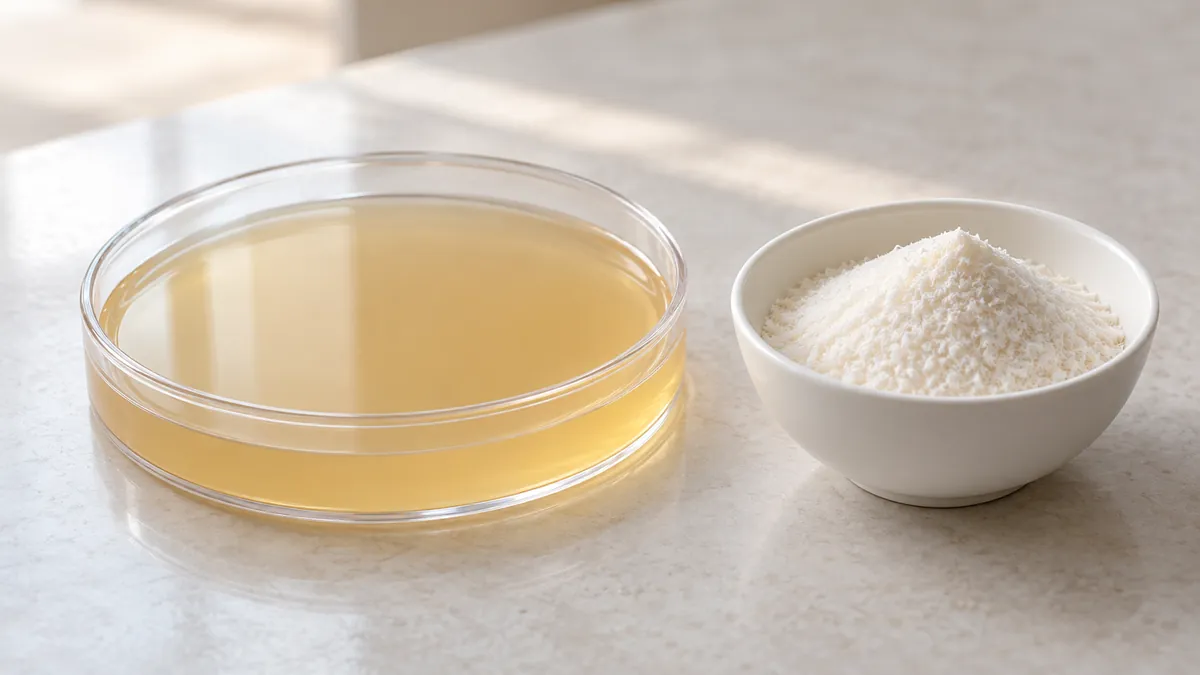
The gel commonly used in a Petri dish is agar, not ordinary dessert gelatin. If you are solving a four-letter crossword clue such as “Petri dish gelatin,” AGAR is usually the answer to check against the crossing letters. In a laboratory, the full material is often an agar-based culture medium, which contains ingredients beyond the gelling agent.
Gelatin can form a gel inside a shallow dish, but that does not make it equivalent to an agar plate. The two ingredients have different origins, textures, and behavior when warmed.
This guide explains the Petri dish gelatin name, what the gel contains, whether gelatin can replace agar, and how the laboratory use differs from making a food gel at home.
Jump to: Crossword answer · Agar vs gelatin · Ingredients · Mixing the two.
What Is Petri Dish Gelatin Called?
The short answer is agar, also called agar-agar. People sometimes describe it as gelatin because it looks like a firm jelly, but the similarity in appearance does not make the ingredients identical.
It also helps to distinguish the container from its contents. A Petri dish is the shallow, lidded vessel. An agar plate is a dish containing a layer of agar-based material. A culture medium is the formulation used to support a particular laboratory purpose.
| Term | What it means |
|---|---|
| Petri dish | The container, not a gelling ingredient |
| Agar or agar-agar | A seaweed-derived gelling material |
| Agar gel | A gel formed using agar |
| Agar plate | A dish containing a solidified agar-based layer |
| Culture medium | A preparation with ingredients selected for a laboratory application |
| Gelatin | An animal-collagen-derived gelling ingredient |
These distinctions explain why a shopping search for “Petri dish gelatin” can produce several different products. An empty dish, plain agar powder, and a prepared culture plate are not the same purchase.
Petri Dish Gelatin Crossword Clue
For a four-letter answer, try AGAR. It is the likely intended word when a clue describes a jelly-like material associated with laboratory dishes.
The clue’s use of “gelatin” is descriptive rather than a precise ingredient definition. Agar has a gel-like appearance, so a puzzle may use the everyday comparison even though agar is not animal gelatin.
Check the letter count and crossings before entering an answer. If the puzzle gives a different length, look at the full wording rather than assuming every clue uses exactly the same term. “Agar-agar” is a longer name for the ingredient, but punctuation and spelling conventions vary between puzzles.
You do not need a recipe or a laboratory product to answer the clue. The useful connection is simply: Petri dish gel → agar.
What Kind of Gel Do You Put in a Petri Dish?
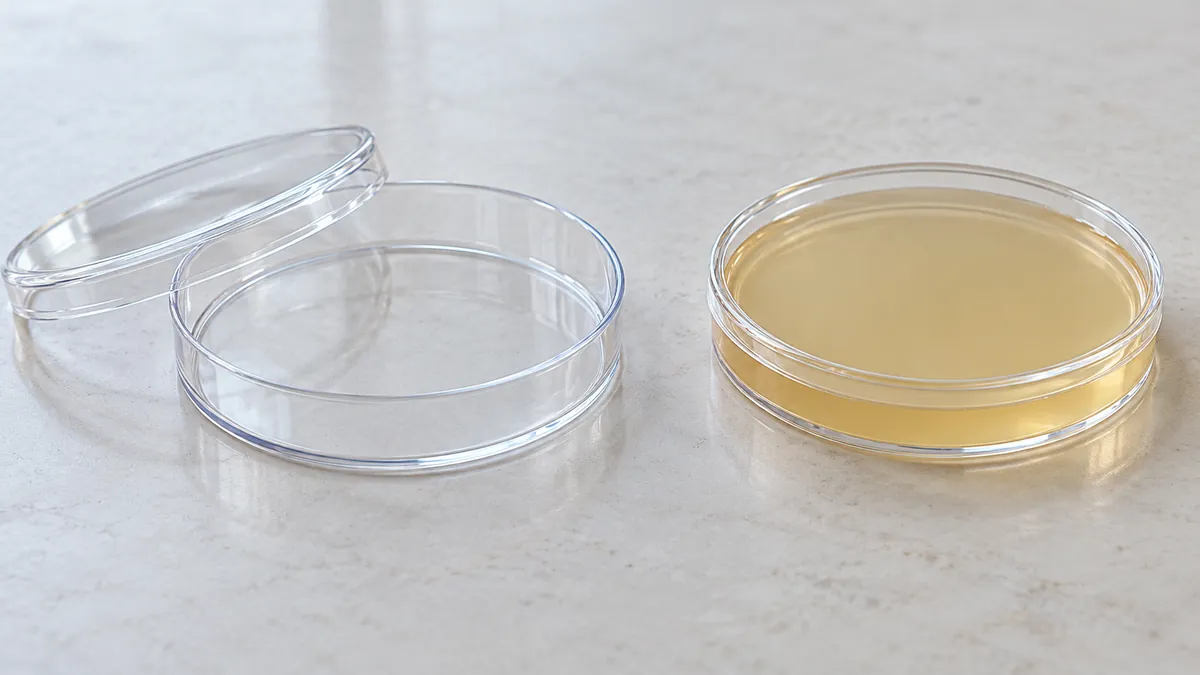
In many microbiology applications, the surface is an agar-based medium. Agar helps create the solid structure; the rest of the formulation determines its other properties.
Think of the gel structure and the recipe around it as separate decisions. Two plates can both contain agar while having different ingredients and serving different purposes. That is why a photograph alone does not identify a medium.
The FDA’s Bacteriological Analytical Manual media index lists many distinct laboratory media. There is no single universal mixture called “Petri dish gelatin” that is suitable for every application.
The same distinction matters outside the lab. Plain agar in a pantry is a gelling ingredient. A formulated laboratory medium is a product with a particular intended use. Neither should be identified solely by whether it looks clear, yellowish, or jelly-like.
Why Is Agar Used Instead of Gelatin?
Agar and gelatin behave differently, particularly when warmth and microorganisms are involved.
The University of Utah’s teaching notes on agar and gelatin explain two practical drawbacks of gelatin in this setting: it can soften or melt under conditions where an agar surface remains firm, and some bacteria can digest it. A surface that changes during an activity becomes harder to interpret.
That does not mean gelatin is a poor ingredient. Its soft texture and melting behavior are useful in many desserts. They simply do not make it an interchangeable structural material for a laboratory plate.
| Property | Agar | Gelatin |
|---|---|---|
| Source | Extracted from certain red algae | Derived from animal collagen |
| Typical gel character | Firm, with a different bite from gelatin desserts | Often softer and more elastic in food applications |
| Behavior when warmed | More resistant to melting than ordinary gelatin gels | Can soften or melt much sooner |
| Laboratory substitution | Chosen as part of a specified medium | Not an automatic replacement for agar |
| Common food role | Firm jellies and other suitable preparations | Desserts, mousses, marshmallows, and other suitable preparations |
For the wider cooking comparison, see our agar-agar vs gelatin guide. This page focuses on the specific terminology used around Petri dishes.
Can You Use Gelatin for a Petri Dish?
You can put a gelatin gel in a suitable shallow container. That answers the physical question, but it does not establish that the result is a suitable culture plate.
There are three different projects people may have in mind:
- A visual model: You want a shallow jelly-like layer to show what a plate looks like.
- An edible presentation: You want a food gel served in a shallow, food-contact-safe container.
- A microbiology activity: You want a medium appropriate for an instructor-approved investigation.
Gelatin can be relevant to the first two, provided the ingredients and container suit the purpose. The third requires the intended medium and the activity’s handling procedures, not just a liquid that sets.
Adding more gelatin until a mixture feels firmer does not establish that it has become equivalent to agar. Firmness is only one property, and it does not prove sterility, suitability, or predictable behavior throughout an activity.
Petri Dish Gelatin Ingredients: What Is Actually in the Gel?
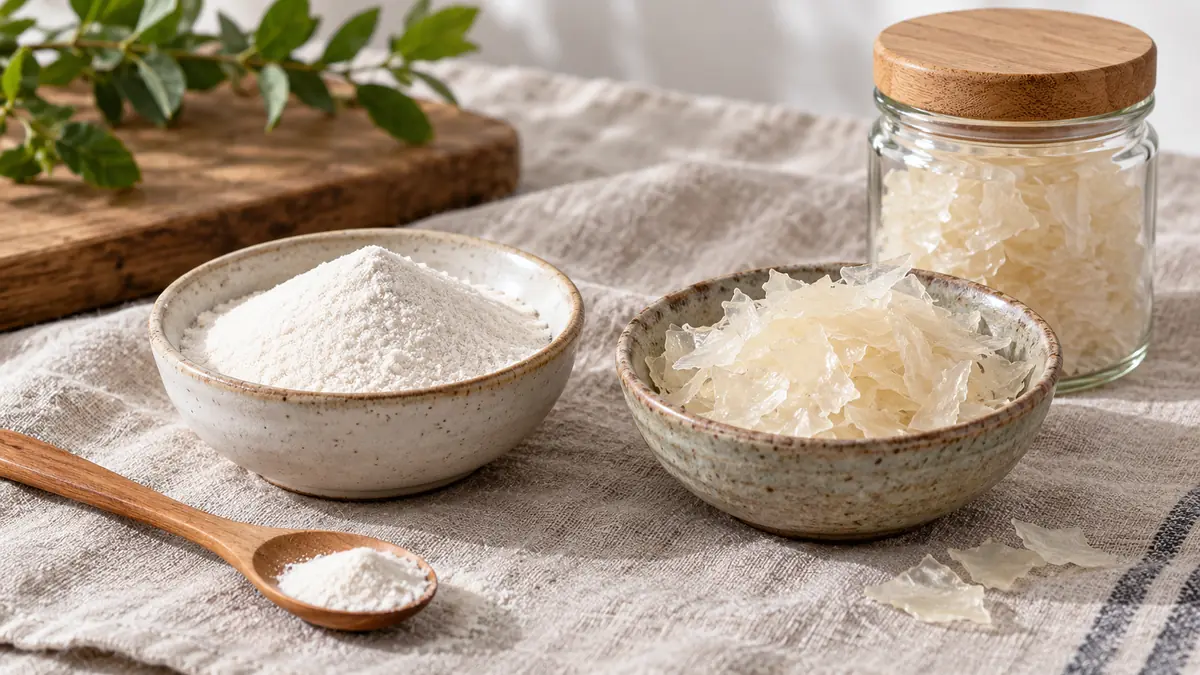
The answer depends on whether you mean a food gel or a laboratory medium.
In a food gel
A simple culinary preparation usually starts with a food-safe liquid and a gelling ingredient. Flavor, sweetness, and color depend on the recipe. A fruit jelly and a plain demonstration gel can look different while using the same gelling ingredient.
For an edible result, every ingredient must be intended for food use. The container matters too: “clean” and “food-contact-safe” are different properties.
In a laboratory medium
An agar-based medium generally includes water, the gelling material, and other ingredients selected for its intended application. Those may include nutrient components or salts. The exact formulation is defined by the relevant method or product.
An ingredient category is not a working recipe. Knowing that a medium contains agar and nutrients does not identify which preparation it is, whether it has been prepared appropriately, or what it is intended to support.
If you are reading a product label, distinguish plain agar powder, dehydrated formulated medium, and prepared plates. A ready-made medium may already contain the gelling component, so the name on the container needs to be read in full.
What Is Agar Gelatine?
“Agar gelatine” or “agar gelatin” is often an informal name for agar used as a gelatin alternative. It does not necessarily mean that the product contains animal gelatin.
The FAO/JECFA specification for agar defines agar as a material extracted from certain red algae and identifies it as a polysaccharide. Gelatin is a different type of material: a protein ingredient derived from collagen.
Read the ingredient list rather than relying on a loose product nickname. A package may contain pure agar or a mixture. A flavored dessert product may include sugar and other ingredients alongside its setting agent.
If your question concerns an animal-free dessert, our vegan gelatin substitutes guide covers that kitchen decision. It is a separate question from choosing material for a culture plate.
Can I Add Gelatin to Agar-Agar?
Yes, both ingredients can occur in the same formulation. Their presence together does not make them interchangeable or guarantee a useful texture at any ratio.
For example, the FDA lists a laboratory medium specifically called Gelatin Agar. Its name reflects a defined formulation containing both materials. It does not mean that all agar plates contain gelatin.
In cooking, combining gelling agents is also a formulation choice. Each ingredient brings its own behavior, so adding one to the other without a suitable recipe can change the texture in unexpected ways.
For a dessert, begin with a recipe developed for the combination. For a laboratory application, use the specified medium. A general “add some gelatin” instruction leaves too many unanswered questions in either setting.
Petri Dish Gelatin Substitute: Which Ingredient Fits the Job?
The right substitute depends on what the original ingredient was supposed to do.
| Your goal | Useful direction |
|---|---|
| Solve a four-letter crossword clue | Check AGAR against the crossing letters. |
| Understand the usual laboratory gel | Look for the agar-based medium specified for the application. |
| Make a food gel without animal gelatin | Choose a culinary recipe designed around a suitable alternative. |
| Make a shallow visual model | Use an appropriate food gel and container, without adding microbial samples. |
| Replace agar in a laboratory method | Do not assume a pantry thickener is equivalent; use the method’s specified material. |
Pectin, starch, gelatin, and agar are not a single category of interchangeable powders. A material that thickens a sauce may not produce the same kind of self-supporting gel, and a material that sets a dessert may not behave like a culture medium.
For a kitchen comparison, our pectin vs gelatin guide explains another common source of confusion. Keep those food substitutions separate from laboratory-media decisions.
How to Make Agar for Petri Dishes at Home: Clarify the Goal First
This search can mean either a home gel demonstration or a microbiology project. They should not share an improvised recipe simply because both use a shallow dish.
For a gel-only demonstration, use a food-grade product and follow its package directions in a suitable, heat-safe, food-contact-safe container. The activity can show a liquid becoming a gel without collecting or growing microorganisms.
You do not manufacture agar itself by mixing gelatin, sugar, or broth. Agar is the ingredient you purchase. Preparing an agar gel and producing the agar material from its source are different processes.
For actual culture plates, follow an educator-approved activity using the specified materials and procedures. Preparing a dish includes considerations beyond setting the gel, including the intended organisms, handling, and disposal.
The American Society for Microbiology’s teaching-laboratory guidelines explicitly address risk assessment, training, and laboratory practices. This ingredient guide is not a substitute for that framework or an organism-specific protocol.
What About Agar Plates for Growing Bacteria?
A bacterial culture plate is a laboratory tool, not a food recipe. Its purpose and formulation need to match the activity, and the appearance of a finished plate does not reveal whether it is appropriate to handle.
Unknown material collected from a surface is not automatically harmless. ASM’s guidance for at-home microbiology kits says that colonies arising from environmental sampling should be observed in sealed plates and not handled further.
For a school assignment, ask the instructor which prepared materials and approved activity to use. Follow the activity’s disposal instructions. A picture of colored growth is not enough to identify the organisms or establish their safety.
If the goal is to learn about gel texture, a no-culture demonstration answers that question without turning it into a microbial-growth project.
How to Make a Petri Dish: Container vs Contents
Strictly speaking, making the gel does not make the Petri dish. The dish is the vessel that holds it.
For a visual model or an edible presentation, a shallow food-safe container may provide the shape you need. It should be suitable for the temperature and the intended food contact. Do not assume that a craft container or a laboratory dish has those properties.
For actual laboratory work, use the dish specified by the activity. An improvised lid or reused food container may resemble a Petri dish without having the properties required for that purpose.
Keeping the nouns separate makes instructions easier to follow: choose a container, choose a material, and identify the purpose. None of those decisions automatically answers the other two.
Food-Grade Agar vs Laboratory Media
Food-grade agar is sold for food preparation. Laboratory media are sold for analytical, research, or teaching applications. A familiar ingredient in the name does not make the complete laboratory product something to eat.
Conversely, a pantry product is not automatically a prepared laboratory medium. Its intended use, formulation, and product specifications matter.
The distinction also applies after use. A dish associated with a microbiology activity should not be treated as a serving dish or a dessert mold. Keep food projects and culture work separate from the start.
For edible gelatin preparations, use dedicated kitchen equipment and a food recipe, such as our unflavored gelatin recipe. That is the appropriate route when your goal is a dessert rather than a laboratory plate.
Common Petri Dish Gelatin Misunderstandings
A jelly-like appearance proves that it is gelatin
It does not. Different materials can form gels. The ingredient list or medium name gives more useful information than appearance alone.
Plain agar and nutrient agar are the same product
They are not necessarily the same. One names a gelling ingredient; the other refers to a formulated medium. Check the complete label and intended use.
A firmer homemade gel must be a better culture plate
Firmness does not establish suitability. The purpose, formulation, preparation, and handling all matter in a laboratory context.
Agar is animal gelatin with a different name
Agar and gelatin have different sources and chemical identities. “Agar gelatine” is often a loose description of agar’s function, not evidence that it contains animal gelatin.
Mixing the two creates a universal replacement
A combination is still a formulation that needs a purpose. A named medium or a developed food recipe provides that context; an arbitrary mixture does not.
FAQS
What is Petri dish gelatin called?
Usually agar or agar-agar. In a laboratory, the complete gel is often an agar-based culture medium, which includes ingredients beyond the gelling agent.
What is the answer to “Petri dish gelatin” in a crossword?
AGAR is the likely four-letter answer. Check the full clue and crossing letters because a puzzle’s wording and required length can vary.
Can you use gelatin for a Petri dish?
Gelatin can form a gel in a suitable dish, but it is not an automatic substitute for agar in culture plates. It behaves differently when warmed, and some microorganisms can break it down.
What kind of gel do you put in a Petri dish?
Many microbiology plates contain an agar-based medium. The exact medium depends on the application; the dish itself does not determine the formulation.
What are Petri dish gelatin ingredients?
For a laboratory plate, the ingredients depend on the specified medium. Water, agar, and other defined components serve different roles. A food gelatin mixture is a separate preparation.
What is a substitute for gelatin in a Petri dish?
If you mean the usual laboratory gelling material, the word you are looking for is often agar. If you mean a food gel, choose a recipe designed around an appropriate culinary alternative.
Can I add gelatin to agar-agar?
Yes, a defined formulation can contain both. The FDA lists a medium called Gelatin Agar. That does not mean arbitrary mixtures are equivalent to a specified laboratory medium or a developed dessert recipe.
What is agar gelatine?
It is often an informal name for agar used as a gelatin alternative. Agar comes from certain red algae and is not animal-collagen gelatin. Read the label to see whether a product is pure agar or a blend.
Can I make agar plates for growing bacteria at home?
Microbiology activities require appropriate materials, supervision, and handling and disposal procedures. Use an instructor-approved activity rather than adapting a dessert recipe or treating unknown growth as harmless.
Can you eat the gel from a laboratory Petri dish?
Do not eat laboratory media or material used in a culture activity. For an edible gel, use food-grade ingredients, dedicated kitchen equipment, and a food-contact-safe container.