
Psyllium husk powder, whole husk, and capsules all provide the same basic gel-forming fiber, but they differ in texture, convenience, serving size, and how quickly they thicken in liquid. Powder is usually the easiest format for mixing into a drink, whole husk has a coarser texture, and capsules are the most convenient to carry—but often require several capsules to deliver the same amount of fiber as a powder serving.
This article answers a different question from our other psyllium pages. If you want preparation instructions, use our psyllium husk drink guide. If your question is specifically about weight management, see psyllium husk for weight loss. And if you are deciding between two different fiber foods, see psyllium husk vs chia seeds.
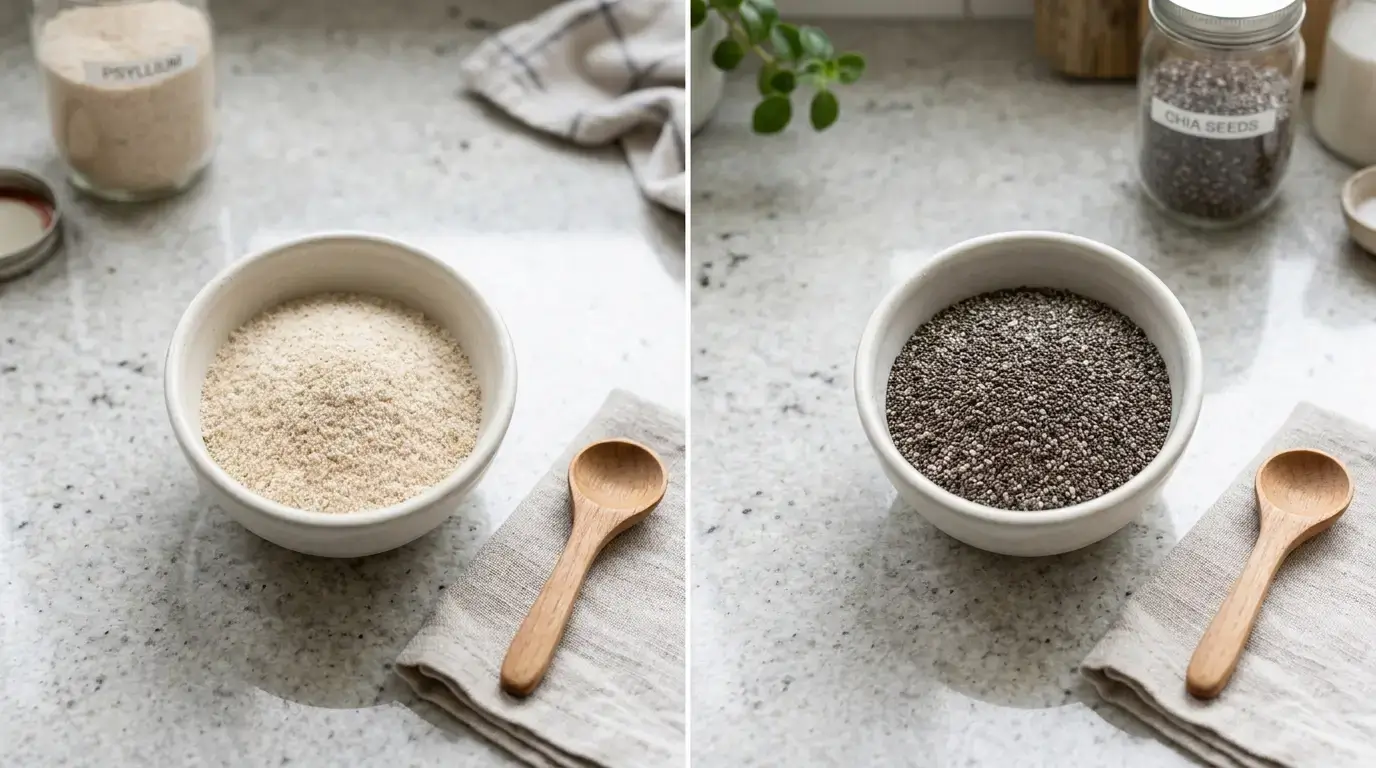
Psyllium Husk Powder vs Whole Husk vs Capsules: Quick Comparison
| Format | Best For | Main Advantage | Main Drawback |
|---|---|---|---|
| Psyllium husk powder | Drinks, quick mixing | Easy to measure and disperse | Thickens very quickly |
| Whole psyllium husk | People who prefer a coarser texture | Less finely milled | Can feel grainier in liquid |
| Psyllium capsules | Travel and convenience | No mixing required | May require many capsules per serving |
What Is Psyllium Husk Powder?
Psyllium husk powder is simply psyllium husk that has been milled into a finer texture. Because the particles are smaller, the powder disperses rapidly when stirred into water and begins to thicken quickly.
This makes powder convenient for anyone who wants a fast fiber drink, but it also means you need to work quickly. If you leave it sitting in a glass for several minutes, the liquid can become much thicker.
Powder is often the easiest format to measure by weight or labeled serving size. It also tends to be the format most commonly used in flavored fiber products.
What Is Whole Psyllium Husk?
Whole psyllium husk is less finely milled. It usually looks like light, flaky pieces rather than a uniform powder.
When added to water, whole husk still absorbs liquid and forms a gel, but the texture can feel different from powder. Some people prefer it because the drink can feel less dense if consumed promptly. Others dislike the visible flakes and prefer the smoother texture of powder.
From a fiber perspective, both formats are still psyllium. The key is not whether one is “stronger,” but how many grams of psyllium you actually take.
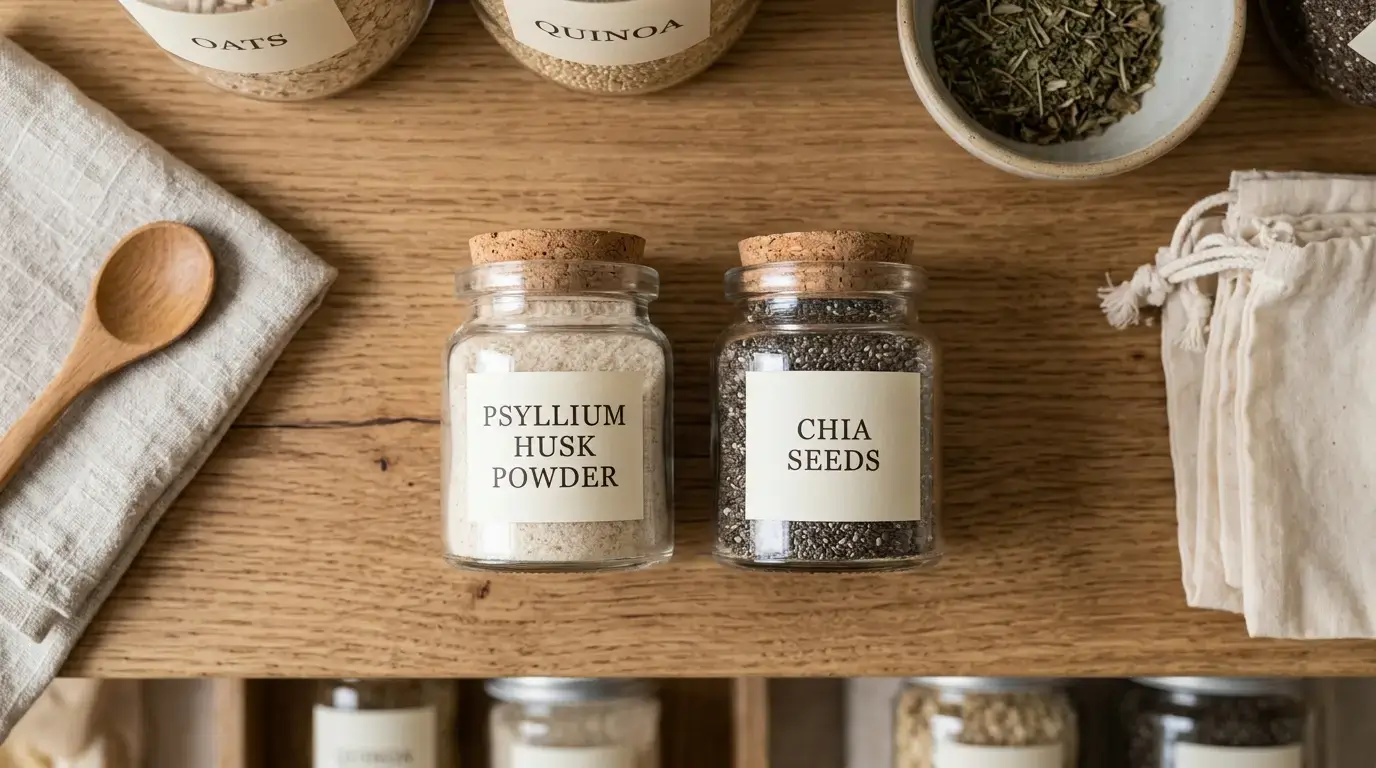
What Are Psyllium Husk Capsules?
Psyllium capsules contain powdered or finely milled psyllium inside a capsule shell. They are attractive because you do not have to stir a thick drink.
The main limitation is dose. One capsule usually contains much less psyllium than a full powder serving, so the label may require multiple capsules to reach the intended amount.
That is why you should compare grams of psyllium per serving, not simply the number of capsules.
Capsules still require adequate water. Swallowing a fiber capsule does not eliminate the need for liquid because the psyllium will expand after the capsule dissolves.
Which Form Has the Most Fiber?
There is no universal winner. The fiber content depends on the product and serving size.
A tablespoon of one brand of whole husk cannot automatically be compared with a tablespoon of another brand of powder because milling changes volume. Capsules add another variable because each capsule contains a relatively small amount.
The best comparison is the nutrition or supplement label:
- grams of psyllium per serving;
- grams of dietary fiber per serving;
- number of capsules per serving if applicable;
- serving size in grams, teaspoons, or capsules.
Which Form Mixes Best With Water?
Powder usually disperses most evenly, especially if you stir immediately. Whole husk can feel more textured, and capsules require no mixing at all.
If your main goal is to make a drink, powder is usually the easiest starting point. Our dedicated Psyllium Husk Drink guide explains the safe mixing sequence, water requirement, and timing in detail.
Which Form Is Best for Beginners?
For most beginners, powder is the most straightforward because the serving size is easy to see and the preparation method is simple.
Whole husk may be better if you dislike the dense texture of finely ground powder. Capsules may be better if convenience is the main concern, but beginners should read the label carefully because a serving may be several capsules rather than one or two.
Which Form Is Best for Constipation?
Psyllium is widely used as a bulk-forming laxative for occasional constipation. Powder, whole husk, and capsules can all provide psyllium fiber.
The important factors are:
- the actual amount of psyllium taken;
- enough water;
- consistent use according to the label;
- not increasing the dose too quickly.
The format itself matters less than using the product correctly.
Which Form Is Best for Weight Loss?
No format has a special weight-loss advantage simply because it is powder, whole husk, or a capsule.
Psyllium can increase fullness, but that does not mean any one formulation reliably causes significant weight loss. Our separate evidence review on psyllium and weight loss covers that question so we do not duplicate the same research here.
Psyllium Husk Powder vs Capsules
If convenience is your priority, capsules are easier. If cost per gram and flexibility are more important, powder often makes more sense.
Powder also allows you to see exactly how it hydrates, while capsules hide the fiber until the shell dissolves.
The tradeoff is texture. Some people strongly dislike drinking psyllium and find capsules easier to stick with.
Whole Psyllium Husk vs Powder
The main difference is particle size.
Powder is more finely ground, so it hydrates more quickly. Whole husk is coarser and can remain more visibly textured in the glass.
Neither form is automatically more effective. If the labeled serving delivers the same amount of psyllium fiber and both are taken with enough liquid, the nutritional difference is usually small.
Does Finely Ground Psyllium Work Faster?
Finely ground powder may thicken faster in a glass because more surface area is exposed to water. That does not necessarily mean it produces a stronger health effect.
The practical consequence is simply that powder should be stirred and consumed promptly.
Flavored vs Unflavored Psyllium Powder
Flavored products can make psyllium easier to drink, but check the ingredient list.
Depending on the brand, flavored powders may contain:
- sugar;
- non-nutritive sweeteners;
- citric acid;
- colorings;
- flavoring agents.
If your priority is a simple fiber supplement, unflavored psyllium gives you more control over what you add. You can flavor it yourself with lemon or another low-calorie ingredient.
What Should “Best Psyllium Husk” Actually Mean?
The phrase best psyllium husk is often treated like a brand-ranking question, but a more useful way to choose is by label and format.
Look for:
- a clearly stated amount of psyllium per serving;
- simple ingredient lists if you want plain fiber;
- clear mixing and water instructions;
- a format you can realistically use consistently;
- minimal added sugar if you are choosing a flavored powder.
If you are comparing psyllium with other fiber supplements rather than other psyllium formats, our fiber supplement comparison covers psyllium, glucomannan, and chia.
Does Psyllium Powder Need More Water Than Capsules?
Both need adequate liquid. Do not assume capsules are safer to take with only a sip of water.
OTC psyllium labels commonly direct users to take each serving with at least 8 ounces (240 mL) of liquid. Follow the exact directions on your product, because formulations vary.
Can You Put Psyllium Powder in Smoothies?
You can, but psyllium thickens quickly and can turn a smoothie very dense. If you use it in a smoothie, drink it soon after blending and make sure the drink contains enough liquid.
A thick smoothie is not a substitute for proper hydration.
Can You Bake With Psyllium Husk Powder?
Yes. Psyllium is often used in gluten-free and low-carb baking because its gel-forming fiber can improve structure and moisture retention.
However, baking recipes may specify either whole husk or powder, and the two are not always interchangeable by volume. Powder is more concentrated by volume because it is more finely milled.
For baking, follow the recipe’s specified form and gram weight whenever possible.
How to Switch From Capsules to Powder
Do not convert by guessing.
First, look at how many grams of psyllium are in one labeled capsule serving. Then compare that with the grams in one serving of your powder.
For example, if the capsule label gives 3 grams per full serving and the powder label gives 5 grams per serving, those are not equivalent doses even if both are called “one serving.”
Safety Is the Same for Every Format
Powder, whole husk, and capsules all swell when exposed to liquid. The most important safety rule does not change with format.
Take psyllium with enough liquid. Do not swallow dry powder or dry husk. Capsules should also be taken with a full glass of water.
Seek medical attention if you experience difficulty swallowing, difficulty breathing, chest pain, or vomiting after taking psyllium.
If you have swallowing problems, unexplained abdominal pain, nausea, vomiting, or a persistent change in bowel habits, ask a healthcare professional before using psyllium.
Psyllium and Medication Timing
Psyllium can affect the absorption of some oral medications. Many OTC labels recommend separating prescription medicines from psyllium by at least two hours.
Some medicines may require different timing, so check the instructions for your specific medication or ask a pharmacist.
Which Psyllium Form Should You Choose?
Choose powder if you want the easiest format for drinks and precise measuring.
Choose whole husk if you prefer a coarser texture or use psyllium in recipes that specifically call for whole husk.
Choose capsules if portability and convenience matter more than the number of pills required.
None of these forms is universally best. The best one is the format that gives you an appropriate amount of psyllium, fits your routine, and is used with enough liquid.
Bottom Line
Psyllium husk powder is not inherently better than whole husk or capsules. It is simply more finely milled and often easier to mix into drinks. Whole husk offers a coarser texture, while capsules are more portable but may require several pills per serving.
Compare actual grams of psyllium, not package claims or spoon sizes. And regardless of format, adequate water remains essential.
FAQS
Is psyllium husk powder better than whole husk?
Not necessarily. Powder disperses faster and is easier to measure into drinks, while whole husk has a coarser texture and may feel easier to tolerate for some people. The best choice depends on how you prefer to take it and the serving size on your product label.
Are psyllium capsules as effective as powder?
Capsules can provide the same type of psyllium fiber, but you may need several capsules to match the amount of fiber in one powder serving. Always compare the actual grams of psyllium per serving rather than the number of capsules.
What is the difference between psyllium powder and whole husk?
Whole husk is coarser and less finely milled. Powder is ground more finely, so it hydrates and thickens faster. Both still require adequate liquid.
Which psyllium form is easiest to drink?
Many people find finely ground powder easiest to mix quickly, while others prefer whole husk because its texture can be less dense if consumed promptly. Taste and texture preferences vary.
Which psyllium form is best for constipation?
Powder, whole husk, and capsules can all provide psyllium fiber. The important factors are the actual dose, adequate fluid, and following the product instructions.
Can I switch from capsules to powder?
Yes, but do not assume the same number of capsules equals one spoonful of powder. Compare grams of psyllium per labeled serving and follow the directions on the new product.
Do psyllium capsules still need water?
Yes. Capsules must still be taken with a full glass of water because psyllium swells as it absorbs liquid.
What should I look for when choosing psyllium husk?
Check the grams of psyllium per serving, added sugar or sweeteners, flavorings, serving size, directions for liquid, and whether you prefer powder, whole husk, or capsules.