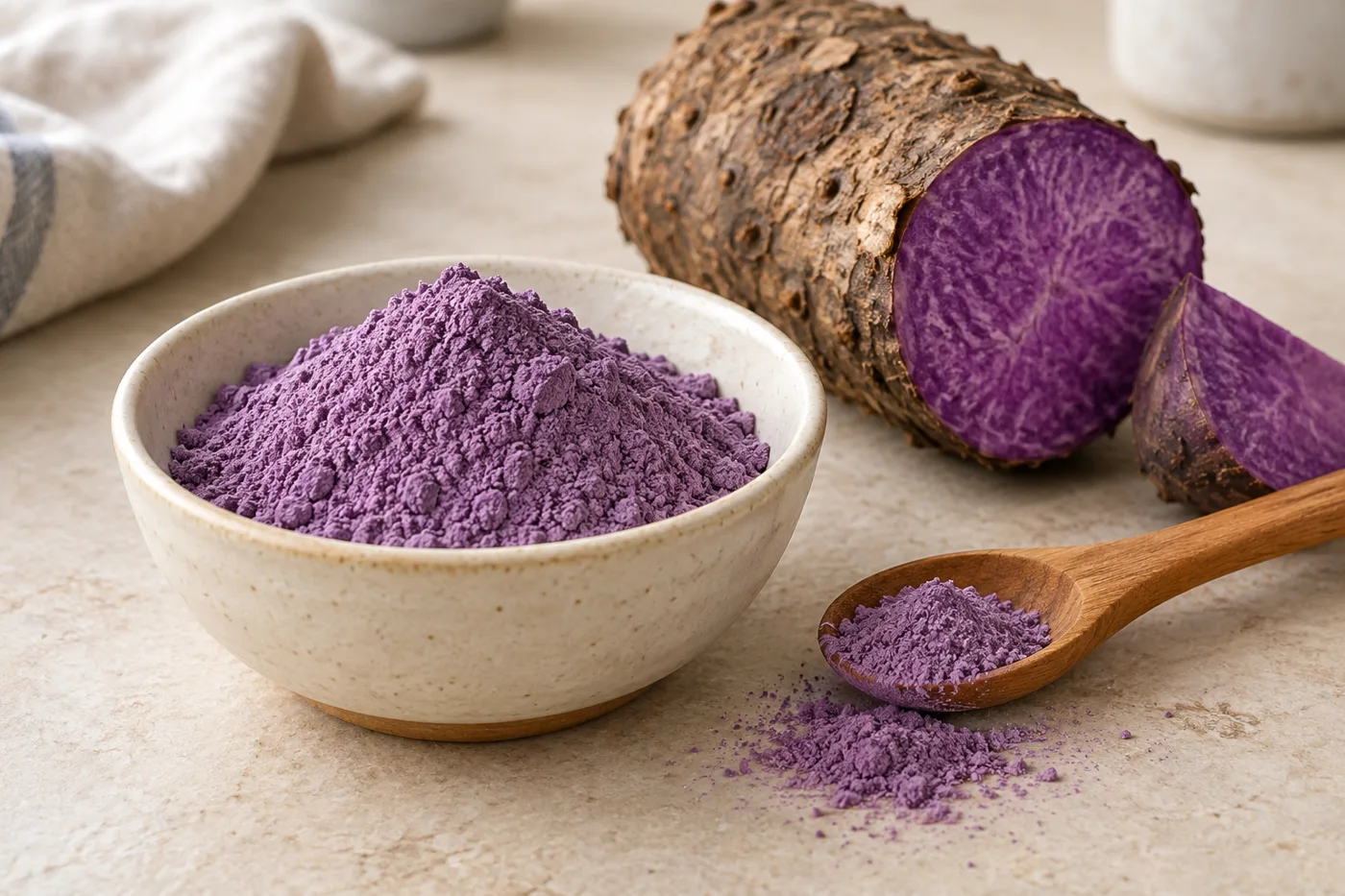
Ube powder is a powdered purple yam ingredient used to bring ube flavor, color, and body to recipes. However, products sold under that name are not all interchangeable. A plain dehydrated yam powder, an instant sweetened drink mix, and an ube-flavored protein powder require different decisions in the kitchen.
Before adding a spoonful to a smoothie or breakfast bowl, check what the product contains and how the manufacturer says to prepare it. Some powders require rehydration and cooking. Others are formulated for quicker preparation.
This guide explains how to identify your powder, prepare it according to its intended use, and choose suitable recipes. It also covers portion considerations when you want to include ube in an eating plan for weight management.
For the broader nutrition discussion, read our guide to whether ube is good for weight loss.
What Is Ube Powder?
Plain ube powder is made from purple yam that has been processed into a dry, ground ingredient. The specific processing method affects how the powder behaves when mixed with liquid.
The word powder describes its physical form. It does not establish whether the product is precooked, ready to consume, sweetened, or suitable for direct use in a cold drink. That is why the package instructions matter more than a universal online ratio.
When buying a product, look for three pieces of information:
- The actual ingredient or ingredients.
- Preparation instructions for the intended use.
- Nutrition information with a clearly defined serving size.
If these details are unclear, ask the manufacturer before using the powder in a preparation that receives no further cooking. A familiar purple color does not answer questions about processing.
Is ube powder the same as purple sweet potato powder?
No. Ube is a purple yam, while purple sweet potato is a different plant. The University of Georgia plant database distinguishes Dioscorea alata, or ube, from purple sweet potato.
Both powders may look purple, but appearance does not make their flavors, preparation requirements, or recipe performance identical. Check the ingredient list rather than relying on a photograph or the words purple powder.
The Main Types of Ube Products
Understanding the product category prevents many recipe problems.
| Product | What it may contain | What to check before use |
|---|---|---|
| Plain ube powder | Dehydrated purple yam | Rehydration and cooking requirements |
| Instant ube drink mix | Yam or flavoring, sugar, creamer, and other ingredients | Liquid quantity, serving size, sweetness, and allergens |
| Ube-flavored protein powder | A protein source with flavoring and possibly yam | Protein per serving, preparation instructions, and allergens |
| Ube extract | Concentrated flavoring or coloring ingredients | Suggested dose and suitability for the recipe |
| Ube halaya | A prepared sweet yam mixture | Ingredients, sweetness, moisture, and storage directions |
These products perform different jobs. Extract may add flavor without supplying the body of cooked yam. A drink mix may already contain sweetener. Protein powder may change the texture considerably.
Do not substitute one for another solely because their names include ube. Decide which function the original ingredient performs before changing it.
How to Choose Ube Powder for Healthy Recipes
Start with the recipe you want to make. For a preparation where you want control over sweetness, a plain powder can be useful. You can prepare the yam component first and decide separately what milk, yogurt, sweetener, or toppings to include.
For an instant drink, choose a product explicitly intended for that use. Convenience is useful, but compare its ingredients and serving directions with your needs.
For a protein shake, determine whether you want real yam powder, a protein supplement, or both. They are separate ingredients rather than equivalent choices.
Read beyond the front of the package
A front label may emphasize color, flavor, or a dietary description. The back of the package gives you more practical information. Check:
- Whether purple yam is identified as an ingredient.
- Whether sugar or creamer is already included.
- Whether the powder must be heated.
- Whether nutrition applies to dry powder or a prepared drink.
- How many servings the package contains.
Natural, vegan, or gluten-free does not explain how the powder should be prepared or how much a serving contributes to a recipe. Those descriptions answer different questions about the product.
Does Ube Powder Need Cooking?
Follow the instructions for your particular product. Do not assume that all ube powders are ready to eat, and do not assume that all require the same cooking process.
For example, Giron powdered ube package directions reproduced by a retailer call for rehydrating the product. Meanwhile, Ube Nolia publishes a quick latte preparation for its own powder. Those directions belong to their respective products; they are not universal instructions for every brand.
If your powder requires cooking, stirring it into yogurt or leaving it in the refrigerator overnight does not replace that cooking step. Similarly, adding a small amount of hot water does not automatically satisfy instructions that require simmering.
What if the package instructions are missing?
Contact the manufacturer or choose a product with clear instructions. A recipe written for another brand cannot establish the preparation requirements of an unidentified powder.
This matters especially for cold preparations such as shakes, yogurt bowls, and overnight oats, because there may be no later cooking step. Keep the instructions with the product if you transfer the powder into another container.
How to Prepare Ube Powder
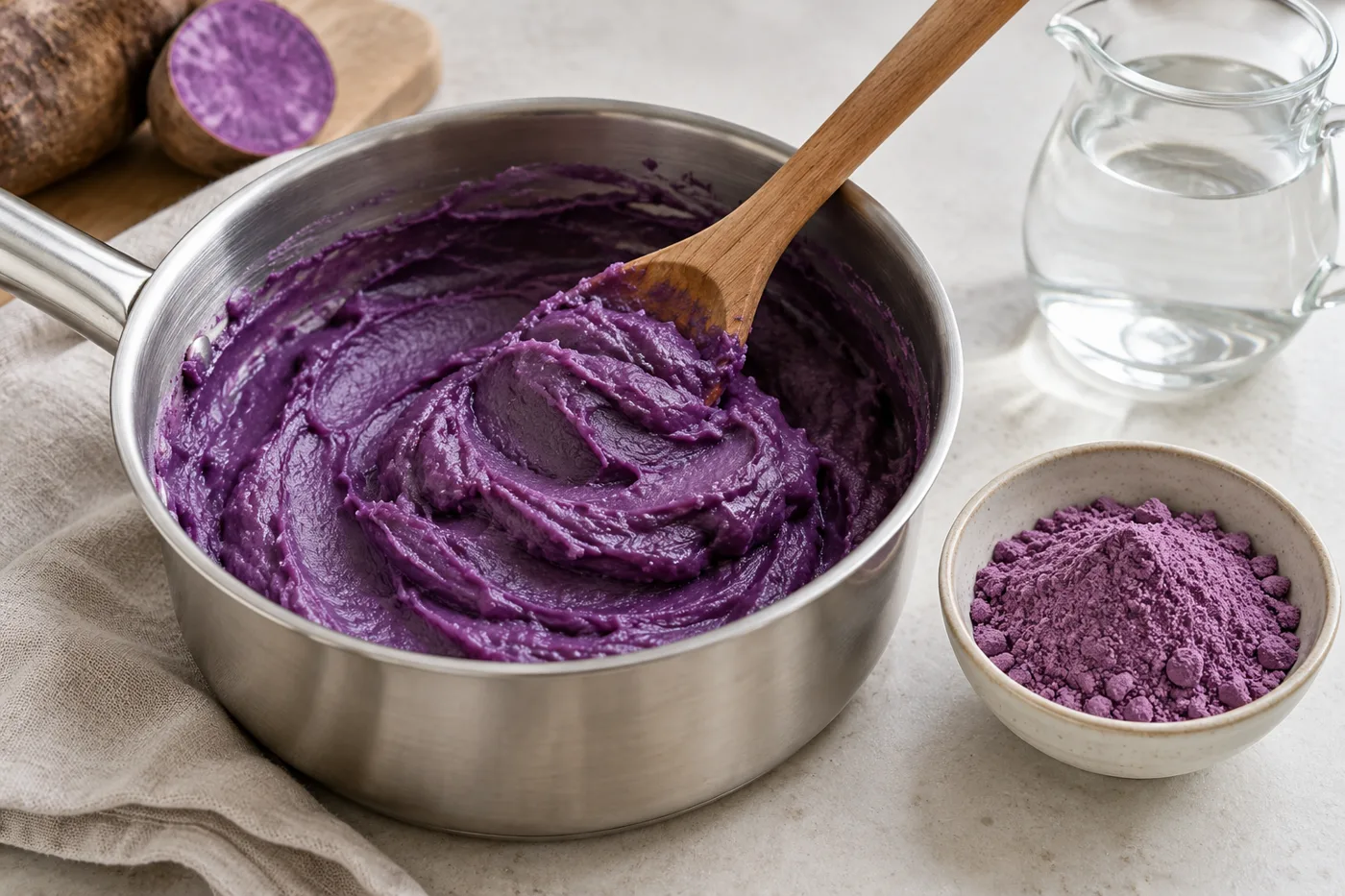
The following sequence is a way to organize your preparation. Use the package for the actual quantities, temperature, and time. It is not a universal recipe for every powder.
1. Identify the intended result
Decide whether you need a prepared yam mash, a pourable drink, or an ingredient for a cooked batter. A product prepared for halaya may not have the same consistency as one prepared for a latte. Read both the package and the recipe before starting.
2. Measure the dry powder
Use the stated weight when available. A loosely filled tablespoon and a tightly packed tablespoon can contain different amounts. Weighing makes it easier to repeat the same version. Record the quantity if you are testing an adaptation.
3. Add the specified liquid
Use the amount and type of liquid required by the instructions. If you want to prepare an unsweetened base, make sure the product and method allow that. Do not automatically add all the sweet ingredients from a dessert recipe when your goal is simply to prepare yam for another dish.
4. Complete the required preparation
Rehydrate, heat, or cook as directed. Stir when instructed and use suitable equipment. If the mixture thickens, assess it against the expected result rather than assuming that a thicker texture means it is finished.
Do not shorten a required cooking step just because the color looks right. The cooking time and texture instructions are separate pieces of information.
5. Cool when the next recipe requires it
For a cold shake or yogurt preparation, allow the prepared yam component to cool and refrigerate it promptly. Keep dairy ingredients chilled until assembly. Do not blend hot prepared yam with cold yogurt simply to avoid waiting.
6. Measure the prepared quantity
Once the powder has been prepared, measure the amount needed for the final recipe. The weight of dry powder and the weight of the prepared mixture are different measurements. Keep a note of both when calculating nutrition.
How Much Ube Powder Should You Use?
There is no single amount that works for every product and recipe. The correct quantity depends on the manufacturer’s preparation method, the amount of liquid, and what else is in the dish.
Use a recipe developed for your product when possible. If adapting a recipe, make a small batch and change one variable at a time.
| Intended use | Useful starting reference |
|---|---|
| Prepared yam mash | The package’s rehydration and cooking instructions |
| Latte or other drink | The product’s drink preparation directions |
| Shake | A compatible recipe plus the powder’s preparation requirements |
| Oatmeal | A recipe specifying dry powder or prepared yam clearly |
| Baking | A recipe developed for the relevant powder |
Do not keep adding powder solely to produce a darker purple color. You may change the thickness and flavor before achieving the appearance of a photograph. Assess whether the preparation tastes and behaves as intended.
Can Ube Powder Replace Cooked Ube?
Sometimes, but not gram for gram. Cooked yam contains water. Dry powder has a different concentration and must be prepared according to its instructions.
Even after rehydration, the resulting mixture may not exactly match the moisture or texture of cooked whole yam. If a recipe calls for prepared ube, first establish whether the author allows a powder-based substitute.
If you experiment, record the dry powder quantity, liquid added, required cooking method, finished prepared weight, and amount used in the recipe. This makes the adaptation repeatable and helps identify why a result became too thick, loose, or strongly flavored.
Do not describe a powder variation as equivalent until you have evaluated the actual result. Small differences in moisture can matter in a batter or a thick breakfast bowl.
Ways to Use Ube Powder in Healthy Recipes
These are preparation ideas rather than fully tested recipes. Each requires a suitable product and appropriate quantities.
1. Ube protein shake
Prepared, cooled ube can contribute flavor and body to a shake. Our ube protein shake recipe uses cooked purple yam, plain Greek yogurt, and unsweetened soy milk. It explains how a powder-based variation changes preparation and the nutrition calculation.
Keep the recipe’s protein sources separate from the yam ingredient in your thinking. Plain ube powder and protein powder are not equivalent.
2. Ube oatmeal
A prepared ube component can be incorporated into oatmeal when the recipe and product instructions are compatible. Decide whether the recipe needs additional liquid after adding the yam. Taste before adding sweetener, especially if your powder is already sweetened.
For breakfast combinations, explore our high-protein oatmeal ideas.
3. Ube overnight oats
Our ube overnight oats with Greek yogurt uses cooked yam and explains the limits of adapting it with prepared powder. Complete any product-specific cooking before assembling the cold breakfast.
Use a product suitable for the method, completing any required cooking before assembling the cold preparation. Do not rely on overnight soaking to replace cooking instructions.
You can use our overnight oats recipes for ideas about breakfast combinations, while keeping the ube preparation specific to your product.
4. Ube yogurt bowl
Combine an appropriately prepared and cooled yam component with plain yogurt. Add toppings deliberately rather than treating them as decoration outside the recipe. Fruit, oats, seeds, and nut butter change the finished serving. If the yam base already contains sweetener, taste before adding more.
5. Ube pancakes
Choose a pancake recipe written for the powder you have, or one that clearly specifies a prepared yam component. Do not replace all the flour with ube powder without a suitable recipe. A color ingredient is not automatically a structural substitute for the other dry ingredients. The batter must still be cooked appropriately.
6. Ube desserts
Powder can be useful in dessert preparations, but adding it does not establish that the dessert is low-calorie. Assess the whole recipe, including sweeteners, dairy, fats, and toppings. You can enjoy a portioned dessert without presenting it as a food that causes weight loss.
Using Ube Powder When Managing Weight
For weight management, focus on the complete prepared serving, rather than the ingredient’s name. A measured powder portion in an unsweetened preparation and a large drink made with sweetened mix, syrup, and cream are different foods.
Know how much dry powder goes into the recipe. Include milk, yogurt, and other additions. Define the finished yield, count toppings and sweeteners, and decide whether the preparation replaces something or adds another eating occasion.
For the detailed discussion of portions and plain yam nutrition, use the linked nutrition guide near the beginning of this article.
Calculate from the dry product used
If you prepare a batch from powder and water, calculate the powder’s contribution from its label. Divide the batch according to the amount you actually use. Adding water changes the prepared weight but does not erase the calories supplied by the powder.
Include any other ingredients added during preparation. Do not automatically apply the nutrition of boiled whole yam to your powder-based mixture. If you change the powder brand or the preparation, update the estimate rather than reusing an old total.
Ube Powder Troubleshooting
| Problem | What to check | Practical response |
|---|---|---|
| Grainy texture | Whether rehydration and cooking were completed | Follow the product’s full preparation method |
| Clumps | Mixing method and liquid quantity | Use the recommended sequence and equipment |
| Mixture is too thick | Powder concentration and later additions | Adjust only as the recipe permits |
| Drink is too sweet | Sweetened powder, milk, or syrup | Review the complete ingredient list |
| Weak flavor | Product type and dilution | Check the recommended dose before increasing it |
| Unexpected flavor | Whether the product is yam powder or a flavored mix | Confirm what was purchased |
A pale color is not proof that the preparation failed. Product variation, dilution, yogurt, and milk can all affect appearance. Make adjustments for flavor and texture rather than trying to reproduce an edited image exactly.
How to Store Ube Powder
Follow the package’s storage instructions and best-before information. Keep the container properly closed and use a clean, dry utensil when measuring. Avoid introducing moisture into the package.
Once you add water, milk, or other ingredients, the mixture is no longer the same dry pantry product. Follow suitable instructions for the prepared food and refrigerate promptly when required.
Do not assume the shelf life of unopened powder applies to prepared yam, a finished shake, or a yogurt bowl. If the manufacturer gives specific storage guidance after opening or preparation, use it. Label any prepared batch so its ingredients and preparation date remain clear.
FAQS
What is ube powder used for?
It is used in drinks, breakfasts, desserts, and other recipes. Its preparation depends on whether the product is plain yam powder, an instant mix, or another formulation.
Can I add ube powder directly to a smoothie?
Only when the product instructions permit that use. Complete any required cooking or rehydration before making a cold smoothie.
Is ube powder the same as ube extract?
No. Powder contributes solids, while extract mainly provides concentrated flavor or color. They are not equivalent substitutes.
Is ube powder the same as purple sweet potato powder?
No. They come from different plants. Check the ingredient list and use directions for the product you actually have.
Is ube powder high in protein?
Do not assume it is. Read the label and distinguish plain yam powder from an ube-flavored protein supplement.
How much ube powder replaces cooked ube?
There is no universal conversion across products. Follow the manufacturer’s preparation instructions and use a recipe that specifies a compatible substitution.
Is ube powder good for weight loss?
It is not inherently slimming. Assess the complete recipe, its portion, and how it fits your overall eating pattern.
Why is my ube powder mixture grainy?
Possible reasons include incomplete preparation, clumping, or a product unsuitable for direct mixing. Check the package instructions before changing the recipe.
1 thought on “Ube Powder: How to Use It in Healthy Recipes”