
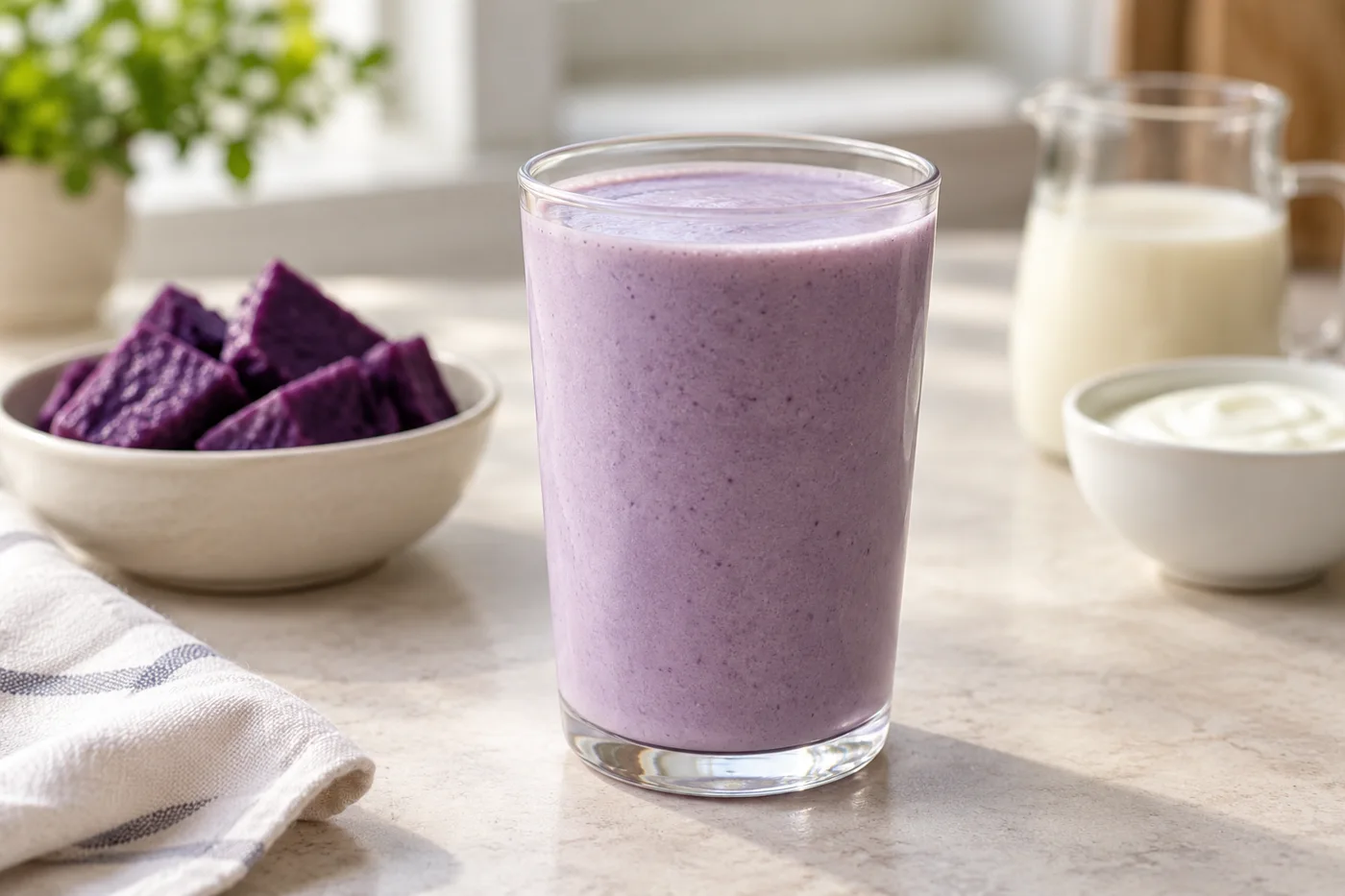
An ube protein shake blends cooked purple yam with a protein-rich base to create a creamy purple drink. This version uses plain Greek yogurt and unsweetened soy milk, with no condensed milk, ice cream, or syrup required.
If you are looking for an ube protein shake for weight loss, the useful features are measurable ingredients, a defined serving, and room to adjust the recipe to your eating plan. Ube does not make a shake automatically slimming, and drinking it does not guarantee weight loss.
The recipe below makes one serving with approximately 230 calories and 25 grams of protein, based on the reference ingredients explained in the nutrition section. Your brands, cooking method, and additions will change those estimates.
For more combinations beyond purple yam, explore our protein shakes for weight loss and choose a recipe that fits your preferred ingredients and portions.
Use already cooked, chilled ube for a shake that takes about five minutes to assemble. This original formulation has not been kitchen-tested; texture and flavor adjustments are included below.
For a closer look at plain purple yam, portions and sweetened ube products, read our guide to whether ube fits a weight-loss eating plan.
Can an Ube Protein Shake Fit a Weight-Loss Plan?
Yes, an ube protein shake can fit a weight-loss eating plan when its portion and ingredients work with your overall food intake.
The important question is how you use the drink. Replacing a higher-calorie sweet beverage with a measured shake is different from adding the shake on top of everything you normally eat.
The National Institute of Diabetes and Digestive and Kidney Diseases recommends a sustainable eating plan with an appropriate reduction in calories for weight management. No individual ingredient replaces that overall approach.
For this recipe, measure the cooked ube, choose plain yogurt and unsweetened milk, and blend one portion. Account for any fruit, sweeteners, or toppings you add. Decide whether the drink serves as a snack or part of a meal rather than automatically treating it as something extra.
There is no special time of day when this shake becomes more effective for losing weight. Choose a time that suits your appetite and routine. The words “weight loss” describe how you might use a measured recipe within an eating plan, not a proven slimming effect of purple yam.
What Is Ube?
Ube is a purple yam associated with Filipino cooking. Its botanical name is Dioscorea alata, and it is used in preparations ranging from cooked tubers to halaya, cakes, and ice cream. The University of Georgia plant genome database identifies ube as a yam and distinguishes it from purple sweet potato.
For this shake, use plain cooked ube rather than a sweetened dessert preparation. Ube contributes the purple yam flavor and body of the drink. Most of this recipe’s protein comes from the yogurt and soy milk, rather than the yam.
Is ube the same as purple sweet potato?
No. Ube and purple sweet potato are different plants, even though their colors can look similar. You can experiment with cooked purple sweet potato in a smoothie, but that creates a variation with a different flavor, texture, and nutritional profile.
When shopping, check the ingredient description rather than choosing a product solely because its photograph is purple. This distinction also matters when buying a powder: the front label may emphasize color while the ingredient list identifies the actual tuber.
Ube Protein Shake Ingredients
For one serving
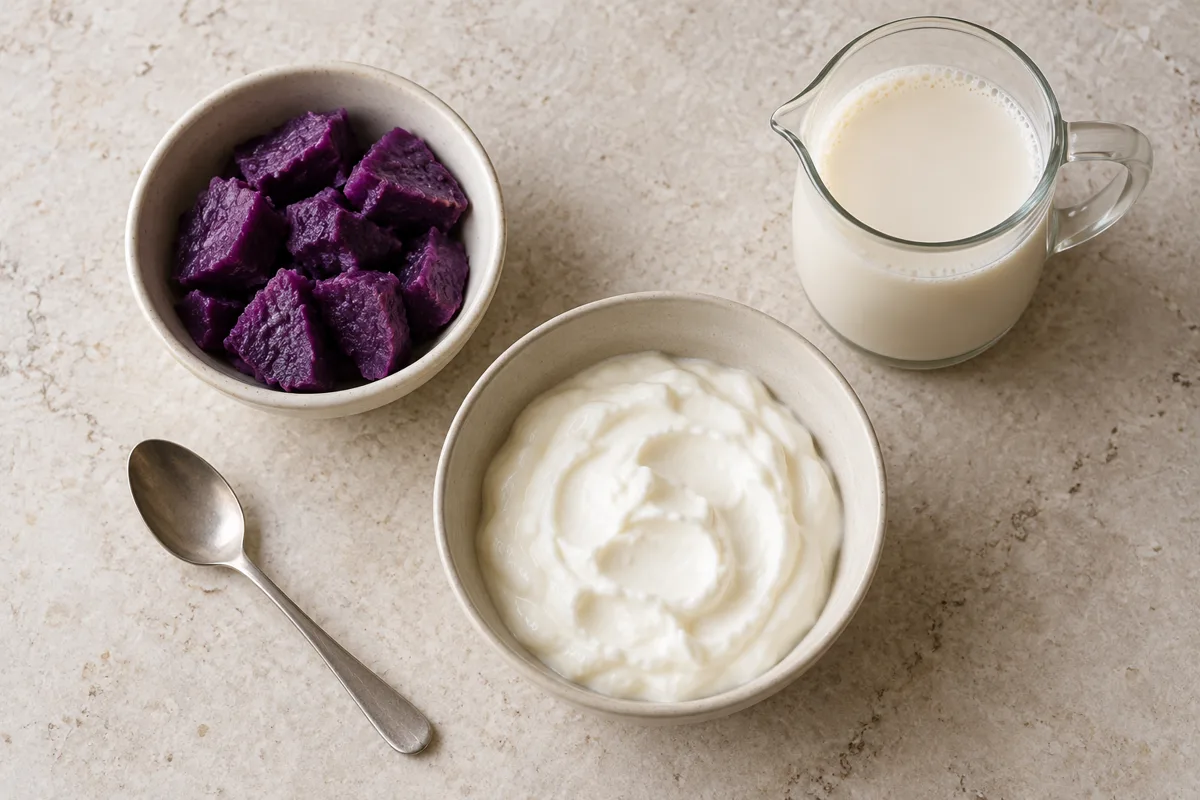
- 100 g plain cooked ube, peeled, cooled, and chilled
- 170 g plain nonfat Greek yogurt
- 180 ml unsweetened soy milk, approximately 3/4 US cup
- 1/4 teaspoon vanilla extract, optional
- 3 to 5 small ice cubes, optional
- Cold water, 1 tablespoon at a time, only if needed
The cooked ube must be unsweetened. Do not use 100 g of dry ube powder in place of 100 g cooked yam.
Cooked ube
Use ube that has been cooked until tender, then cooled and refrigerated promptly. Plain frozen cooked ube can be convenient if the label confirms its ingredients and preparation requirements. Some frozen products still require cooking, so check the package before blending.
Weigh the ube after cooking and peeling. Raw weight and cooked weight are not interchangeable for this recipe. Boiling and roasting also produce different moisture levels, which can affect how much liquid your blender needs.
Plain Greek yogurt
Greek yogurt gives the shake a creamy base and contributes protein. Choose plain yogurt so you can control the sweetness. Vanilla-flavored yogurt may contain added sugar, and different brands provide different amounts of protein.
A thick yogurt reduces the need for banana or extra ingredients simply to create body. Start with the stated amount before deciding whether the shake needs any additional thickener.
Unsweetened soy milk
Unsweetened soy milk adds liquid and protein without requiring a separate scoop of protein powder. The reference product used for the estimate provides 80 calories and 8 g protein per cup. Other products may differ.
If you substitute another milk, use its label to update the estimate. A lower-calorie milk does not necessarily provide the same amount of protein.
Vanilla and ice
Vanilla is optional. Start with a small amount so it does not overpower the ube. Ice makes the drink colder and slightly thicker, but too much can dilute the flavor as it melts. If all your ingredients are well chilled, you may prefer to skip it.
How to Make an Ube Protein Shake
1. Check and prepare the ube
Make sure the yam is fully cooked and chilled. Break it into small pieces that your blender can handle. Remove any tough or fibrous sections rather than relying on extended blending to disguise them.
If your cooked ube is frozen solid, thaw it according to the product instructions or use a blender suitable for frozen ingredients. Do not add hot yam to a cold shake.
2. Add the liquid first
Pour the soy milk into the blender. Adding liquid first helps the blades circulate the thicker ingredients. Reserve any extra water until you have assessed the initial consistency.
Starting with too much liquid makes it harder to recover a creamy texture without adding more ingredients. A small blender may also need a brief pause to redistribute the mixture.
3. Add yogurt and cooked ube
Spoon in the yogurt, followed by the ube pieces. Add the optional vanilla. Leave the ice out for the first blend if you are unsure how thick the mixture will become. Secure the lid before starting the blender.
4. Blend until smooth
Begin at a low setting, then increase the speed as appropriate for your appliance. Blend until the ube is incorporated and no obvious pieces remain. Stop and scrape down the sides with the appliance switched off if necessary.
The exact blending time depends on your equipment and the texture of the cooked yam. Follow the blender’s capacity and operating instructions rather than forcing a thick mixture through stalled blades.
5. Adjust the texture
For a thinner shake, add cold water one tablespoon at a time and blend briefly. For a colder, thicker shake, add a few small ice cubes.
Avoid automatically adding more yogurt, nut butter, or fruit to fix the consistency. Those ingredients can work, but they also change the recipe and its nutrition.
6. Taste and serve
Taste before adding sweetener. This shake is less sweet than an ube milkshake made with syrup or condensed milk. Its flavor will depend on the ube and yogurt you use.
Pour the entire batch into one glass. The recipe makes one serving, even if it fills two smaller glasses. If you add a sweetener, record its amount when updating your nutrition estimate.
Estimated Calories and Protein
The following calculation uses specific reference values. It is an estimate rather than a laboratory analysis.
| Ingredient | Amount | Estimated calories | Estimated protein |
|---|---|---|---|
| Plain boiled ube | 100 g | 77 | 0.7 g |
| Plain nonfat Greek yogurt | 170 g | 90 | 18 g |
| Unsweetened soy milk | 180 ml | 60 | 6 g |
| Total before optional additions | One recipe | 227 | 24.7 g |
For practical recipe labeling, this is approximately 230 calories and 25 g protein per serving.
The ube estimate uses boiled-yam composition figures reproduced by Philippine Ube from the Philippine Food Composition Tables. The yogurt reference is FAGE Total 0%, and the milk reference is Silk Unsweet Soymilk. This is a calculation example, not a requirement to buy those brands.
Roasted ube, a different yogurt, sweetened milk, or an added scoop of powder will change the total. Optional vanilla and other additions are excluded. No full vitamin, mineral, or fiber panel has been calculated for the finished shake.
How to calculate your own version
For each packaged ingredient, find the calories and protein per labeled serving. Divide your measured amount by the labeled serving amount, multiply that fraction by the listed nutrition, and add the ingredient totals together.
Use the same units throughout. Do not compare grams of powder with milliliters of prepared drink. If a label uses a different serving volume from the recipe, scale it before adding the totals.
How to Adjust the Shake for Weight Management
Keep the serving intentional
The complete recipe is one portion. You can split it into two smaller servings if that suits your plan, but each contains approximately half the protein as well as half the calories.
Portion needs differ between people. The NIDDK portion guide explains why body size, activity, and overall intake matter. There is no universal shake portion that produces weight loss.
Choose the additions you actually enjoy
Banana, oats, nut butter, and coconut milk can all be used in smoothies. They also change the energy content and texture. Instead of adding several ingredients automatically, decide what the shake needs.
If the texture is already creamy, nut butter may be unnecessary. If the flavor is pleasant, syrup may add sweetness you do not need. If you do enjoy either addition, measure it rather than estimating from a large spoonful.
Treat toppings as ingredients
Whipped cream, granola, coconut flakes, and sweet drizzles belong in the nutritional calculation. They do not become irrelevant because they sit on top of the glass.
For the simplest version, serve the shake without toppings. If you prefer a garnish, measure it and include it in your estimate. Avoid changing several ingredients at once when learning which version you enjoy.
If you enjoy rotating your breakfast drinks, our smoothie recipes for weight loss offer other combinations with measured ingredients and estimated nutrition.
Can You Make It with Ube Powder?
Before adapting this shake, read our guide to choosing and preparing ube powder for product differences, rehydration and cooking requirements.
Yes, but ube powder is not a gram-for-gram replacement for cooked yam. Products vary. Some are plain dehydrated yam, some are formulated drink mixes, and others contain sugar, creamer, flavoring, or coloring.
Read both the ingredient list and preparation instructions. If the powder requires heating or rehydration, complete those steps and cool the prepared ube before blending. Do not assume every purple powder can be added directly to a cold drink.
The most straightforward adaptation is to prepare the powder into an unsweetened mash according to its label, then use 100 g of that prepared mash. However, its water content and nutrition may differ from boiled whole ube.
Recalculate using the powder quantity actually used, rather than applying the boiled-yam estimate automatically. This powder variation has not been kitchen-tested, and there is no single universal conversion across products.
Ube Powder vs Ube Protein Powder
Plain ube powder contributes yam flavor and solids. A sweetened ube drink mix can add sugar or creamer. Ube-flavored protein powder supplies protein according to its formulation, while ube extract mainly adds flavor or color and cannot replace the yam’s texture.
The base recipe does not require protein powder. If you want to add one, follow its recommended use and adjust the liquid as needed. Include its calories and protein in your total.
Avoid assuming that a product marketed with “ube” contains a meaningful quantity of purple yam. Check the protein source, allergens, serving size, and ingredient list before using it.
Variations
With dairy milk
Replace the soy milk with the same volume of your preferred dairy milk. The shake still contains yogurt, so this does not change its suitability for someone avoiding dairy. Update the nutrition using the milk label.
Dairy-free version
Use a plain dairy-free yogurt alternative and a milk that suits your needs. Check the protein carefully. A coconut-based yogurt may produce a creamy drink without matching the protein contribution of Greek yogurt.
Choose the combination based on its actual label rather than assuming all yogurt alternatives are equivalent. This substitution changes the estimate in the recipe card.
With banana or protein powder
Add a small measured amount of banana if you prefer a sweeter, fruitier shake. Start with less than you think you need, then taste. For protein powder, add a measured amount and enough liquid to maintain a drinkable texture.
Both variations need a new nutrition calculation. Strongly flavored powders can dominate the ube, so try a small amount before committing an entire batch.
Troubleshooting
| Problem | Possible reason | Adjustment |
|---|---|---|
| Shake is too thick | Dense yam or thick yogurt | Add cold water gradually |
| Texture is grainy | Fibrous yam or incorrectly prepared powder | Check preparation and blend again |
| Flavor is too tangy | Yogurt dominates | Try a milder plain yogurt next time |
| Shake is too sweet | Sweetened milk, yogurt, or mix | Choose unsweetened ingredients |
| Color is pale | Ingredient variation and dilution | Accept the natural shade |
| Flavor is mostly vanilla | Too much extract or flavored powder | Reduce or omit the flavoring |
A pale lavender shake is not necessarily a failed recipe. Color depends on ingredients and proportions. Do not keep adding yam solely to reproduce a photograph if the texture and flavor already suit you.
What to Serve with This Shake
If you prefer a spoonable breakfast instead of a drink, try our ube overnight oats with Greek yogurt, which uses cooked purple yam and a refrigerated overnight soak.
If you prefer a smaller shake alongside a breakfast you can eat with a spoon, browse our overnight oats recipes and adjust both portions to suit your meal.
For ideas beyond breakfast, explore our high-protein, high-fiber meals to bring more variety to your weekly menu. The shake has not been formulated as a nutritionally complete meal replacement.
Preparing Ahead
For the quickest assembly, prepare plain cooked ube ahead and divide it into measured portions. Cool and refrigerate cooked ingredients promptly. Follow the storage instructions for any packaged ube, yogurt, and milk.
Blend near serving time for the most consistent texture. If the shake separates after refrigeration, stir or blend it again. For a packed snack, keep it chilled during transport rather than leaving a dairy-based drink at room temperature.
Printable Ube Protein Shake Recipe
PrintUbe Protein Shake
- Total Time: 5 minutes
- Yield: 1 serving 1x
Description
A creamy ube protein shake with plain cooked purple yam, nonfat Greek yogurt and unsweetened soy milk. Approximately 230 calories and 25 g protein using the reference ingredients; not a weight-loss guarantee.
Ingredients
- 100 g plain cooked ube, peeled and chilled
- 170 g plain nonfat Greek yogurt
- 180 ml unsweetened soy milk (approximately 3/4 US cup)
- 1/4 teaspoon vanilla extract, optional
- 3 to 5 small ice cubes, optional
- Cold water, 1 tablespoon at a time, only as needed
Instructions
- Check that the ube is fully cooked and chilled. Break into small pieces.
- Pour the soy milk into the blender first.
- Add yogurt, cooked ube and optional vanilla. Secure the lid.
- Blend until smooth, stopping the appliance before scraping the sides if necessary.
- Thin with cold water a tablespoon at a time or add a few small ice cubes for a colder shake.
- Taste and serve the complete batch as one portion. Count any sweetener or toppings separately.
Notes
This original recipe has not been kitchen-tested. The five-minute time assumes already cooked and chilled ube and excludes cooking, cooling and thawing. Use plain cooked yam, not sweetened halaya. Ube powder is not a gram-for-gram substitute; prepare according to its label first. Contains milk and soy. Nutrition is estimated from 100 g boiled ube (77 kcal, 0.7 g protein), 170 g FAGE Total 0% yogurt (90 kcal, 18 g protein), and 180 ml Silk Unsweet Soymilk (60 kcal, 6 g protein), excluding optional additions. Brands and preparation change the values. This shake has not been formulated as a complete meal replacement.
- Prep Time: 5 minutes
- Cook Time: 0 minutes
- Category: Drinks
- Method: Blender
- Cuisine: Filipino-inspired
Nutrition
- Serving Size: 1 complete recipe
- Calories: 230
- Protein: 25 g
Keywords: ube protein shake recipe, ube protein shake for weight loss, ube smoothie, purple yam shake
FAQS
Is an ube protein shake good for weight loss?
It can fit a weight-loss eating plan when its ingredients and portion suit your overall intake. Ube itself does not make the shake cause weight loss.
How many calories are in this ube protein shake?
The base recipe provides approximately 230 calories using the reference ingredients. Different brands, cooking methods, and additions change that estimate.
How much protein does the recipe contain?
Approximately 25 g per serving using the specified reference yogurt and soy milk. Most comes from those ingredients rather than the ube.
Can I make it without protein powder?
Yes. The base recipe uses Greek yogurt and soy milk to provide protein, so a separate powder is optional.
Can I use ube halaya?
You can make a variation with halaya, but it is not equivalent to plain cooked yam. Check its ingredients and recalculate the nutrition, especially when it contains sugar or condensed milk.
Can I blend ube powder directly into the shake?
Only if the product’s instructions allow that use. Some powders require cooking or rehydration before consumption.
Can I use purple sweet potato instead?
Yes, as a recipe variation. It changes the ingredient, flavor, texture, and nutritional calculation.
Is this a complete meal replacement?
It has not been formulated as a nutritionally complete meal replacement. Use it as a snack or part of a meal according to your needs.
3 thoughts on “Ube Protein Shake for Weight Loss: Recipe and Portion Guide”