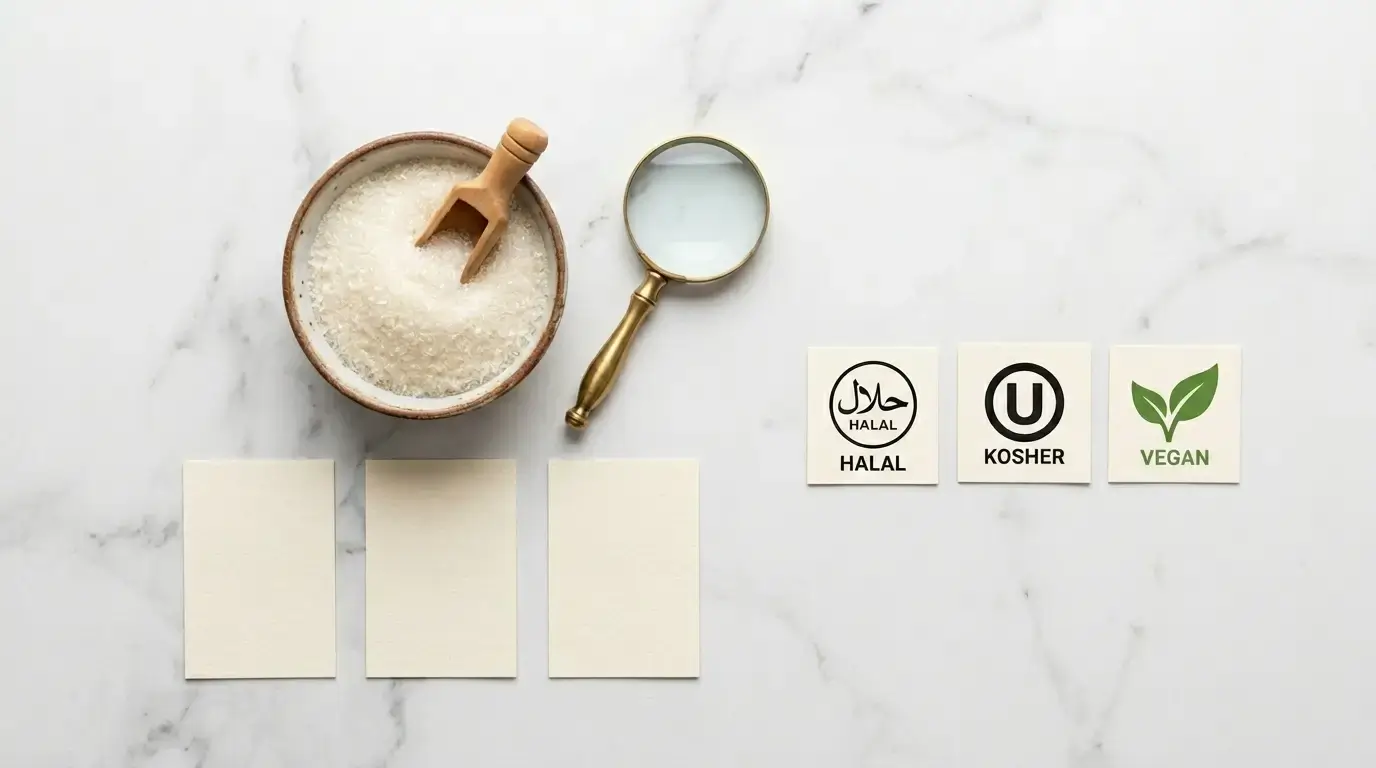
The short answer: most commercial gelatin is pork-derived — but not all of it.
This question matters for millions of people: Muslims following halal dietary law, Jewish consumers keeping kosher, Hindus who avoid beef, vegetarians, vegans, and anyone who simply wants to know what they’re eating. The frustrating reality is that most food labels just say “gelatin” without specifying the source — and that ambiguity is what sends people searching.
For a full list of which foods and products contain gelatin, see our complete gelatin foods guide.
This article gives you a clear answer, explains how to identify the source on any label, and points you to the best alternatives.
What Is Gelatin Made From?
Gelatin is a protein extracted from the collagen found in animal skin, bones, and connective tissue. The production process involves prolonged boiling that breaks collagen down into soluble proteins, which then form a gel when cooled.
The three primary commercial sources are porcine (pig skin and bones), bovine (cattle hides and bones), and marine (fish skin and scales). Porcine gelatin accounts for approximately 46% of global production, bovine around 29%, and bones from both sources roughly 23%. Jelytide
In practical terms: when you see “gelatin” listed on a US ingredient panel without any other qualifier, it is most often derived from pigs. This is the default across most of the food industry because porcine gelatin is cost-effective, widely available as a byproduct of pork processing, and produces a strong, clear, flexible gel ideal for confectionery and food manufacturing. Jellytide
Is Gelatin Always From Pork?
No — but pork is the default assumption when no source is stated.
Gelatin can be derived from bovine (beef), piscine (fish), poultry, and plant-based sources, in addition to pork. Here’s what each type means in practice: Us-en-jellytide
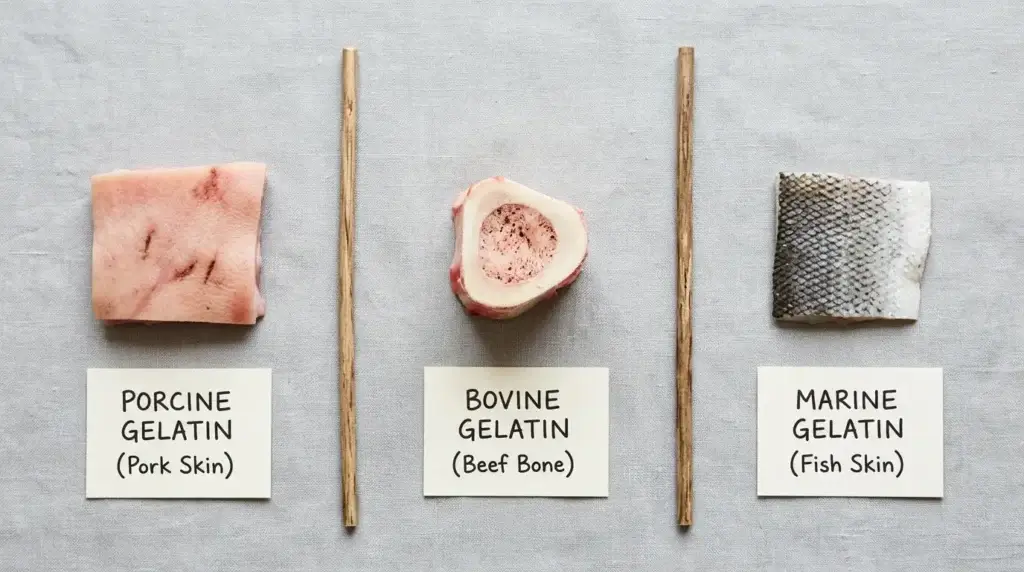
Porcine gelatin (pork) The most widely used type globally. Made primarily from pigskin. Pork gelatin is not halal since it comes from pigs, which Muslims are forbidden from consuming. It is likewise not kosher. This limits its acceptability for a significant portion of the global population, but its low cost keeps it dominant in general commercial food production. Newswire
Bovine gelatin (beef) Extracted from cattle hides and bones, bovine gelatin is widely available and often used to meet specific religious dietary needs, provided the animal was slaughtered in accordance with the relevant laws. Beef gelatin certified halal or kosher is the standard alternative to pork gelatin for Muslim and Jewish consumers. Hindu religious convictions, however, require gelatin products to be free from bovine sources — meaning bovine gelatin is not universally acceptable either. Us-en-jellytideJelytide
Fish (marine) gelatin Derived from fish skin and scales, fish gelatin has a lower melting point and gelling strength than its mammalian counterparts, making it suitable for softer gels. It is halal, kosher-friendly (when from kosher-certified fish), and acceptable across most religious dietary frameworks. The trade-off is a slightly different texture and a higher price point. It is increasingly available in health food stores and online. Us-en-jellytide
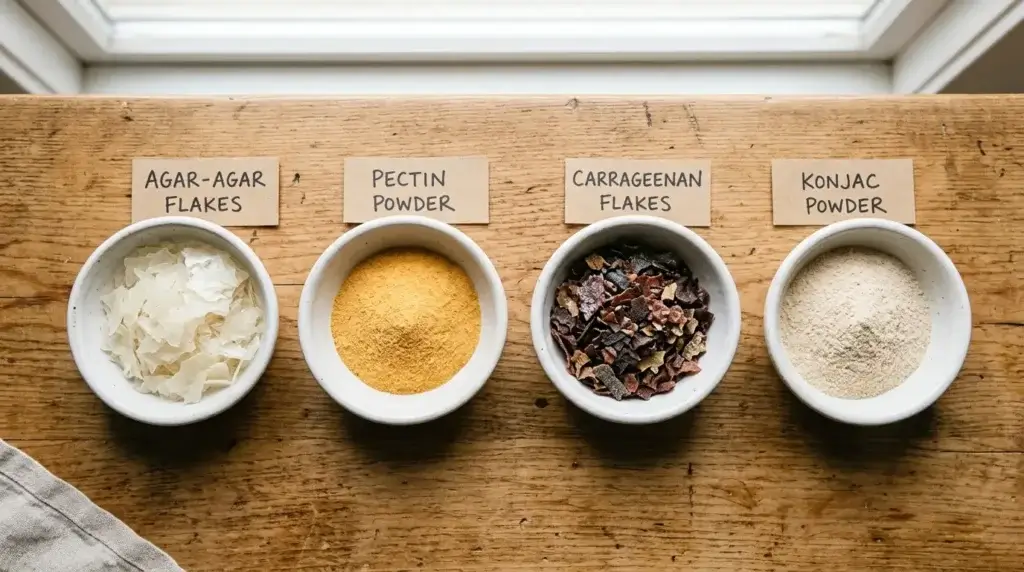
Plant-based alternatives Agar-agar (from seaweed), pectin (from fruit), carrageenan, and konjac all produce gelling effects without animal products. These are fully acceptable for all dietary frameworks including vegan. The complete guide to vegan gelatin substitutes covers each one with ratios and substitution guidelines.
How to Tell If Gelatin Is Pork on a Label
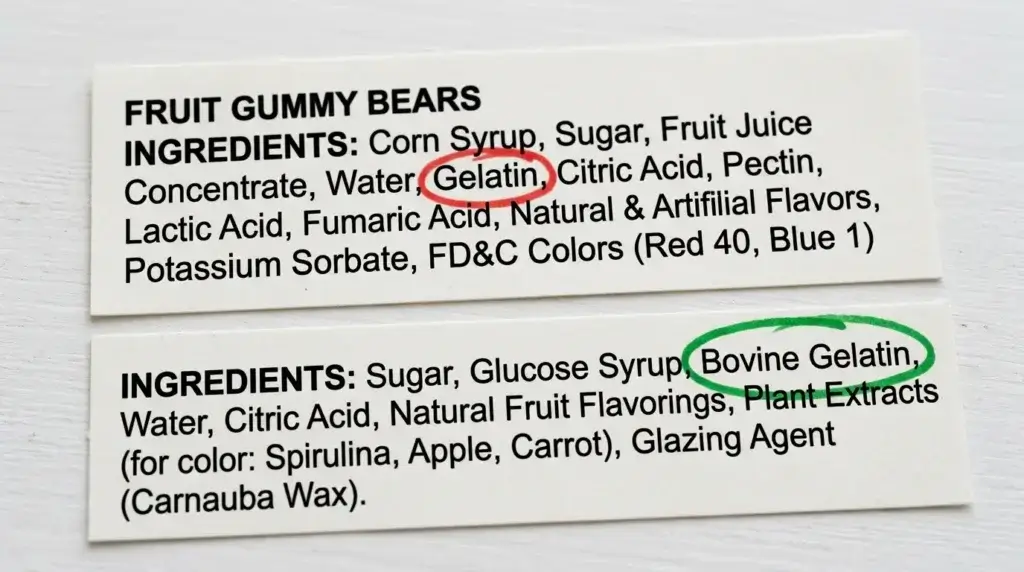
This is the practical core of the question. Here’s exactly what to look for:
🔴 Almost certainly pork:
- “Gelatin” with no further specification
- “Hydrolyzed collagen” with no source listed
- No kosher or halal certification on the product
🟡 Verify further:
- “Gelatin (pork)” — explicitly pork, listed in some products
- Products with kosher certification but no “gelatin” source listed — kosher can include beef or fish gelatin but not pork
🟢 Pork-free gelatin:
- “Bovine gelatin” — beef-derived
- “Fish gelatin” or “marine gelatin” — fish-derived
- Products with a halal certification logo — certification bodies verify the source
- Products with a kosher certification that also specify no pork derivatives
The most reliable way to ensure gelatin is pork-free is to choose products with a kosher or halal certification. The certification process requires source verification, which label reading alone cannot guarantee. Jellytide
Common products where the source is rarely stated:
- Gummy vitamins and supplements
- Frosted pastries (Pop-Tart frosting contains pork gelatin)
- Marshmallows (standard varieties are pork gelatin)
- Certain yogurts and cream cheeses (used as a thickener)
- Gel capsules for medications and supplements
- Some cheeses (gelatin used in processing)
For specific food products — from candy to boba to Pop-Tarts — the complete guide to what foods contain gelatin gives product-by-product answers.
Is Knox Gelatin Pork?
Yes. Knox unflavored gelatin — the most widely available brand in US supermarkets — is derived from pork. This is important to know because Knox is the gelatin most commonly recommended in weight loss recipes, the gelatin trick, and bariatric gelatin protocols.
For consumers who need a pork-free alternative for the gelatin trick, bovine-source unflavored gelatin is available from brands including Great Lakes, Vital Proteins (check current label), and NOW Foods — all available at health food stores and online. The Knox gelatin guide covers the full product breakdown, and the halal gelatin guide identifies halal-certified alternatives specifically.
Is Jell-O Pork Gelatin?
Standard Jell-O contains pork gelatin. This has been confirmed by Kraft Heinz (Jell-O’s manufacturer) through consumer inquiries over the years. The gelatin in both the flavored and unflavored Jell-O products sold in the US is porcine.
Halal and kosher-certified jello alternatives are available — primarily from specialty food brands and some international manufacturers who produce halal-certified gel desserts using bovine or fish gelatin.
Pork Gelatin in Medications and Supplements
One area that surprises many people: gel capsules. The vast majority of soft gel capsules and hard gel capsules used for medications, vitamins, and supplements are made from porcine gelatin. This includes many common over-the-counter medications and prescription drugs.
For strict halal or kosher compliance, pharmaceutical-grade bovine gelatin capsules and plant-based HPMC (hydroxypropyl methylcellulose) capsule alternatives exist. Many supplement manufacturers now offer vegetarian capsule versions of their products — look for “vegetarian capsule” or “HPMC capsule” on the label.
This extends beyond food and into everyday health management, which is why the halal gelatin question has grown beyond dietary observance into broader consumer awareness.
Pork-Free Gelatin Alternatives
For cooking, baking, and the gelatin trick specifically:
Bovine gelatin — the most direct swap. Same usage, same ratios, pork-free. Look for halal-certified brands. Widely available online and in health food stores.
Agar-agar — plant-based, from red algae. Sets firmer than gelatin. Use approximately 60% of the amount called for in a recipe. Best for firm desserts and jellies. Fully vegan and halal.
Pectin — plant-based, from fruit. Requires sugar and acid to gel properly. Best for jams, jellies, and fruit-based desserts. Not suitable as a direct gelatin substitute in all applications.
Carrageenan — extracted from seaweed. Produces a smooth, creamy gel. Used commercially in dairy products and plant-based milks. Available in refined form for home cooking.
Konjac — derived from the konjac plant root. Produces an extremely firm, rubbery gel. Used in Asian cooking (konnyaku, shirataki noodles). Works best in specific applications rather than as a general gelatin substitute.
The vegan gelatin substitutes guide covers each alternative with specific ratios, best applications, and where to buy — and the halal gelatin guide focuses specifically on certified pork-free options for every use case.
For the Gelatin Trick: Pork-Free Options
If you’re using gelatin for weight loss purposes through the gelatin trick or the 7-day gelatin diet plan, bovine gelatin works identically. The active compound — glycine — is present in both porcine and bovine gelatin in similar concentrations, meaning the GLP-1 stimulating effect is equivalent regardless of source.
Simply substitute the same quantity of a halal-certified bovine unflavored gelatin for Knox. The recipe, the timing, and the results remain the same.
If you follow the horse gelatin trend specifically, the horse gelatin trick for men uses standard bovine gelatin — fully pork-free by default.
Frequently Asked Questions
Is all gelatin made from pork?
No. The assumption that all gelatin is derived from pork is incorrect — it can be porcine, bovine, fish, or poultry derived. However, pork is the most common source in commercial food products, and when a label simply says “gelatin” without specifying the source, it is most often pork-derived.
How can I tell if gelatin is from pork or beef?
Look for source labeling: “bovine gelatin” means beef. “Gelatin” alone usually means pork. The most reliable method is choosing products with halal or kosher certification, which require verified source documentation.
Is gelatin halal?
It depends entirely on the source. Pork gelatin is not halal. Bovine gelatin from halal-slaughtered cattle is halal. Fish gelatin from halal-compliant sources is halal. The halal gelatin guide covers certified brands and products in detail.
Is gelatin vegetarian or vegan?
No. All animal-derived gelatin — pork, beef, fish, or poultry — is unsuitable for vegetarians and vegans. Plant-based alternatives (agar-agar, pectin, carrageenan, konjac) are the appropriate substitutes.
Does gelatin always come from pigs?
No — but pork is the default in most commercial products. Always check for source labeling or certifications if this matters for your diet.
Is there a pork-free gelatin for weight loss recipes?
Yes. Bovine unflavored gelatin from halal-certified brands works identically to Knox in the gelatin trick and bariatric recipes. The glycine content and GLP-1 stimulating effect are equivalent.
The Bottom Line
Most commercial gelatin is pork-derived by default — but it doesn’t have to be. Look for “bovine” or “fish” specification on the label, or choose products with kosher or halal certification to ensure the gelatin is pork-free. Jellytide
For cooking and baking, bovine gelatin is the most seamless pork-free swap. For fully plant-based needs, agar-agar is the most versatile alternative. For the gelatin trick and weight loss protocols, bovine gelatin produces the same results as Knox at the same quantities.
The key is reading labels carefully — and knowing that “gelatin” without a source qualifier almost always means pork in the US market.
This article is for informational purposes only. Ingredient formulations and certifications can change — always verify current product labels and certifications for religious dietary compliance.