
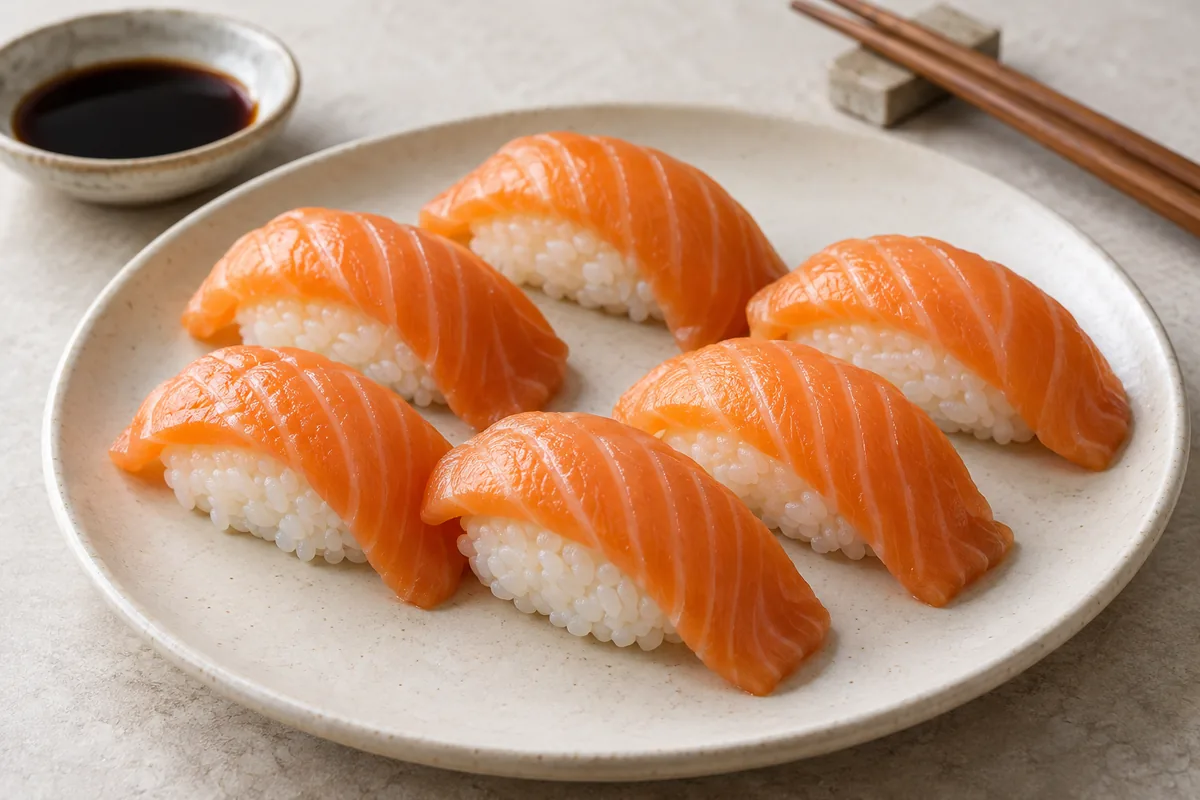
Salmon nigiri is a piece of hand-shaped, vinegared sushi rice topped with a thin slice of salmon. To make it at home, prepare Japanese short-grain rice, season it while warm, let it cool until barely warm, then gently shape small rice ovals and add the salmon. The rice should hold together without feeling tightly packed.
For the broader sushi terminology, read our guide to nigiri sushi.
This salmon nigiri recipe focuses on the practical details: how much rice to use, how to slice the topping, how to keep your hands from sticking, and how to assemble pieces that are comfortable to eat. You do not need a bamboo rolling mat or a restaurant-sized collection of tools.
Before you buy the fish, decide whether you are making raw salmon nigiri or a fully cooked salmon variation. Raw seafood carries food-safety risks even when carefully sourced. Cooking the salmon thoroughly is the lower-risk choice; a quick surface sear does not make the center fully cooked.
This recipe has not been kitchen-tested. Follow your rice package for cooking and soaking directions; preparation times are estimates.
Salmon Nigiri Recipe at a Glance
| Detail | Recipe |
|---|---|
| Yield | About 16 pieces, 4 appetizer servings |
| Active preparation | About 30 minutes |
| Rice cooking | About 20 minutes, depending on the package |
| Resting and cooling | About 25 minutes |
| Total time | About 75 minutes |
| Main ingredients | Short-grain rice, salmon, rice vinegar, sugar, salt |
| Equipment | Saucepan with lid or rice cooker, shallow bowl, sharp knife |
The timing assumes thawed fish and rice that does not require an additional soak. Follow your rice package if its cooking or soaking directions differ. Sixteen pieces are an appetizer quantity for four people, rather than a complete dinner for everyone.
Ingredients for Salmon Nigiri
For the sushi rice
- 1 US cup uncooked Japanese short-grain white rice, approximately 200 g
- Water as directed on the rice package; for a stovetop starting point, about 1 1/4 US cups, 300 ml
- 2 tablespoons unseasoned rice vinegar, 30 ml
- 2 teaspoons granulated sugar, about 8 g
- 1/2 teaspoon fine salt, about 3 g
For the topping and serving
- 240 g skinless, boneless salmon, about 8 1/2 ounces, prepared and handled for the intended use
- Wasabi, optional, a small amount for each piece
- Soy sauce or verified gluten-free tamari, served separately
- Pickled ginger, optional, served separately
- A small bowl of clean water for moistening your fingers
For raw preparation, buy from a supplier who can explain whether the salmon is intended for raw consumption and how relevant hazards have been controlled. Do not assume an ordinary refrigerated salmon fillet is suitable just because it looks fresh. If the supplier cannot answer your questions, choose fully cooked salmon instead.
Why Japanese short-grain rice matters
Nigiri needs rice that naturally holds together. Japanese short-grain white rice produces a cohesive texture while still allowing individual grains to remain visible. Basmati or jasmine rice will not behave the same way, even when the fish and seasoning are identical.
Avoid using glutinous sweet rice as a direct substitute. Despite its name, it is a different type of rice and can make the finished mound excessively sticky. A package labeled Japanese short-grain or sushi rice is a more useful starting point.
Use unseasoned rice vinegar
Unseasoned vinegar gives you control over sweetness and salt. If you have seasoned sushi vinegar, check its label before adding the sugar and salt in this recipe. Otherwise, you may double the seasoning and overwhelm the salmon.
Rice vinegar contributes flavor here. This home recipe is not a validated acidification process for holding rice at room temperature for extended periods.
Choosing Salmon for Homemade Nigiri
The topping should be skinless, boneless, and large enough to cut into broad slices. A relatively even center-cut portion is easier to work with than a thin tail end. Ask the seller to remove pin bones, then check again carefully before slicing.
Keep the fish cold while preparing the rice. Thaw frozen salmon in the refrigerator according to its packaging directions. Follow any instructions about opening or removing vacuum packaging before thawing; do not leave the fish on the counter to speed up the process.
The FDA seafood safety guidance explains that freezing can address parasites but does not eliminate all harmful germs. Previously frozen fish is therefore not a guarantee of risk-free raw sushi.
If you prefer cooked salmon
Use a skinless salmon portion, cook it to an internal temperature of 145°F, 63°C, then divide it into pieces that fit the rice. Cooked salmon flakes more readily than raw slices, so handle it gently and, if necessary, secure it with a narrow strip of nori.
This variation has a different texture but keeps the rice-and-topping format. Do not confuse cold-smoked salmon or lightly torched salmon with thoroughly cooked fish.
How to Make Salmon Nigiri Step by Step
1. Rinse and drain the rice
Place the rice in a bowl, cover with cool water, and gently move it around with your fingers. Drain carefully and repeat a few times until the water becomes less cloudy. It does not need to turn completely transparent.
Drain the rice well before measuring the cooking water. Residual rinse water can change the final texture, particularly in a small batch. If your package calls for soaking, follow that direction and allow extra time.
2. Cook the rice
Transfer the drained rice to a small, heavy saucepan. Add the amount of water recommended by the manufacturer. If no directions are available, 300 ml is a reasonable starting point for this quantity, although the best amount depends on the rice and pan.
Bring to a gentle boil, cover, and reduce the heat to low. Cook until the water is absorbed, approximately 15 to 20 minutes. Remove the pan from the heat and leave it covered for 10 minutes. Avoid repeatedly lifting the lid, which lets steam escape.
A rice cooker is equally useful. Use its rice measuring cup, matching water marks, and sushi-rice setting when provided rather than mixing measurement systems.
3. Mix the seasoning
While the rice cooks, combine the rice vinegar, sugar, and salt in a small bowl. Stir until dissolved. If necessary, warm the mixture gently; it does not need to boil.
The finished mixture should taste tangy with a mild sweetness. This recipe intentionally leaves room for the salmon and any soy sauce added at the table. You can adjust future batches to your preference after tasting the complete dish.
4. Season and cool the rice
Transfer the hot cooked rice to a wide, shallow bowl. Sprinkle the seasoning evenly over it. Use a rice paddle or spatula to fold and cut through the rice rather than stirring in circles or crushing the grains.
Spread the rice into a relatively shallow layer and let steam escape. Fan gently if you wish. Begin shaping when it is no longer hot and feels only barely warm. Do not place cold raw salmon on hot rice.
Prepare only the quantity you plan to assemble promptly. If the rice will not be used immediately, cool and refrigerate it promptly rather than keeping a bowl on the counter for hours.
5. Slice the salmon
Use a clean board and a sharp knife. Pat the salmon dry with disposable kitchen paper if needed, then identify the direction of the visible muscle grain. Slice across it where the shape of your portion allows.
Aim for about 16 broad slices, approximately 15 g each. A useful starting size is roughly 5 to 6 cm long, 2.5 to 3 cm wide, and 4 to 5 mm thick. Exact dimensions vary with the cut; the important point is that the salmon drapes over the rice instead of balancing on top like a thick cube.
Draw the knife through in one smooth movement where possible. Repeated sawing can tear the edges. Keep the remaining fish refrigerated while you work with a small portion.
6. Shape small rice ovals
Lightly moisten your clean fingers and shake off excess water. Your hands should be damp, not dripping. Weigh your first few portions to establish a consistent size: about 20 to 25 g cooked rice per piece is a practical home starting point.
Form each portion into a short oval in your palm with a few gentle presses. The mound should support its topping while remaining tender. If your first piece feels like a tightly compressed rice ball, use less pressure on the next one.
Use enough rice for about 16 pieces. Depending on the cooked yield and your chosen portion size, you may have some rice left over. Do not keep making the mounds larger simply to use every grain.
7. Add the salmon
If using wasabi, spread a very small dab on the underside of a salmon slice. Place it over a rice oval, then gently settle the topping around the rice with clean fingers. A light press is usually enough.
Work in small batches so the fish spends less time outside the refrigerator. Wash your hands and clean utensils whenever needed, and keep raw fish and its juices away from ready-to-eat accompaniments.
8. Serve promptly
Arrange the nigiri on a clean serving plate. Offer soy sauce and pickled ginger separately so each person can season their own pieces. Avoid pouring sauce over the entire plate, which can make the rice fall apart.
Serve as soon as the pieces are assembled. For a larger group, prepare a few pieces at a time and keep the remaining salmon chilled rather than displaying all of it at once.
For a comparison of serving styles, our nigiri vs sashimi guide explains how the rice changes the dish.
How Much Rice Goes in Each Piece?
A 20 to 25 g portion is an accessible starting point for homemade salmon nigiri. Smaller portions give a stronger salmon-to-rice balance; larger ones can become awkward to eat. There is no need for every home cook to imitate a particular restaurant’s exact size.
Weighing just the first three or four portions helps your hands learn the amount. After that, compare each mound with the first one. Keep the ovals short enough that the salmon covers the top and slightly overhangs the ends.
If you are serving children, a fully cooked topping and smaller portions can be more practical. Make the pieces a comfortable size rather than insisting that everyone eat a large piece in one bite.
Troubleshooting Homemade Salmon Nigiri
| Problem | Likely cause | What to change |
|---|---|---|
| Rice sticks to your hands | Fingers are too dry | Moisten lightly between pieces |
| Rice feels slippery | Too much water on your hands | Shake off excess before shaping |
| Rice falls apart | Unsuitable rice or too little cohesion | Use Japanese short-grain rice and shape gently |
| Rice feels dense | Too much pressure | Use fewer, lighter presses |
| Salmon slides off | Thick topping or very wet surface | Cut broader, thinner slices and blot excess moisture |
| Salmon tears | Dull knife or repeated sawing | Sharpen the knife and use a smooth slicing stroke |
| Rice tastes too strong | Seasoned vinegar plus added seasoning | Check the vinegar label and adjust the next batch |
Do not try to rescue mushy rice by squeezing out liquid or adding uncooked grains. It is better used for a different dish when handled safely. For nigiri, distinct grains and controlled moisture make assembly easier.
Serving Ideas and Simple Variations
For a lightly seared topping, follow our aburi salmon nigiri recipe, which explains how to sear the fish separately before placing it over the rice.
Serve with cucumber salad, edamame, or a bowl of miso soup for a more complete meal. Keep the plate simple so the salmon and seasoned rice remain the focus. Heavy sauces can hide the balance you worked to create.
A tiny amount of wasabi can sit between the fish and rice, but it is optional. If serving guests, explain which pieces contain it. Check sauces and packaged accompaniments for allergens rather than assuming that rice and salmon make the whole meal gluten-free.
For a fully cooked variation, use cooked salmon as described above. For a different topping, cooked shrimp or an omelet can be assembled with the same rice-shaping method. These substitutions change the recipe, so label them clearly when serving an assortment.
Aburi salmon nigiri uses a lightly seared surface and deserves its own method. A brief sear is a flavor technique, not a substitute for the sourcing and handling required for a raw or undercooked center.
If you prefer a fully cooked salmon dinner, try our hot honey salmon recipe.
Can You Make Salmon Nigiri Ahead?
This dish is best assembled close to serving. Chilled sushi rice becomes firmer, while warm rice and raw fish should not be held together on the counter. Preparing every component hours ahead may make the final assembly convenient, but it also makes temperature control more important.
You can measure the dry rice and seasoning ingredients beforehand and prepare clean serving dishes. Keep the salmon refrigerated until needed. If you cook rice ahead, cool it quickly, refrigerate promptly, and use within 24 hours, following the UK government guidance on cooked rice.
For the simplest workflow, cook the rice shortly before the meal, cool it enough for assembly, then slice and shape while everything is ready to serve.
Storage and Food Safety
Buy and prepare only as much raw fish as you expect to eat promptly. Do not plan a batch of raw salmon nigiri as several days of meal prep. For leftovers, temperature history matters as much as appearance; smell alone cannot confirm that seafood is safe.
Keep seafood refrigerated at 40°F, 4°C, or below. Discard perishable food left out for more than two hours, or more than one hour in temperatures above 90°F, 32°C. These limits are maximums, not a target for how long to display sushi.
People who are pregnant, young children, older adults, and people with weakened immune systems should avoid raw or undercooked seafood. Choose thoroughly cooked salmon for those diners. Keep raw seafood separate from ready-to-eat ingredients and wash hands, boards, and utensils carefully.
Printable Salmon Nigiri Recipe
Print
Salmon Nigiri
- Total Time: 75 minutes
- Yield: 16 pieces (4 appetizer servings) 1x
Description
About 16 salmon nigiri pieces made with seasoned Japanese short-grain rice and thin salmon slices. Includes a fully cooked variation and guidance for raw seafood.
Ingredients
- 200 g Japanese short-grain white rice, about 1 US cup uncooked
- Water according to the rice package; about 300 ml as a stovetop starting point
- 30 ml unseasoned rice vinegar, 2 tablespoons
- 8 g granulated sugar, 2 teaspoons
- 3 g fine salt, 1/2 teaspoon
- 240 g skinless, boneless salmon, handled for its intended raw or cooked use
- Wasabi, optional
- Soy sauce or verified gluten-free tamari, for serving
- Pickled ginger, optional
- Clean water for moistening hands
Instructions
- Rinse the rice in several changes of cool water and drain well. Follow any soaking directions on the package.
- Add the recommended water and cook according to the package. For stovetop preparation, cover and cook over low heat until absorbed, about 15 to 20 minutes, then rest covered off the heat for 10 minutes.
- Stir the vinegar, sugar, and salt until dissolved. Transfer the hot rice to a shallow bowl and fold in the seasoning gently. Let steam escape until the rice is barely warm, about 15 minutes. Do not place raw salmon over hot rice.
- On a clean board, use a sharp knife to cut the cold salmon into approximately 16 broad slices of about 15 g each. Keep fish chilled except while working with a small batch.
- Lightly moisten clean fingers. Shape 20 to 25 g cooked rice into a short oval with a few gentle presses. Repeat to make about 16 ovals; some rice may remain.
- If desired, put a tiny dab of wasabi under a salmon slice. Drape it over a rice oval and press gently to settle it. Repeat in small batches.
- Serve promptly with soy sauce and ginger separately. Keep remaining fish refrigerated.
Notes
This recipe has not been kitchen-tested. Package cooking directions take priority over the starting water ratio. Total time excludes any extra soaking or fish thawing.
For a raw topping, obtain salmon intended for raw consumption from a supplier who can explain the relevant controls. Freezing does not remove every foodborne hazard. Do not assume a normal supermarket fillet is suitable for raw use.
For the lower-risk variation, cook salmon to 145°F, 63°C, then portion gently and top the rice. A brief surface sear and cold smoking do not make salmon fully cooked. Pregnant people, young children, older adults, and immunocompromised people should avoid raw or undercooked seafood.
- Prep Time: 30 minutes
- Resting and cooling: 25 minutes
- Cook Time: 20 minutes
- Category: Appetizer
- Method: Stovetop and hand shaping
- Cuisine: Japanese-inspired
Nutrition
- Serving Size: 4 pieces
Keywords: salmon nigiri, salmon nigiri recipe, homemade nigiri, salmon sushi
FAQS
Is salmon nigiri raw?
It often uses raw salmon, but it can also be made with a fully cooked topping. The recipe must clearly identify the preparation. Lightly seared salmon can still be raw inside.
Can I use supermarket salmon for nigiri?
Do not assume every supermarket fillet is suitable for eating raw. Ask whether the specific product is intended for raw consumption and how relevant hazards have been controlled. If that cannot be established, cook the salmon thoroughly.
Can I make salmon nigiri without a sushi mat?
Yes. Nigiri is shaped by hand. A rice paddle, sharp knife, clean board, and lightly moistened fingers are more useful than a rolling mat for this recipe.
Why does my nigiri rice fall apart?
Common causes include long-grain rice, poorly cooked rice, or an oval that has not been gently shaped. Start with Japanese short-grain rice and use a few light presses. Heavy squeezing can create a dense texture instead.
Can I use smoked salmon?
Smoked salmon creates a different variation. Cold-smoked salmon should not be treated as fully cooked. For a thoroughly cooked version, use salmon cooked to 145°F, 63°C, and handle it carefully because it flakes more easily.
How many pieces does this recipe make?
It makes about 16 pieces with 240 g salmon and roughly 20 to 25 g cooked rice per piece. That is about four appetizer servings. The exact yield depends on your slicing and shaping.
Is salmon nigiri gluten-free?
Plain salmon, rice, and suitable rice vinegar may be gluten-free, but soy sauce, wasabi mixtures, marinades, and cross-contact can change that. Check every ingredient and use verified gluten-free accompaniments when required.
1 thought on “Salmon Nigiri: How to Make It at Home”