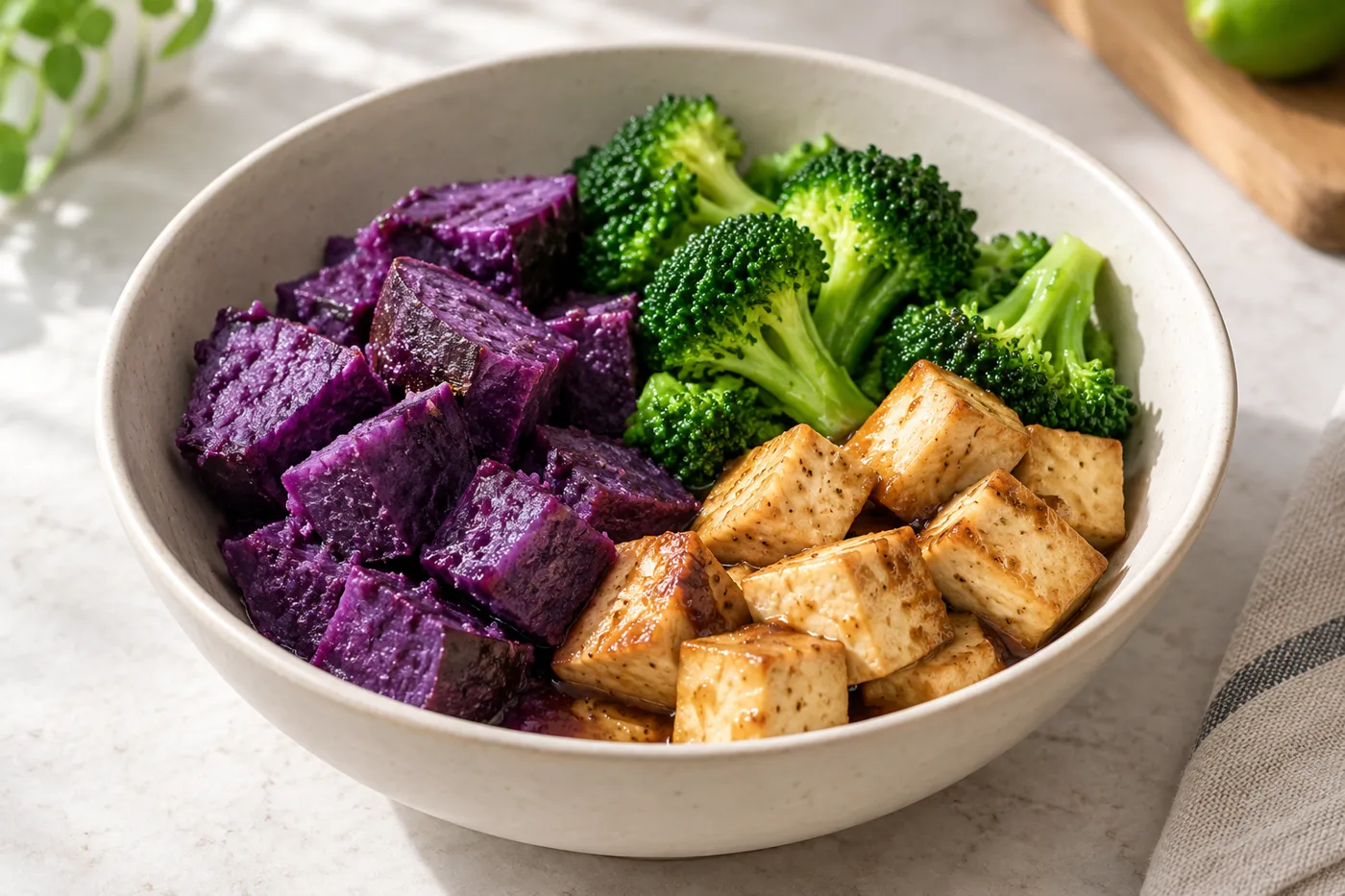
This savory purple yam bowl combines plain cooked ube, pan-seared tofu, and broccoli with a simple lime-soy dressing. The yam provides the starchy component, tofu adds protein, and broccoli brings a contrasting texture.
To make it, prepare plain cooked purple yam, brown the tofu in measured oil, steam the broccoli, and divide everything between two bowls. Add the dressing just before serving.
If you are searching for purple yam recipes savory, this is a practical way to use ube without turning it into a dessert. It contains no halaya, condensed milk, or sweet syrup.
The recipe makes two servings with approximately 440 calories and 32 grams of protein per bowl, using the illustrative ingredient references explained below. Tofu brands vary considerably, so check your package before applying those estimates.
This original recipe has not been kitchen-tested. Cooking times and nutrition are estimates, and the method includes adjustments for different tofu textures.
What Is a Savory Purple Yam Bowl?
A savory purple yam bowl uses cooked yam as one component of a meal rather than sweetening it into a dessert preparation. Here, the yam stays in chunks. Tofu and broccoli are prepared separately so you can control their texture before assembly.
The dressing is deliberately simple: soy sauce, lime juice, garlic, ginger, and water. There is no need to coat every ingredient in a thick sauce. For the broader nutrition discussion, read our guide to ube, portions, and weight management.
Is this a traditional Filipino dish?
This is a Filipino-inspired meal using ube, not a claim to reproduce a specific traditional dish. The bowl format and lime-soy dressing are practical choices for this recipe. Labeling the inspiration clearly helps distinguish it from traditional ube desserts.
Ingredients
For two servings
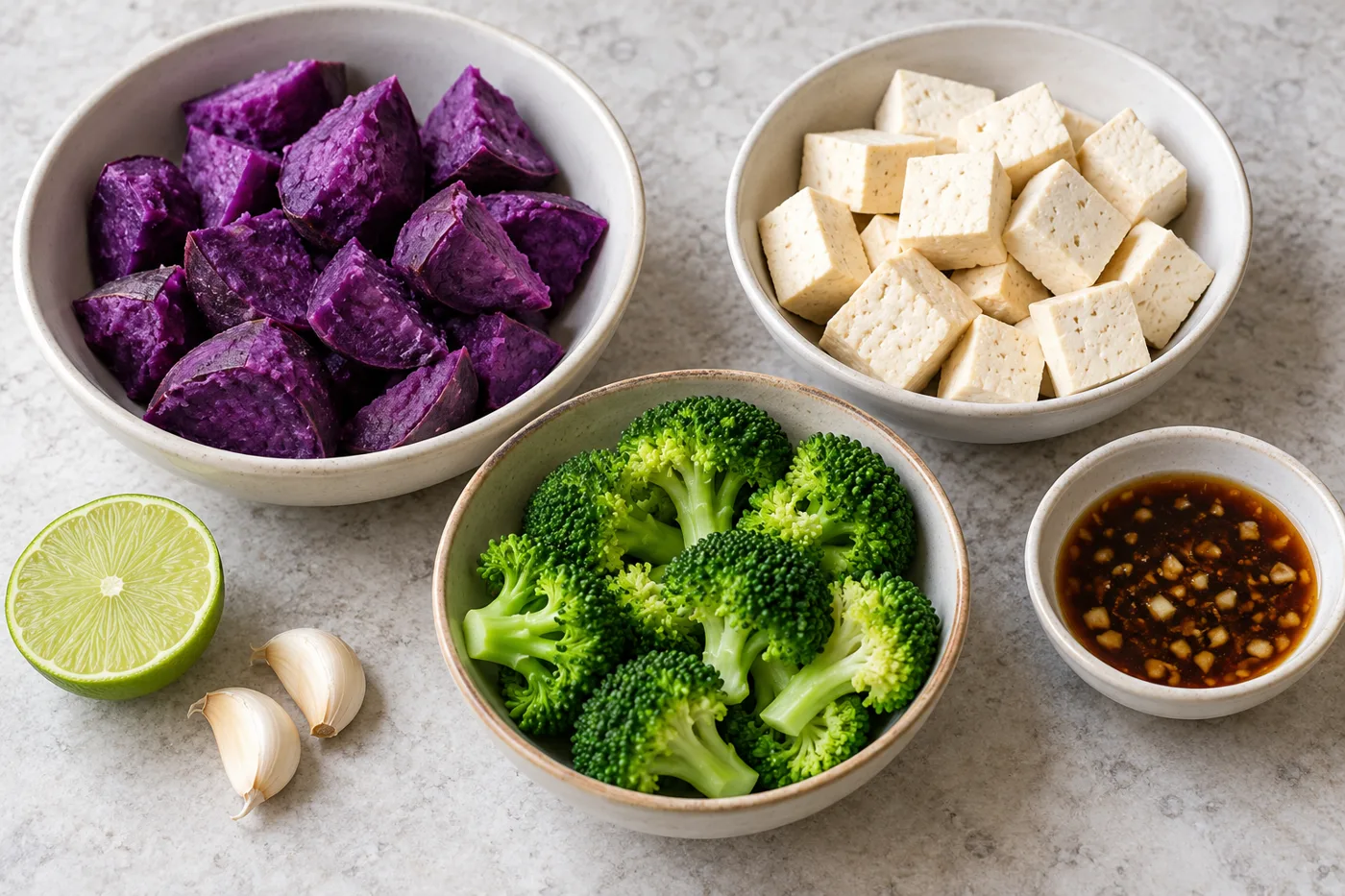
- 300 g plain cooked purple yam, peeled and cut into bite-sized chunks
- 300 g plain firm tofu, drained, before optional pressing
- 300 g broccoli florets, weighed before cooking
- 10 g neutral cooking oil, divided as needed
- Freshly ground black pepper, optional
For the dressing
- 1 tablespoon soy sauce, 15 ml
- 1 tablespoon lime juice, 15 ml
- 1 tablespoon water, 15 ml
- 2 small garlic cloves, approximately 6 g, finely grated
- 1 teaspoon finely grated fresh ginger, approximately 5 g
Use verified gluten-free tamari instead of soy sauce when required, and check its label. The nutrition estimate includes the stated oil and dressing. Extra toppings, additional sauces, rice, or other accompaniments are not included.
A note about ingredient weights
The yam quantity is a cooked, peeled weight. The tofu quantity is the drained amount before optional pressing, while the broccoli is weighed before cooking. Using clearly identified weights makes the recipe easier to repeat and prevents confusion when calculating portions.
If you prepare more yam than the recipe needs, measure the cooked portion for this batch and store the remainder appropriately. Do not enlarge both bowls automatically just to use everything you cooked.
Choosing Purple Yam for a Savory Recipe
Use plain ube rather than halaya or a sweetened prepared mixture. If buying frozen yam, check whether it is already cooked. Frozen grated raw yam still needs its required preparation before it becomes suitable for this bowl.
The cooked yam should be tender enough to eat comfortably but firm enough to hold in chunks.
Ube versus purple sweet potato
Ube and purple sweet potato are different ingredients. The University of Georgia plant database identifies ube as Dioscorea alata and distinguishes it from purple sweet potato.
You can make a bowl with purple sweet potato, but describe it as a variation and use the corresponding nutrition information. Do not assume every purple tuber sold in a grocery store is ube.
If your ingredient is purple sweet potato rather than ube, try our purple sweet potato soup with light coconut milk for a separate preparation.
Can you use ube powder?
Powder is not a direct substitute for the chunks in this recipe. A prepared powder-based mash would produce a different presentation and texture. If you want to experiment, follow the product instructions and treat it as a separate variation.
Our ube powder guide explains preparation requirements and why dry powder cannot replace cooked yam gram for gram.
Which Tofu Should You Use?
Choose plain firm tofu that can be handled in cubes. Extra-firm tofu can also work, but its moisture, texture, and nutrition may differ. Silken tofu is not a direct substitute for this pan-searing method because it is more delicate. Read the package instructions before preparation.
Does tofu need pressing?
That depends on the product and your preferred texture. Drain it well and blot the surface. If the package recommends pressing, follow that guidance. Do not press so aggressively that the block crumbles. The aim is manageable cubes, not extracting every possible drop of moisture.
Allow extra preparation time when your product needs pressing. The thirty-minute estimate assumes drained tofu ready to cut, with any optional pressing already completed.
Why tofu nutrition varies
Firmness labels do not establish one universal amount of protein. Different products have different moisture levels and formulations. Nasoya’s product guidance likewise advises checking the specific tofu product’s Nutrition Facts rather than assuming all tofu has the same protein content. Use your package when calculating your own version of the bowl.
How to Prepare the Purple Yam
If you already have plain cooked yam, use it for the main recipe. If starting with fresh ube, peel and prepare the edible tuber appropriately, cut it into reasonably even pieces, and cook in water until tender. The exact time depends on the size and condition of the pieces.
Drain well, then weigh out 300 g for the recipe. The stated preparation and cooking times exclude cooking and cooling the yam from raw.
Check texture rather than relying only on time
A fork should enter the center without meeting a hard core. Avoid continuing to cook until every piece collapses if you want neat chunks. If the yam becomes very soft, serve it as a mash beneath the other ingredients instead. That changes presentation without requiring you to discard a safely prepared ingredient.
Using refrigerated cooked yam
Keep it chilled until preparation. Reheat the cooked yam appropriately before serving it as part of a hot bowl. Do not leave it on the counter while completing the rest of the meal. The stated recipe time assumes the yam has already been cooked.
How to Make the Savory Purple Yam Bowl
1. Prepare the tofu
Drain the tofu and follow any pressing instructions for the product. Cut into bite-sized cubes of roughly similar size. Blot visible surface moisture with clean kitchen paper. Even pieces are easier to turn and brown consistently than a mixture of thin fragments and large blocks.
2. Mix the dressing
Combine the soy sauce, lime juice, water, garlic, and ginger in a small bowl. Stir and set aside while you cook the other ingredients. Taste before adding extra soy sauce. The dressing is intended to season two bowls, not to fill the bottom of each bowl with liquid.
3. Brown the tofu
Heat the measured oil in a suitable nonstick or well-seasoned pan over medium heat. Add the tofu in a single layer. If your pan is small, work in batches rather than crowding the cubes.
Allow one side to develop some color before turning gently. Cook according to the product instructions, aiming for a heated center and lightly browned surfaces. Around 8 to 12 minutes can be a useful planning estimate, but the pan, cube size, and product affect timing.
The method does not use a starch coating or deep frying, so do not expect the same crust as restaurant-style fried tofu. A few browned faces are sufficient for the intended texture.
4. Cook the broccoli
Steam the broccoli until it reaches your preferred tenderness. Aim for florets that are cooked but still hold their shape. Drain any collected water before assembly. Excess liquid can dilute the dressing and make the bowl watery.
You can use a saucepan steamer or a suitable microwave-safe method according to your equipment instructions. Prepare it while the tofu cooks when your equipment and attention allow.
5. Prepare the cooked yam for serving
Warm the previously cooked yam appropriately. Handle gently to preserve the chunks. If it is very soft, place it in the bowls first and spoon the other ingredients alongside it. Avoid repeatedly stirring the yam in the tofu pan simply to combine everything.
6. Divide and dress
Divide the yam, tofu, and broccoli evenly between two bowls. Stir the dressing again, then divide it between the servings. Add optional black pepper and serve promptly.
Each bowl contains half the recipe. If you add rice, nuts, seeds, or another sauce, include those additions when considering the finished portion.
Estimated Calories and Protein
The following calculation is an illustrative estimate, not an analysis of a kitchen-tested dish.
| Component per bowl | Amount | Estimated calories | Estimated protein |
|---|---|---|---|
| Plain boiled purple yam | 150 g | 116 | 1 g |
| Firm calcium-set tofu | 150 g | 216 | 26 g |
| Broccoli | Half the recipe | 51 | 4 g |
| Cooking oil | 5 g | 44 | 0 g |
| Dressing | Half the recipe | About 13 | About 1 g |
| Estimated total | One bowl | About 440 | About 32 g |
The yam estimate uses the Philippine Food Composition Tables. The tofu example uses a generic firm calcium-set tofu reference of approximately 144 calories and 17.3 g protein per 100 g. Your packaged tofu may differ substantially.
Broccoli, oil, and dressing values are approximate standard ingredient estimates. Optional extras are excluded. The calculation assumes the measured cooking oil is included rather than trying to estimate how much remains in the pan.
Update the tofu calculation first
Tofu is the largest protein contributor in this formulation. If your product provides a different amount per labeled serving, scale that value to the 150 g used in each bowl. Do the same for calories before treating the example total as applicable to your meal.
Can This Be a Purple Yam Recipe for Weight Loss?
It can fit an eating plan for weight management when the serving suits your needs. The useful features are clear ingredient quantities, a defined yield, and a dressing whose additions are visible. Those features do not establish that the bowl causes weight loss. Its role depends on your overall intake and eating pattern.
Measure oil rather than guessing
The recipe specifies 10 g for the full batch. If you pour directly from the bottle or add more during cooking, update the estimate. A measured recipe is only informative when its quantities resemble what actually goes into the pan.
Decide whether to add another starch
The bowl already contains yam as a starchy component. You can add rice or another food if it suits your meal, but consider the complete serving rather than treating the addition as nutritionally separate.
Keep sauces intentional
A thicker bottled sauce may contain ingredients not included in the lime-soy dressing. Check the label and portion when substituting. A small change in appearance can conceal a larger change in the recipe.
Variations
With extra-firm tofu
Use the same initial drained weight and follow the product’s preparation instructions. You may prefer its texture, but recalculate the nutrition rather than assuming equivalence.
With different vegetables
Green beans, cabbage, or bok choy can create another version. Adjust the cooking method for the vegetable. Do not apply the broccoli timing automatically to every substitute. Update nutrition if you want an estimate for the changed recipe.
With purple yam mash
Mash the cooked yam and use it as a base. Keep added butter, oil, milk, or coconut milk separate from the original formulation unless you include them in the calculation.
With a different protein
Chicken, fish, beans, or another protein source creates a different recipe. Use the preparation and food-safety instructions appropriate to that ingredient. The tofu cooking method should not be transferred to raw meat or fish.
For another plant-based meal format, explore our soya chunks recipe for weight loss.
Troubleshooting
| Problem | Likely reason | Adjustment |
|---|---|---|
| Tofu sticks | Moist surface, unsuitable pan, or turning too early | Drain, blot, and allow browning before turning |
| Tofu crumbles | Delicate product or rough handling | Use firm tofu and turn gently |
| Yam breaks apart | Very soft cooked pieces | Serve as a mash or handle less |
| Broccoli releases water | Poor draining | Drain before assembly |
| Bowl tastes too salty | Extra soy sauce or a salty substitute | Measure dressing and taste before adding more |
| Ingredients taste separate | Dressing distributed unevenly | Stir the dressing again and divide carefully |
Do not try to solve every issue by adding more oil or sauce. For a repeat batch, change one factor at a time so you can identify what improved the result.
Make-Ahead and Storage
Prepare components separately when possible. Keep cooked yam, tofu, broccoli, and dressing in suitable covered containers, refrigerated promptly. Follow the tofu package guidance and account for how long any precooked ingredient has already been stored. Preparing a new bowl does not restart the storage life of older cooked yam.
Packing for lunch
Transport the meal chilled and refrigerate it when you arrive. Keep the dressing separate if you prefer to add it after reheating the other components. Use microwave-safe containers when reheating and ensure the food is heated appropriately throughout.
A practical first batch
Make the two servings described here before scaling up. That lets you assess the tofu texture, dressing strength, and yam consistency without preparing a large quantity of an untested formulation. For additional meal combinations, browse our high-protein, high-fiber meals.
Printable Savory Purple Yam Bowl Recipe
PrintSavory Purple Yam Bowl with Tofu
- Total Time: 30 minutes
- Yield: 2 servings 1x
Description
A savory purple yam bowl with plain cooked ube, pan-seared tofu, broccoli and a simple lime-soy dressing. Makes two measured lunch servings.
Ingredients
- 300 g plain cooked purple yam, peeled and cut into chunks
- 300 g plain firm tofu, drained before optional pressing
- 300 g broccoli florets, weighed before cooking
- 10 g neutral cooking oil
- 15 ml soy sauce or verified gluten-free tamari
- 15 ml lime juice
- 15 ml water
- 6 g garlic, finely grated (about 2 small cloves)
- 5 g fresh ginger, finely grated (about 1 teaspoon)
- Black pepper, optional
Instructions
- Drain the tofu and follow any package pressing instructions. Cut into similar bite-sized cubes and blot surface moisture.
- Mix soy sauce, lime juice, water, garlic and ginger for the dressing.
- Heat the measured oil in a suitable pan over medium heat. Add tofu in a single layer and brown gently, turning carefully. Follow package instructions; roughly 8 to 12 minutes is a planning estimate.
- Steam broccoli until cooked to your preferred tenderness, then drain collected water.
- Warm the already cooked purple yam appropriately. Handle gently to preserve chunks, or use as a mash if very soft.
- Divide yam, tofu and broccoli evenly between two bowls. Stir and divide the dressing. Add optional black pepper and serve promptly.
Notes
This original recipe has not been kitchen-tested. Times assume already cooked purple yam and tofu ready to cut; exclude cooking and cooling raw yam and optional tofu pressing. Contains soy; ordinary soy sauce may contain wheat. Use verified gluten-free tamari when required and verify all ingredients. Refrigerate components promptly and account for the prior storage history of cooked yam.
Illustrative nutrition per bowl: 150 g boiled purple yam approximately 116 kcal and 1 g protein; 150 g generic firm calcium-set tofu approximately 216 kcal and 26 g protein; broccoli approximately 51 kcal and 4 g protein; 5 g oil approximately 44 kcal; half the dressing approximately 13 kcal and 1 g protein. About 440 kcal and 32 g protein total. Tofu brands vary substantially; calculate from your label. Extras are excluded. The recipe does not guarantee weight loss.
- Prep Time: 15 minutes
- Cook Time: 15 minutes
- Category: Lunch
- Method: Stovetop and steaming
- Cuisine: Filipino-inspired
Nutrition
- Serving Size: 1 bowl (half the recipe)
- Calories: 440
- Protein: 32 g
Keywords: purple yam recipes savory, savory purple yam bowl, ube tofu bowl, purple yam recipe for weight loss
FAQS
Can purple yam be used in savory recipes?
Yes. Plain cooked purple yam can be served with savory ingredients rather than sweetened into a dessert.
Is purple yam the same as ube?
Ube commonly refers to the purple yam Dioscorea alata. Check the ingredient identity, especially when shopping for products labeled loosely.
Can I use purple sweet potato instead?
Yes, as a variation. It is a different ingredient, so expect changes in flavor, texture, and nutrition.
Can I use ube halaya?
Halaya is not suitable as an equivalent replacement for the plain yam chunks in this savory formulation.
Can I make this with ube powder?
Powder does not directly replace the chunks. A prepared powder-based mash would be a separate variation requiring its own preparation and calculation.
What tofu works best?
Plain firm tofu is the starting choice. Extra-firm tofu can also work, with preparation and nutrition adjusted to its label.
Is this bowl gluten-free?
Use verified gluten-free tamari and check the tofu, other ingredients, and preparation surfaces when gluten avoidance is necessary.
Is this recipe good for weight loss?
It can fit an eating plan when the portion suits your needs. The recipe itself does not guarantee weight loss.
2 thoughts on “Savory Purple Yam Bowl with Tofu and Vegetables”